 listicle
 5 Easy Ways to Play the D Guitar Chord (Open, Barre & Beyond)
Learn 5 easy ways to play a D guitar chord, from a beginner-friendly open shape to movable voicings that keep the chord fresh anywhere on the neck.
150+ practical lessons and how-tos for skills that stick, from beginner fundamentals to advanced technique.

We may earn a small commission through links on this page, at no extra cost to you. As an Amazon Associate, we earn from qualifying purchases. Ratings reflect our own editorial evaluation.
Last Updated: May 27, 2026
The most effective guitar tips center on short daily practice sessions, a structured routine, and developing your ear alongside your technique. Players who use a metronome, master open chords before barre chords, and regularly record themselves see faster, more measurable improvement than those practicing without direction or structure.
The gap between wanting to play guitar and actually playing well feels enormous when you're staring at your first chord diagram. Fingers land on wrong strings, transitions sound clumsy, and songs that look simple on a tutorial video feel impossible at full speed.
What separates players who push past that initial frustration from those who quit is rarely talent. It almost always comes down to how they practice.
The right habits, in the right order, can compress months of spinning your wheels into a few focused weeks of real improvement. These guitar tips come straight from what experienced teachers and gigging musicians keep saying works, so you can skip the trial-and-error phase.
Put simply, short daily sessions build muscle memory and neural pathways faster than longer, less frequent practice blocks.
Here's the thing about motor skills. Your brain builds them through daily repetition, not marathon sessions.
Ten minutes of focused guitar practice every day does more for your neural pathways than a two-hour weekend binge followed by five days off the instrument.
Of all the guitar tips on this page, daily consistency delivers the biggest return. Remove every barrier between you and your guitar by keeping it on a stand in a room you walk through regularly.
Tie practice to something you already do every day, like right after morning coffee, during a study break, or just before bed. On days when motivation disappears, just tell yourself you'll do three minutes.
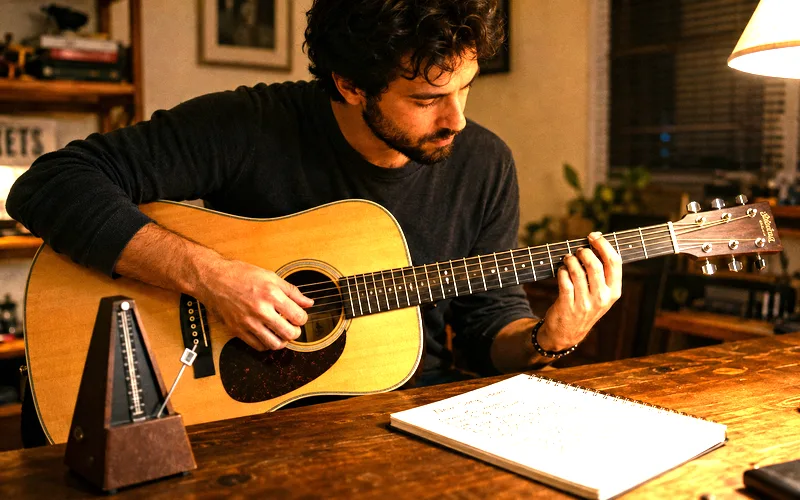
Once your hands are on the strings, most players end up practicing far longer than the minimum they set. The hardest part is always sitting down, not the actual playing.
Structure those short sessions deliberately. Five minutes on chord transitions and five on a song section beats ten minutes of random strumming.
Track your streak with a simple calendar and check marks. The longest-lasting guitar players aren't the most gifted.
They're the most consistent.
Ten to twenty minutes of focused, intentional practice is enough for most beginners. Consistency matters far more than duration.
Five short sessions across a week outperform one long weekend session every time.
A quick chromatic warm-up prevents finger strain and gets your hands ready to play cleanly from the first note.
This is one of the most overlooked guitar tips: warm up before every session. Cold fingers are stiff fingers, and jumping straight into difficult passages with cold hands increases the risk of strain.
Start each session with two to three minutes of chromatic exercises. Place your index finger on the first fret of the low E string, then walk each finger across four consecutive frets: index, middle, ring, pinky.
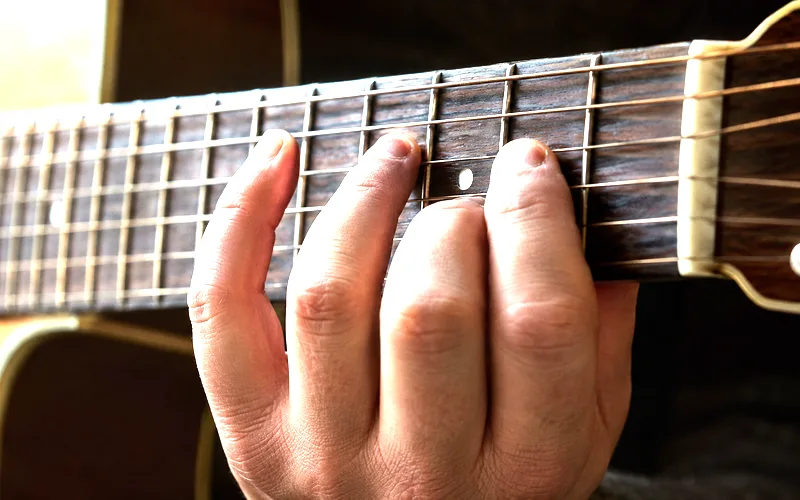
Move to the next string and repeat the pattern. Focus on clean sound and even pressure rather than speed.
You can also warm up by playing through simple open chord shapes at a slow pace. Strum each chord once, let it ring, check that every string sounds clean, then move on.
Finger stretches round out the routine. Spread your fretting hand wide, hold for five seconds, release, and repeat three times.
There's a mental side to warming up too. Going from scrolling your phone to concentrating on finger placement is a real shift, and a quick warm-up routine bridges that gap naturally.
If you skip the warm-up, the first five minutes of real practice become the warm-up anyway.
Random practice produces random results. Players who improve their guitar playing fastest divide their sessions into defined blocks, each focused on a different skill category.
Allocate time across four areas: guitar technique drills, chord and scale work, song learning, and ear training. Rotating through multiple skill types prevents the boredom that comes from drilling one thing for an entire session.
Beginners should weight toward chords, while intermediate players can lean into scales and improvisation.
A common trap is spending all your practice time on songs you can already play well. That feels rewarding but doesn't push your ability forward.
Dedicate at least a third of every session to material that challenges you. A guitar chord you can't switch to cleanly, a riff above your speed ceiling, or a guitar scale pattern you haven't memorized yet.
Write down what you worked on and how it went after each session. A notebook with the date, what you practiced, and a one-sentence note on what gave you trouble is enough to reveal patterns you'd miss otherwise.
| Activity | Time | Focus |
|---|---|---|
| Warm-Up / Chromatic Exercises | 3 min | Finger dexterity, clean fretting |
| Chord Transitions | 7 min | Switching between two-chord pairs |
| Scale Practice | 5 min | Pentatonic or major scale patterns |
| Song Learning | 10 min | New material or difficult sections |
| Free Play / Improvisation | 5 min | Creativity, applying what you've learned |
Adjust those numbers based on what you need most right now. If barre chords are your current wall, shift five minutes from free play into dedicated chord work.
Here is what matters: nail your open chord voicings first, and barre chords become significantly easier when you eventually reach them.
Open guitar chords are the foundation of rhythm guitar playing. G, C, D, E minor, and A minor appear in thousands of popular songs and form the basis for understanding how chords relate to each other within a key.
Spend time on clean, buzz-free voicings before worrying about speed. If a string buzzes or sounds muted, check your finger placement.
You're likely pressing too far from the fret wire or touching an adjacent string.
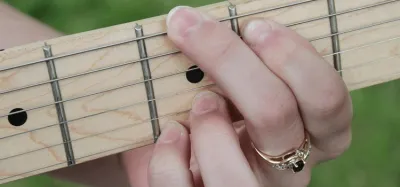
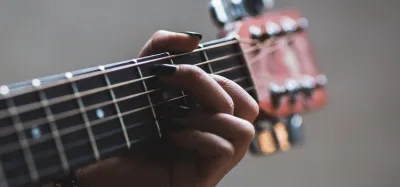
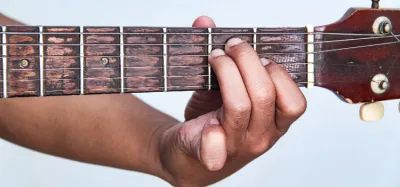
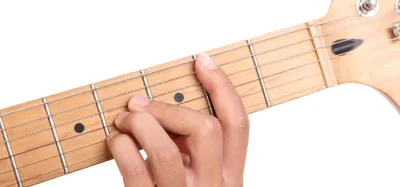
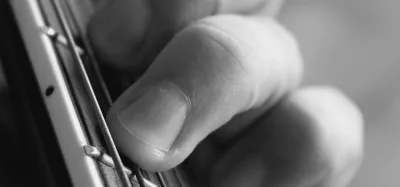
Use the tips of your fingers, not the pads, and keep your thumb centered behind the neck. This positioning gives you the leverage to press strings cleanly with minimal effort.
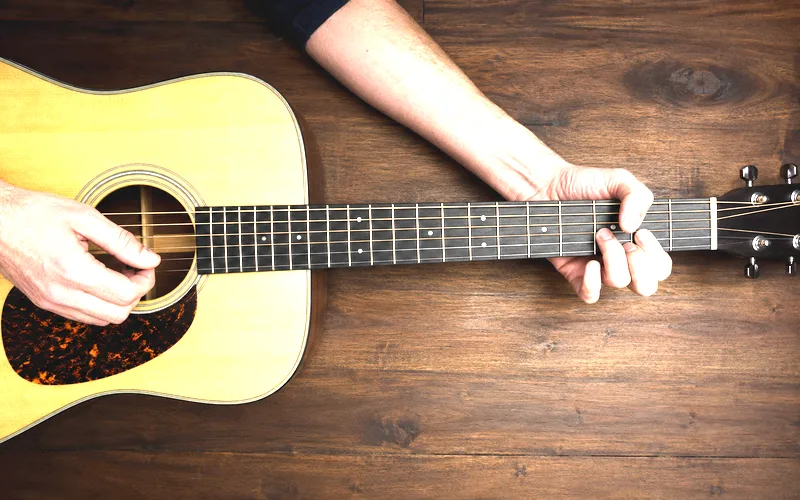
If you need visual references for proper finger placement, Fender offers free chord diagrams and beginner tutorials on their site. Having a clear picture of each voicing saves a lot of guesswork early on.
Practice transitions between two chords at a time. Set a timer for one minute and count how many clean switches you can make between G and C, then try to beat that number the next day.
Once you can switch between five or six open chords smoothly, add strumming patterns to the mix. Practicing chord changes alongside a rhythm pattern trains both hands in coordination simultaneously.
Don't rush into barre chords too early. Players who jump to barres before their open chords are solid tend to develop excess tension in the fretting hand and inconsistent finger pressure.
Strong open chord fundamentals make barre chords way easier when you eventually get to them. Get the foundation right, and the rest follows.
The short answer is that ear training bridges the gap between hearing music and reproducing it on the fretboard.
You can have great finger technique and still sound lost if your ear isn't keeping up. Among essential guitar tips, ear training is the one that gets skipped most often.
It connects what you hear in your head to what your fingers produce on the fretboard. Start with a simple exercise: play a note on one string, then try to find that same pitch on a different string without looking at a tuner.

Sing or hum melodies before you play them. This forces your brain to process pitch relationships before your fingers get involved, strengthening the connection between hearing and playing.
Try learning simple songs by ear instead of relying on tabs. Pick a melody you already know well, like a nursery rhyme, a TV theme, or a chorus you've heard a thousand times, and figure out the notes on one string.
It feels hard the first few times, but it gets dramatically easier with repetition. Once it clicks, everything speeds up.
You'll learn new songs faster, improvise with more confidence, and catch your own mistakes way sooner.
Interval recognition takes ear training further. Recognizing common intervals like a perfect fifth or a minor third by sound lets you decode melodies and chord progressions without reference material.
Even five minutes of ear training per day creates noticeable results within a few weeks. The skill compounds quickly because every song you listen to, not just the ones you practice, becomes an opportunity to sharpen your recognition.
A metronome reveals your actual tempo stability and builds the internal clock that makes you sound tight and confident.
Ask any guitar teacher for their top guitar tips and metronome practice will be near the top of every list. Timing separates decent players from genuinely good ones, and a metronome forces honesty about your actual tempo stability.
Set the metronome to a tempo where you can play the exercise or passage without mistakes. If errors creep in, the tempo is too fast.
Drop it by 10 BPM and try again.
The goal is flawless execution at a slow speed, then gradual bumps in 5 BPM increments. You're building muscle memory on accuracy, not sloppy speed.
Practice chord transitions with the metronome clicking on beats one and three. Strum on every beat, but use those clicks as timing anchors to keep your rhythm locked.
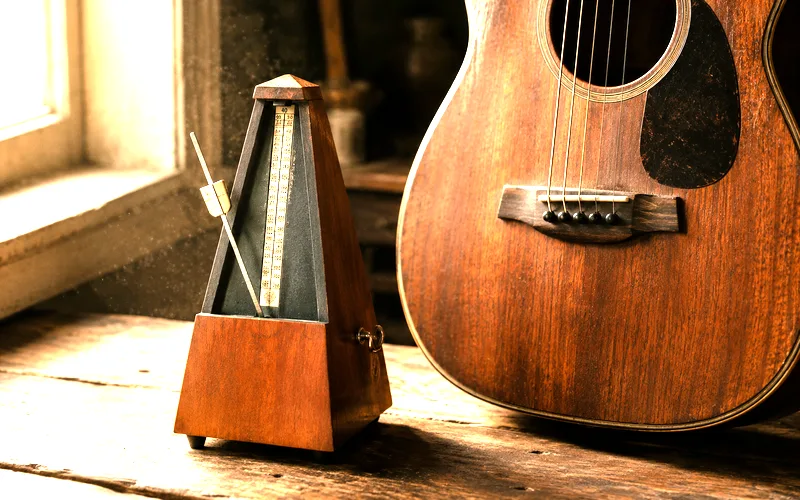
A free metronome app on your phone works perfectly well. What matters is using it consistently, not occasionally when you remember.
A lot of players avoid the metronome because it shows them how unsteady their timing really is. That's exactly why it works.
The metronome just tells the truth, and adjusting to that truth builds the internal clock that eventually lets you play in time on your own.
When you feel confident, try subdividing the beat. Play eighth notes or sixteenth notes against the quarter-note click to deepen rhythmic control and unlock strumming patterns that require more precise right-hand coordination.
Each genre introduces distinct techniques and rhythmic patterns that broaden your playing vocabulary in ways no single style can.
Sticking to one genre limits the guitar techniques and rhythms you're exposed to. A player who only learns rock songs misses out on the fingerpicking patterns in folk, the swing feel in jazz, and the syncopated rhythms in funk.
Choose songs that sit slightly beyond your current ability. The sweet spot is material where you hear audible progress within a few sessions, not so easy it's automatic and not so hard it's demoralizing.
Folk and country songs teach fingerpicking and clean chord work. Rock and blues develop bending, vibrato, and power chord technique.
Jazz introduces extended chords and complex rhythm. Each genre adds tools to your playing vocabulary that transfer across every style you touch.
Build a rotation of three to five songs at different difficulty levels. Keep one that's nearly performance-ready, one in active learning mode, and one that's aspirational.
Beginner guitar songs with three or four chords are ideal starting points. Songs by artists like Johnny Cash, Bob Dylan, and Tom Petty use simple progressions that teach you how chord movement creates emotion in music.
Don't just learn the chords and call it done. Pay attention to the rhythm, dynamics, and picking pattern that make each song sound like itself.
You'll learn more about musicianship from that one habit than from memorizing a hundred chord shapes.
Your picking or strumming hand controls volume, tone, and rhythmic feel, and developing it is just as critical as fretting-hand technique.
Most beginners focus almost entirely on their fretting hand. Developing right-hand guitar techniques deserves equal attention.
Strumming is more than dragging a pick across all six strings at a constant volume. Control which strings you strike by adjusting your wrist angle and limiting the arc of each strum.
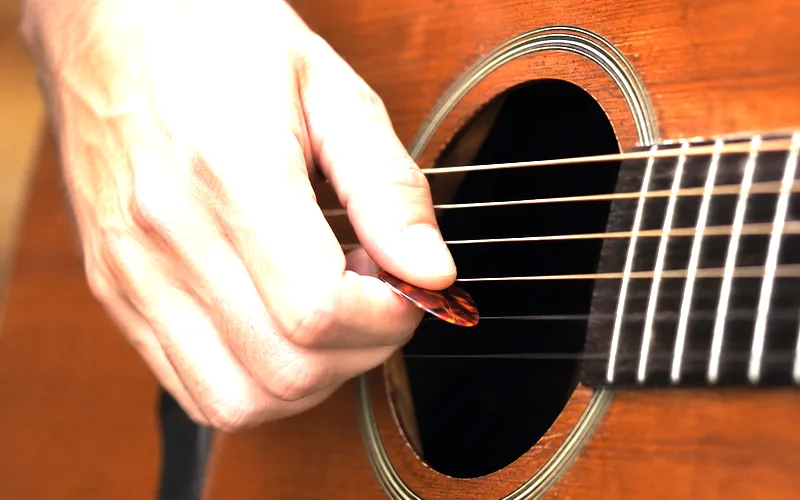
For a D chord, aim to connect with only the top four strings. For an E minor chord, sweep across all six.
Vary your dynamics within each song. Verse sections often benefit from lighter, more restrained strumming, while choruses call for a fuller attack.
Practicing the same chord progression at multiple volume levels develops dynamic control that most self-taught players never build. It's the difference between flat-sounding rhythm guitar and something that actually feels alive.
Assign your thumb to the three bass strings (E, A, D) and your index, middle, and ring fingers to the treble strings (G, B, high E). This assignment stays consistent regardless of what pattern you're playing.
Start with a basic alternating bass pattern. Your thumb picks the root note on beat one, then an alternating bass note on beat three, while your fingers pluck treble strings on the remaining beats.
This forms the backbone of fingerstyle guitar and shows up constantly in folk, country, and acoustic pop. Keep your right hand anchored lightly against the bridge for stability.
Floating your hand above the strings makes it harder to develop the accuracy that consistent fingerpicking requires. With a stable anchor, your fingers can find the right strings without you having to look down.
Recording strips away real-time bias and reveals timing gaps, buzzing strings, and uneven dynamics you cannot hear while playing.
You can't really judge your own guitar playing while you're doing it. Your brain is too busy processing finger placement, chord changes, rhythm, and dynamics all at once to honestly evaluate how you sound.
A phone recording solves this. Prop your phone on a table, hit record, and play through a song or exercise.
Listen back with fresh ears. Timing inconsistencies, uneven strumming, buzzing notes, and rushed transitions become obvious when you're no longer focused on executing them.
Record yourself at least once a week and save the files. Comparing recordings from different weeks reveals progress that feels invisible on a day-to-day basis.
Hearing yourself actually get better in your own recordings is one of the best motivators during difficult stretches.
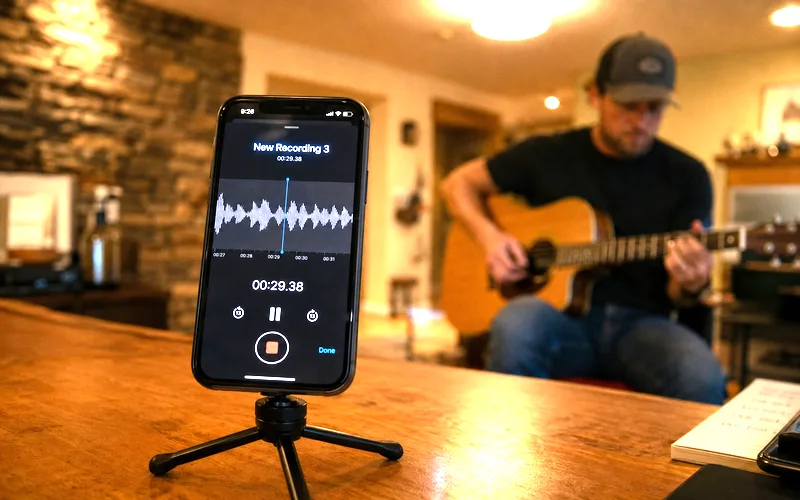
Video recordings add another layer. Watching your hand positioning and technique from an outside perspective reveals habits like a collapsed wrist or hunched shoulders that you can't feel while playing.
Keep a dedicated folder on your phone for these clips. After a few months, going back to your earliest recordings is a powerful reminder of how far you've come, especially during those stretches when progress feels invisible.
Solo practice builds individual skill, but no list of guitar tips is complete without this one: play with other people. It develops musicianship, the ability to listen, respond, and stay locked in time with something other than a metronome click.
Find a friend who plays guitar, bass, drums, or any other instrument and schedule a casual jam. Playing alongside anyone else forces you to hold a steady tempo and adjust your dynamics to blend with another sound source.
If you don't know other musicians locally, open mic nights and community jam sessions offer accessible alternatives. Even trading chord progressions with one other guitar player builds awareness that solo practice cannot replicate.
Playing with others also exposes gaps in your knowledge. You might discover you can't play in certain keys or struggle to recover when you lose your place in a song.
Those gaps become clear targets for your next practice session.
Playing alongside other people brings back the reason you picked up the instrument in the first place.
Every guitarist hits plateaus, periods where progress stalls despite consistent practice. They're normal and temporary, caused by your brain consolidating existing skills before absorbing new complexity.

The worst response to a plateau is quitting. The second worst is repeating the same routine without changing anything.
When progress stalls, shift your approach. Explore a different genre, work on a guitar technique you've been avoiding, or switch from electric to acoustic for a week.
Set small, measurable goals instead of chasing vague ideas like "getting better." Target specifics: increase your one-minute chord change count by five, learn a new song intro, or play a scale cleanly at 10 BPM faster than last week.
Small, visible wins take the sting out of feeling stuck. Progress doesn't always feel linear, but those measurable benchmarks prove it's happening even when your ears can't tell.
Finger soreness and callus development follow a similar pattern of uncomfortable stretches followed by periods where everything feels fine. Trusting the process through the rough phases carries you to the other side.
Common signs include playing the same material without learning anything new, feeling bored during practice, and noticing that techniques you almost nailed last week still feel sloppy. If nothing changes after two to three weeks of consistent effort, you have likely hit one.
Plateaus end. They always do.
The players who stick around long enough break through every single time.
Basic open chords and simple songs become playable within one to three months of consistent daily practice. Smooth transitions between beginner guitar chords typically develop by the three-to-six-month mark.
Playing confidently across a range of songs and styles takes one to two years. There's no fixed endpoint, because guitar is a skill you continue refining for as long as you play.
Both paths work, and many accomplished guitarists use a combination. A teacher spots bad habits early, provides structured progression, and offers real-time feedback.
Self-directed learning through online tutorials and tablature offers flexibility and costs nothing. Institutions like Berklee College of Music even offer free introductory courses online.
If budget allows, even a handful of in-person lessons during the first few months can establish a strong technical foundation that independent practice builds on for years.
Most players who practice guitar daily benefit from changing strings every two to four weeks. Those who practice less can stretch that to six or eight weeks.
If strings feel rough under your fingers, look dull, or refuse to hold tune reliably, they're overdue for a change regardless of the timeline.
Guitar progress doesn't hinge on finding one secret method that unlocks everything overnight. It comes from stacking reliable habits like daily practice, structured routines, ear development, rhythmic discipline, and patience.
Every one of these guitar tips delivers results, but only when applied consistently over weeks and months. Pick up your guitar today, even if you only have ten minutes, and start building the momentum that turns beginners into confident players.
listicle Learn 5 easy ways to play a D guitar chord, from a beginner-friendly open shape to movable voicings that keep the chord fresh anywhere on the neck.
 guide
guide What are guitar frets made of? Compare the two fret wire metals luthiers actually use, see why frets wear down, and learn what a refret involves.
 how to
 Find out when a guitar truly needs a refret and when lighter repairs will save it, with the measurements and symptoms repair techs use to make the call.
 how to
 Learn the best way to travel with a guitar, from choosing the right instrument to packing your case, prepping for flights, and knowing airline policies.
 guide
guide Does playing guitar build muscle? Yes, in specific places. Learn which of the 20-plus muscles involved actually develop and what playing can never do.
 guide
guide Guitar room setup ideas: turn spare space into a practice room that pulls you in every day, with essential gear, layout tips, and realistic costs.
 listicle
 Beginner guitar songs for kids: 6 tunes children already know by heart, simple enough for a first lesson, so progress comes fast and practice sticks.
 listicle
 Want to start flatpicking? Here are 5 easy flatpicking guitar songs for beginners, with simple chords and melodies that build your picking skills fast.
 listicle
 Explore 10 easy Spanish guitar songs for beginners. We explain why each piece suits brand-new players and which skills it'll add to your playing.
 listicle
 Learn guitar with 5 beginner-friendly Noel Gallagher and Oasis songs, from Wonderwall to Don't Look Back in Anger, with tips on chords and strumming.
 roundup
 Want to play metal but don't know where to start? Here are 20 beginner-friendly metal songs with easy riffs, simple rhythms, and approachable solos to learn first.
 roundup
 Beginner Nirvana guitar songs: 11 tracks every new player can manage, from gentle strummers to crunchy riffs, and a sense of what to expect from each.