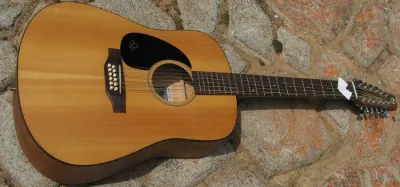

It sounds like a question with one tidy answer. Then you start counting the frets on a few guitars and the numbers refuse to match.
The total depends a lot on the type of guitar. An electric you might buy often carries a couple more frets than the acoustic next to it on the wall, and a handful of oddball builds go much further.
This guide lays out the usual counts by guitar type and the rare designs that break the mold. We also explain whether those upper frets are worth caring about.
There’s more variety here than you’d expect. Let’s start with electric guitars.
How Many Frets Does an Electric Guitar Have?
Typically most electric guitars have either 22 or 24 frets. However, guitar designs vary, and there are 12-string electric guitars - sometimes referred to as “baritone” guitars or “bass” guitars - which often have 28 frets.
There are also a few instruments that have 36 frets. These are specialized instruments, though, and aren’t easily accessible to most people.
Indeed, the most common electric guitars in the world only have 22 or 24 frets.
Electric Guitars With 22 Frets
Probably the most common 22-fret guitars are the Fender Stratocaster, Gibson Les Paul, and Fender Telecaster. These guitars are found in every corner of the world and have been popular for decades.
Electric Guitars With 24 Frets
I usually equate 24-fret guitars with the more modern electrics from brands like Ibanez. The extra two frets give you a full two octaves on each string, which is one reason they’re popular with lead and shred players.
22 vs 24 Fret Guitars: What’s the Difference?
If you’re a new player, not a lot of guitarists can explain what difference having 24 frets really makes. Frankly, most guitarists don’t notice it until they can actually play at least half decently.
So what’s the difference between 24 and 22 fret guitars? Here’s my take on it.
Having more frets means you’ve more room to spread out your fingers. There’s no doubt about it.
More room to slide around means you can play things quite a bit faster, and with higher accuracy, than if you were playing on a guitar with 22 frets.
You also get 12 more notes to play with, since the extra two frets add a full octave at the top of each string.
How to Tell a 22-Fret Guitar From a 24-Fret Guitar
You can always just count the frets on the guitar fretboard, but there’s a quicker way to tell on most guitars. Just look at the last fret on the neck - the one closest to the bridge.
If it has an inlay with two dots, like the 12th fret, you have a 24-fret guitar. If not, it usually means it’s a 22-fret guitar.
(Don’t confuse the last fret with the zero fret some guitars have right at the nut.)
How Many Frets Does an Acoustic Guitar Have?
Even though it may not seem like it to some people, acoustic guitars have frets too. The most common types of acoustic guitars have 20 frets.
There are exceptions to this rule, but for the most part, 20 is what you usually find. Many of the upper frets sit over the body, where they can be awkward to reach, which is part of why acoustics tend to have fewer than electrics.
If you want to go deeper, it’s worth reading up on what guitar frets are made of, brushing up on your beginner guitar chords, and learning when refretting a guitar becomes necessary.
Frequently Asked Questions
Do more frets make a guitar better?
Not necessarily. More frets give you extra high notes and a bit more room to move your fingers, which suits fast lead playing and shredding.
For rhythm playing, blues, and most acoustic styles, those top frets rarely get used, so 22 or even 20 frets is plenty.
How many frets do bass guitars have?
Bass guitars and 12-string baritone-style electrics often have around 28 frets, though standard 4-string basses commonly come with 20, 21, or 24 frets depending on the model. As with guitars, fewer frets is more than enough for most players.
Can you add more frets to a guitar?
Adding frets beyond the existing fretboard isn’t practical, because the fretboard would have to be physically extended and the scale length is fixed. If you want a different fret count, the simplest option is to buy a guitar built with the number of frets you need.
How many frets does a classical guitar have?
Classical and nylon-string guitars usually have around 19 or 20 frets. Like steel-string acoustics, the body limits how far the neck and fretboard can extend, so they tend to carry fewer frets than electric guitars.
Final Thoughts
In short, guitars with 22 or 24 frets are the norm for electrics, while most acoustics have 20. There are a few oddballs out there, including 28-fret and 36-fret instruments, but you won’t run into them often.
Generally, electric guitarists lean toward 24 frets for the extra range, and acoustic guitarists are perfectly happy with 20. The easiest way to know what you’ve got is to count, or just glance at that last fret near the bridge.