You’ve got a beginner guitar in your lap and no idea where to point your fingers. Start with eight chords.
These are all open chords, which means a few of their notes ring on strings you never press down. That open ring is what makes them friendly for sore, new hands.
The same eight work on acoustic guitars and electric guitars, left handed or right. Switching between them cleanly and in time is the part that turns chords into songs, and we’ll cover that too.
For more starter habits, see our guitar tips for beginners. So which chords should you learn first?
What Guitar Chords Should I Learn First?
The eight basic guitar chords that any beginner should learn first, before moving on to guitar songs for beginners, are a mix of major and minor chords: C, A, G, E, D, A minor, D minor, and E minor. Here’s a closer look at each one.
1. C Major
The C major chord is one of the most common chords in all of music and a great place to start. It uses your index, middle, and ring fingers across the first three frets, and you skip the lowest string when you strum.
See more on the C guitar chord and its variations.
2. A Major
A major is a bright, cheerful sounding chord built in the second fret. Many beginners stack their first three fingers on the same fret, which can feel cramped at first but gets comfortable quickly.
It pairs naturally with the D and E chords.
3. G Major
G major is one of the most heavily used chords in popular music. It stretches your fingers across the neck a bit more than the others, which is great practice for building finger independence early on.
Explore the G guitar chord and its variations.
4. E Major
E major is a full, ringing chord that uses all six strings, so it’s one of the most satisfying chords to strum as a beginner. It also shares finger shapes with E minor, which makes the two easy to learn together.
See the E guitar chord and its variations.
5. D Major
D major is built mostly on the higher strings and gives you a bright, focused sound. You only strum the top four strings, so getting your strumming hand to skip the lowest two strings is part of the challenge.
Check out the D guitar chord and its variations.
6. A Minor
A minor is the first minor chord on the list and one of the easiest chords to play. It has a warmer, more emotional sound than the major chords, and it shares a very similar shape with C major, so switching between the two is quick to learn.
7. D Minor
D minor is another higher-string chord with a moody, somber tone. Like D major, you only strum the top four strings.
The shape is small and compact, which makes it a good chord for practicing precise finger placement.
8. E Minor
E minor is often the very first chord new players learn because it only requires two fingers. It uses all six strings and has a deep, rich sound.
Once you can play E minor, adding one more finger turns it into E major.
How Do I Read These Guitar Chord Charts?
Reading chord charts is simpler than it looks, and once you build up some muscle memory you’ll be able to glance at a diagram and know exactly where to place your fingers almost instantly. Here’s how to break the charts down:
- Think of the very top of the chart as the nut on your guitar (also called “fret 0”).
- Each vertical line represents one of the six strings.
- Each horizontal line represents a fret.
- Each black dot shows where to place a finger. Remember to use the tips of your fingers.
- The number inside each black dot tells you which finger to use:
- 1 = index finger
- 2 = middle finger
- 3 = ring finger
- 4 = pinky finger
Since these are open guitar chords, all of them are formed within the first four frets.
You’ll also notice an “O” or an “X” above each open string. “O” means you play that open string as part of the chord, while “X” means you skip that string and don’t play it.
A Bonus Chord: The F Chord
Here’s one more chord to throw in as a bonus. If you master the eight chords above, the F chord is a bit more of a challenge and a sneak peek into the next step of your guitar journey.
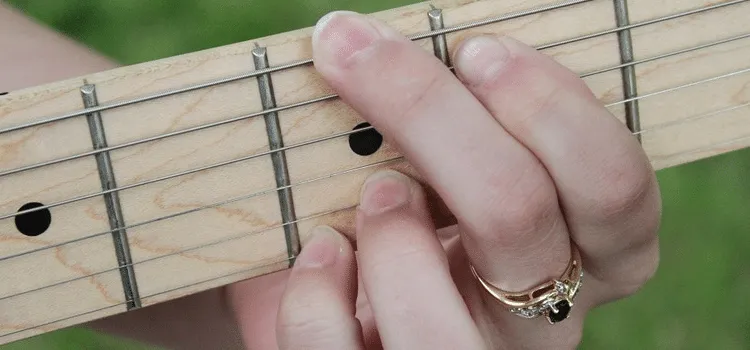
It’s a little trickier because it requires you to press down three notes with your index finger at once. This is called a barre chord, and you fret the remaining notes with your other fingers.
It takes some getting used to, but I invite you to give it a try.
For more detail on individual open chords and their variations, explore these guides:
- A guitar chord and variations
- B guitar chord and variations
- C guitar chord and variations
- D guitar chord and variations
- E guitar chord and variations
- F guitar chord and variations
- G guitar chord and variations
What to Practice Next
The first thing I recommend for any new guitarist is learning and memorizing these eight chords. Once you can play them all without looking at the charts, start working on switching smoothly between them.
A great way to do this is to pick two chords at random and practice changing back and forth until it feels automatic, then repeat with a new pair until you can move between any combination.
Mastering those chord changes is the single most important thing to practice daily. Once you can switch cleanly while you strum, you can move on to additional chords, barre chords, chord progressions, and even lead guitar.
There’s no limit to where this can go.
It also helps to start learning easy songs that use these chords, such as Hallelujah, Happy Birthday, Riptide, Hey There Delilah, Amazing Grace, Stand By Me, Sweet Home Alabama, and Sweet Caroline. You may be surprised how many songs you can play just by knowing how to move between these beginner chords.
Frequently Asked Questions
How long does it take to learn beginner guitar chords?
Most beginners can form all eight of these chords within a few weeks of regular practice. The chord shapes themselves come fairly quickly, but switching cleanly between them is what takes the most time.
If you practice changing chords for even 10 to 15 minutes a day, you should be able to play simple songs within a month or two. Consistency matters far more than long, occasional practice sessions.
Are these chords the same on acoustic and electric guitar?
Yes. These eight open chords are identical on both acoustic and electric guitars, and the finger placement doesn’t change.
They also work the same whether you play left handed or right handed.
The main difference is feel. Acoustic guitars usually have thicker strings and higher action, so chords can take a little more finger strength at first, while electric strings are often easier to press down.
What does an X or O above a chord chart mean?
The symbols sit above the strings that you don’t fret. An “O” means you play that string open as part of the chord, so it should ring out when you strum.
An “X” means you shouldn’t play that string at all. You either skip it with your strumming hand or lightly mute it so it stays silent.
Should beginners learn barre chords or open chords first?
Open chords first, every time. The eight chords in this guide are all open chords, and they’re far easier to play than barre chords because they don’t require pressing multiple strings with one finger.
Once your open chords feel comfortable and your chord changes are smooth, the F chord is a natural first barre chord to attempt. Trying barre chords too early often leads to frustration and sore hands.
Final Thoughts
If you can play C, A, G, E, D, A minor, D minor, and E minor, you have the foundation you need to play a huge portion of popular music. These open chords work on any guitar, and learning them well is the single best use of your early practice time.
Focus first on forming each chord cleanly, then on switching between them without pausing. Those smooth transitions are what turn a handful of shapes into real songs.
From there, the F chord and other barre chords open up even more possibilities. Take it one chord at a time, practice a little every day, and you’ll be playing songs sooner than you think.