You play a clean chord and a nasty rattle buzzes out from down near the bridge. It’s maddening, but don’t go blaming the whole guitar yet.
The list of likely causes is short, and you can rule them out one at a time. Start with your own hands: are you pressing firmly and landing close to the right fret?
A properly set-up guitar should ring out clean chords with no rattle at all. If your technique checks out, the problem is somewhere in the setup.
Below are the usual reasons, ordered from easiest to hardest to fix.
Top Reasons for a Buzzing Guitar Bridge
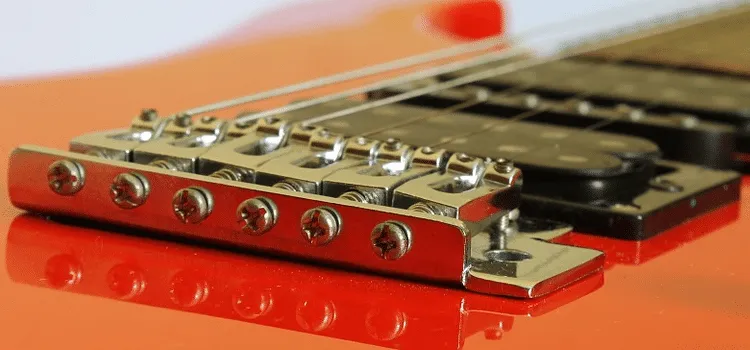
Guitarists often find themselves asking why their guitar bridge has a buzz at the saddle, a “rattle saddle” so to speak. Here are the most common culprits, roughly in the order you should check them.
Dirty Strings
A bridge buzz can start with dirty strings. Over time, strings pick up dust and debris from the air and your hands, and that buildup can be the source of the rattle.
Change your strings occasionally and clean them regularly by running a cloth along their full length. Make sure you cover the underside too, since that’s where grime tends to collect.
Loose String Ends
Many guitars use strings with ball ends that should sit tight against the bridge. If a ball is seated incorrectly, it can rattle, so unwind the string and reseat it so the ball stays in place.
Loose ends on quality classical guitar nylon strings often buzz after they pass over the bridge. In that case, the fix is winding or trimming the string ends so they no longer touch the bridge.
External Factors
Your electric or acoustic guitar bridge can loosen or crack because of environmental conditions. Severe weather - dry, humid, hot, or cold - can separate the bridge from the body over time.
Wood is hygroscopic, meaning it absorbs and releases moisture with changes in humidity. If you aren’t using a humidifier, that expansion and contraction changes string tension and can also affect the neck.
A bridge under distress will often announce itself with a buzz. The best protection is storing your guitar in a temperature- and humidity-controlled environment.
Broken Braces
Damaged braces can lift the bridge and throw off the sound. A lifting bridge puts pressure on the top of the guitar and can damage the wood around it.
Repairing broken braces isn’t a beginner job. The guitar top usually has to be removed so the work can be done properly, and an inexperienced hand can easily make things worse.
For this one, consult an experienced luthier.
Too Little Pressure on the Strings
If you don’t press the strings down hard enough, a note can buzz even when your fingers are in the right position. New players run into this often.
The fix is simply technique and time. Pressing hard enough can be uncomfortable at first, but it gets easier as your fingertips build calluses with regular practice.
A Worn-Out Nut
If you’ve cleaned the strings and the buzz is still there, check the nut. When the nut is worn or the slots are cut too deep, the strings sit too close to the fretboard and buzz against the frets.
Consider replacing the nut, or as a temporary test, slip a folded piece of paper under the string to raise it. Also check the shape of each slot - a string bearing too heavily at the back of the slot can buzz, which you can correct with a few careful strokes of a nut file.
Lack of Neck Relief
A fretboard should never be perfectly straight, because a slight forward curve gives the strings room to vibrate. It shouldn’t bow backward either.
The ideal amount of relief depends on your playing technique, string gauge, and scale length.
If the neck has no dip at the midpoint, it has a forward bow. If it has a hump, it has a back bow, which deprives the neck of relief and causes widespread buzzing.
To add relief, loosen the truss rod slightly. A professional luthier can help you dial in the alignment for your particular style.
The Truss Rod
If the buzz persists on open strings, you may need to raise the low string action, adjust the bridge, or shim the nut. Start by raising the bridge, since that’s the simpler change.
If the buzz only shows up on notes above the 12th fret, adjusting the bridge is usually the answer. When it sits on the lower end of the neck, relieve the neck by loosening the truss rod.
Related - how does a truss rod work on a guitar? - how to adjust saddle height on a guitar
Never settle for faulty action. If raising the bridge leaves you with an uncomfortably high action, that isn’t the fix - adding relief to the truss rod may be.
Keep three adjustments in mind: the truss rod, the bridge, and the nut. The truss rod and the bridge are the most likely culprits and the easiest to adjust.
If you aren’t confident making these changes, get a professional setup instead. Remember that the truss rod is for setting relief, not for changing your action.
What If the Buzzing Persists?
Have you worked through every step above and the buzz still hangs on, whether on an acoustic rig or an electric like a Les Paul or Fender Stratocaster? Don’t overlook any part of the process.
You can also look at the fretboard itself. Poorly selected wood can shift over time and become a source of ongoing buzz.
Always tune to pitch with a tuner before any fretwork and again afterward. In my experience, the low E is one of the hardest strings to get rattle-free.
Frequently Asked Questions
Why does my bridge buzz only on open strings?
Buzz that appears only on open strings usually points to the nut or the neck rather than the bridge itself. A nut slot cut too low, or too little neck relief, lets the open string sit close enough to the frets to rattle.
Start by checking the nut slot height and adding a touch of relief with the truss rod. If those are fine, slightly raising the action at the bridge can clear the last of it.
Can I fix a buzzing bridge myself?
Many causes are easy DIY fixes: cleaning strings, reseating ball ends, raising the action, or making a small truss rod adjustment. These take only basic tools and a little patience.
Structural problems are a different story. A separated bridge, cracked braces, or a worn nut that needs filing are best handled by a luthier, since a mistake can cause lasting damage.
Does humidity really cause bridge buzz?
Yes. Guitar wood absorbs and releases moisture as humidity changes, and that movement can shift the bridge, the neck, and string tension enough to create a buzz.
Keeping your guitar in a stable environment with a humidifier or dehumidifier as needed prevents most of these seasonal problems before they start.
Will heavier strings stop the buzzing?
Heavier strings sit under more tension and vibrate in a slightly tighter arc, which can reduce some buzz, especially if your current strings are very light. It isn’t a guaranteed cure, though.
If the real cause is a worn nut, a back-bowed neck, or a lifting bridge, new strings only mask the problem. Diagnose the underlying issue first, then choose a gauge that suits your playing.
Final Thoughts
One of the most annoying parts of playing guitar is strumming a chord only to hear the strings buzz. It happens to every guitarist eventually, so it pays to understand the root causes and the order in which to check them.
The encouraging news is that there’s almost always a remedy. Work through the causes from the simplest, like dirty strings and seating ball ends, up to neck relief and truss rod adjustments, and be careful not to misdiagnose the problem along the way.
Develop a sharp eye for small irregularities and you’ll be well on your way to a clean, buzz-free action. When a fix calls for removing the top, filing the nut, or reseating the bridge, don’t hesitate to hand it to an experienced luthier.