You’re cruising through a song, then you hit a B and everything grinds to a halt. If that chord has tripped you up, you’re far from alone.
Here’s the part that helps. There isn’t one correct way to play a B, so the fix is matching the right shape to your hand and the song in front of you.
This article lays out five ways to play a B major chord, from a friendlier partial shape up to the full barre versions. Pick the one that gets you through today and work up from there.
New to chord charts? This post makes them quick to read, but first let’s see which notes a B is built from.
What Notes Make Up a B Chord?
A B major chord is built from three notes: B, D#, and F#. That’s the root (B), the major third (D#), and the perfect fifth (F#).
Every version on this page contains those same three notes, just played in different positions on the neck and with different fingerings.
Because B major has no convenient open strings to lean on, there’s no simple open-position shape the way there’s for C, G, or D. That’s the main reason it feels awkward at first, and it’s why most of the options below involve some kind of barre.
5 Ways to Play a B Major Chord
1. The Easy 3-Finger B (Partial Barre)
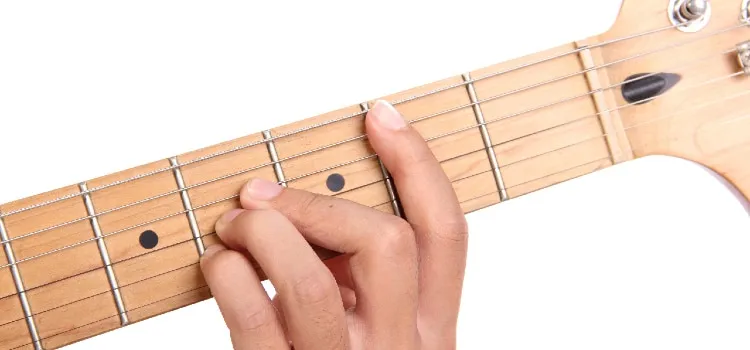
This is the most beginner-friendly version and a great place to start. You play only the middle four strings and skip a full barre.
- Place your first finger across the A, D, and G strings at the 2nd fret (a small partial barre).
- Place your second, third, and fourth fingers on the D, G, and B strings at the 4th fret.
Strum from the A string down and avoid the low E and high E strings. It still contains B, D#, and F#, so it sounds like a proper B major chord without the strain of a full barre.
2. The A-Shape Barre Chord (2nd Fret)
This is the most common “real” B chord and the one most players settle on. It’s an A major shape moved up the neck with a barre.
- Lay your first finger flat across all six strings at the 2nd fret.
- Use your third finger (or a combination of fingers two, three, and four) to fret the D, G, and B strings at the 4th fret.
Strum from the A string down. The barre at the 2nd fret raises an A shape up two frets, which gives you B major.
This shape takes hand strength to play cleanly, so don’t be discouraged if it buzzes at first.
3. The E-Shape Barre Chord (7th Fret)
This version uses the familiar E major shape moved up the neck, and it lets you strum all six strings.
- Barre all six strings with your first finger at the 7th fret.
- Add your second, third, and fourth fingers to form an E major shape on top (9th fret on the A and D strings, 8th fret on the G string).
Because it’s rooted on the low E string at the 7th fret, you get a fuller, lower-sounding B. Many players find the E shape easier to fret cleanly than the A shape once they’re comfortable barring higher up the neck.
4. The Bsus Workaround
When a full B barre is still out of reach, a Bsus2 or Bsus4 shape can stand in during practice. These aren’t technically B major, but they share the B root and work in plenty of progressions while you build strength.
A common Bsus4 uses your first finger barring the A, D, G, and B strings at the 2nd fret, with an added finger at the 4th fret on the D and G strings. Use it as a stepping stone, then swap in the true B major shape from option 1 or 2 once your fingers are ready.
5. The Two-Finger Power Chord (B5)
A B5 power chord is the simplest option of all and is common in rock and punk. It drops the D# (the third), so it’s neither major nor minor, but it’s rooted on B and works great with distortion.
- Fret the A string at the 2nd fret with your first finger.
- Fret the D string at the 4th fret with your third finger.
Strum just those two strings (you can add the G string at the 4th fret for a fuller power chord). It’s the fastest way to get a B sound under your fingers, even though it leaves out the note that makes the chord truly “major.”
Tips for Playing the B Chord Cleanly
Most B chord problems come down to barre technique. Keep your thumb low on the back of the neck, roll your first finger slightly onto its bony edge rather than the soft pad, and press just behind the fret instead of on top of it.
Position your barre as close to the fret wire as you can to reduce the pressure you need.
If the chord buzzes, isolate it: strum one string at a time and find which one is muted or muffled, then adjust that finger. Building up to a clean B takes time, so practice switching between B and chords you already know, like E and F#m, to train the change in a musical context.
Frequently Asked Questions
Why is the B chord so hard for beginners?
B major has no open strings that fall naturally under the fingers, so unlike C, G, or D there’s no easy open shape to lean on. That means you almost always need a barre or partial barre, which requires hand strength and finger independence that take time to develop.
It gets much easier with consistent practice.
What’s the easiest way to play a B chord?
The easiest true B major is the 3-finger partial-barre version covered first on this page, which uses only the middle four strings. If you just need a B sound to keep a song moving, a B5 power chord is even simpler, though it leaves out the major third.
Is the B chord the same as B major?
When someone writes just “B” in a chord chart or song, they mean B major. A minor B chord is always written as “Bm” or “B minor.”
All five shapes above produce a B major chord (except the B5 power chord, which is neither major nor minor).
Do I have to barre the B chord?
Not at the very beginning. The partial-barre 3-finger shape, the Bsus workaround, and the B5 power chord all let you play a usable B without a full six-string barre.
That said, learning the full A-shape barre is worth the effort because it unlocks dozens of other movable chords up and down the neck.
Final Thoughts
The B chord trips up almost every guitarist at first, but it’s one of those skills that pays off for the rest of your playing. Start with the easy 3-finger shape, lean on a B5 power chord or a Bsus when you need to keep a song moving, and work toward the full A-shape and E-shape barres as your hand strength improves.
Each of these five shapes contains the same core notes - B, D#, and F# - so none of them is “wrong.” Pick the one that fits your level and the song in front of you, and keep practicing the changes.
Once the barre clicks into place, you’ll have it for life, and a whole catalog of movable chords will open up along with it.