Ask new players which chord made them want to quit, and the F comes up a lot. The standard shape is a full barre, and that takes more hand strength than the open chords you learned first.
Here’s the good news. You don’t have to start with the hard one, and even the barre gets easier with practice.
Below you’ll find five ways to shape the chord, starting with an easy mini version and working up to the full barre higher on the neck. You pick whichever one fits the song in front of you.
If chord charts are new to you, my post on beginner guitar chords explains them in full. First, let’s see which notes build the chord.
What Notes Make Up an F Chord?
In order to play an F chord, you need to bring together three notes: F, A, and C. From the first-fret barre to the highest voicing, every F major you play is built from the same F, A, and C.
Different shapes simply rearrange and double up those same notes in different orders and octaves, which is why each version has its own character even though it’s the same chord.
Understanding that F major is built from F, A, and C also makes it easier to find new shapes on your own. Once you can spot those notes across the fretboard, you can build the chord almost anywhere, and you’ll understand why the easier partial shapes below still count as an F.
5 Ways to Play the F Guitar Chord
1. The Full F Barre Chord
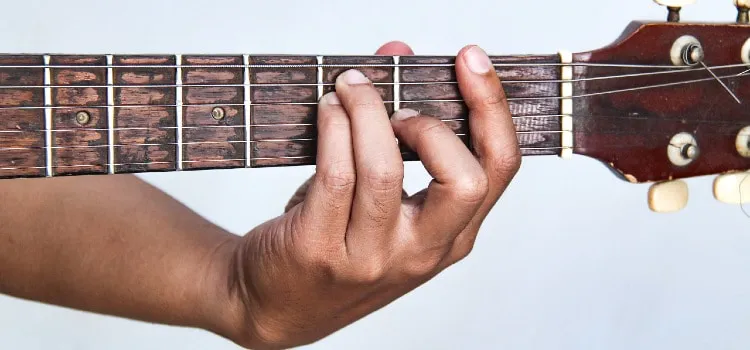
The most common way to play an F chord is the full barre version in the first position. You lay your index finger flat across all six strings at the first fret to act as a movable “nut,” then build the rest of an open E-style shape on top of it.
This is the version most chord charts show, and it’s a perfect example of the CAGED system in action.
It’s also the shape that gives beginners the most trouble. Barring all six strings cleanly takes hand strength and the right thumb position behind the neck, so expect some buzzing and muted notes at first.
Stick with it and it’ll click.
2. The Mini F Chord (Easier 4-String Version)
If the full barre is fighting you, the mini F is the friendliest way in. Instead of barring all six strings, you play only the top four strings and use your index finger to lightly cover the top two.
You leave the low E and A strings out entirely, so there’s far less to barre and a lot less hand strain.
This partial shape still sounds the F, A, and C notes that make up the chord, so it works in plenty of songs while you build up to the full barre. Many beginners use the mini F for months before they ever need the six-string version.
3. The Fmaj7 Shape
Another easy alternative is Fmaj7, which adds an E note to the basic F chord. The common open shape doesn’t require any barring at all, which is why teachers often hand it to beginners as a stepping stone toward the full F.
It isn’t a true F major, so it has a slightly softer, jazzier flavor, but in a lot of songs it substitutes nicely for F. Having Fmaj7 in your back pocket means you can keep playing through a progression even before your barre chords are ready.
4. The F Barre Chord (E-Shape Variation)
Once your barre is solid, you can play F as a full E-shape barre chord at the first fret, sounding all six strings for a big, full version of the chord. This is essentially the open E chord shape moved up one fret, with your index finger barring behind it.
This shape sits low and powerful, which makes it a great rhythm chord. It’s the same fingering you’ll move up and down the neck for other chords, so mastering it here pays off everywhere else.
5. A Higher F Voicing Up the Neck
You can also play an F chord higher up the neck using an A-shape barre at the eighth fret. These upper voicings sound brighter and thinner than the first-position F, and they’re useful for layering with another guitar or for playing parts that need to cut through a mix without sounding muddy.
Moving the chord up the neck is another reminder that F major is just F, A, and C. Wherever those notes line up in a movable shape, you can play the chord, which opens up the whole fretboard once you’re comfortable.
How to Practice the F Chord
I’d recommend learning these F chord shapes one at a time and working them into your playing gradually. If the full barre is frustrating, start with the mini F or Fmaj7 so you can keep making music while your hand gets stronger, then add the six-string barre once your fretting hand is ready.
The key insight is that these are interchangeable. Wherever there’s an F chord in a song you’re playing, you can substitute any of the shapes above.
Next time a song calls for F, try the mini version in one pass and the full barre in the next, and notice how the energy changes even though the harmony doesn’t.
Drilling F voicings is some of the most productive practice there is: the barre builds raw fretting strength, and hearing F in several registers sharpens your ear faster than any drill. Keep your thumb low behind the neck for the barre shapes, press just behind the fret, and the buzzing will fade faster than you expect.
Frequently Asked Questions
Why is the F chord so hard to play?
The standard F chord is a full barre chord, meaning your index finger has to press down all six strings at the first fret while your other fingers form a shape on top. That takes more hand strength and a better thumb position than the open chords most beginners learn first, so it’s common to get buzzing or muted strings at the start.
It gets easier quickly with practice. In the meantime, easier shapes like the mini F or Fmaj7 let you play the chord while you build up to the full barre.
Which F chord shape should a beginner learn first?
Start with the mini F, the four-string version that only asks you to lightly barre the top two strings. It still sounds like an F, requires far less hand strength than the full barre, and lets you keep playing songs right away.
Once the mini F feels comfortable, move on to the full six-string barre version to unlock the rest of the neck.
What’s the difference between F major and Fmaj7?
F major is built from three notes, F, A, and C, while Fmaj7 adds an E on top, giving you F, A, C, and E. That extra note gives Fmaj7 a softer, jazzier sound compared to the brighter, more resolved F major.
Because the common Fmaj7 shape doesn’t require barring, beginners often use it as a stepping stone, substituting it for a full F until their barre chords are ready.
Do these F chord shapes work on both acoustic and electric guitar?
Yes. These F shapes are the same on acoustic and electric, though most players find the barre noticeably more forgiving on an electric’s lighter strings.
Barre chords often feel a little easier on electric guitars because the strings are usually lighter and the action lower, but the shapes themselves don’t change. If you’re learning on an acoustic with high action, the mini F and Fmaj7 will feel especially welcome.
Final Thoughts
The F chord has a reputation as the chord that stops beginners in their tracks, but as you’ve seen, there’s far more to it than one tough barre shape. From the beginner-friendly mini F and Fmaj7 to the full barre chords in the first position and higher up the neck, each voicing gives you the same three notes, F, A, and C, in a new spot on the fretboard.
Learning several shapes pays off quickly. You’ll be able to keep playing songs while your barre technique catches up, add variety to your rhythm playing, and start to see how the CAGED system ties the whole neck together.
Take your time with each one, lean on the easier shapes when you need to, and reach for the full barre once your fretting hand is strong enough. Before long, playing an F chord anywhere on the guitar will feel completely natural.