You’re brand new to the guitar, and naming the six strings should feel simple. Then you notice two of them share a letter and the numbering seems to run backward, and suddenly it isn’t.
Locking in the string names early pays off fast. It’s what scales, chords, and standard tuning all build on once you start practicing in earnest.
This guide names each string and gives it a number. We also share a memory trick that sticks, explain the reason behind this tuning, and cover how alternate tunings change the picture.
One quick note before we start. The names stay the same no matter which string gauge you play, and they’re the foundation for your first beginner chords.
What Are the Guitar String Names in Standard Tuning?
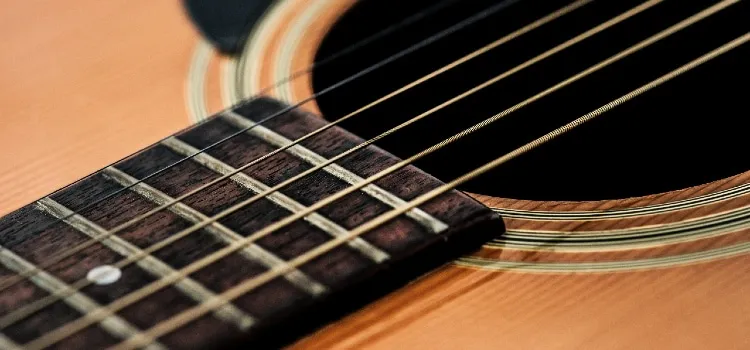
Say you’re holding your guitar and getting ready to play. If you look down at your guitar strings, starting at the very top open string (which is also the thickest), the open string names are E, A, D, G, B, E.
This is the same for both six-string acoustic and electric guitars.
Here’s the full order from the thickest, lowest-sounding string to the thinnest, highest-sounding string:
| String number | Note name | Common label |
|---|---|---|
| 6th string | E | Low E |
| 5th string | A | A |
| 4th string | D | D |
| 3rd string | G | G |
| 2nd string | B | B |
| 1st string | E | High E |
Notice that the two outside strings - the 6th and the 1st - are both named E. They’re two octaves apart, which is why one is called the low E and the other the high E.
These also apply to both electric and acoustic guitars and to classical nylon-string instruments.
How to Remember the Strings on a Guitar
When I was first learning how to play, I took lessons at my local music store (years later, I actually ended up teaching guitar there too). My teacher gave me a simple trick to remember the string names in standard tuning: a short sentence where each word’s first letter matches a string name.
From the thickest string to the thinnest - EADGBE - here’s the phrase.
Eat A Dead Gopher Before Easter
Each word lines up with one string, starting from the lowest:
- 6th string - E (low E string)
- 5th string - A
- 4th string - D
- 3rd string - G
- 2nd string - B
- 1st string - E (high E string)
Yes, it sounds weird, but it works. I learned the string order fast this way, and it makes the names easy to recall when you’re staring at the fretboard.
If you’ve worked with guitar tabs, you’ve already seen this layout, since the lines on a tab represent these same six strings. Bass guitar uses the same idea, just with the four lowest strings.
Also check out - light vs medium guitar strings and why are guitar strings so long?
How Many Strings Does a Guitar Have?
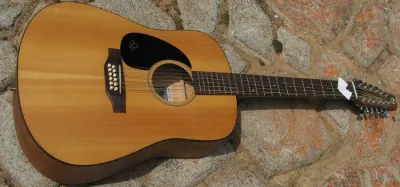
A classic, standard guitar has six strings. You can find guitars built with 7, 8, or even 12 strings, but when most people talk about a standard acoustic or electric guitar, they mean the six-string version running from low E to high E.
Those six open notes are what you hear before you press down on any fret along the fretboard. Music charts and chord diagrams will often label each string with its number, from the 1st string (high E) up to the 6th string (low E), so it helps to know both the names and the numbers.
Why Are Guitar Open Strings Tuned This Way?
If you’ve experience with other stringed instruments, you may know that many of them are tuned in perfect fifths. Guitars are a little different and are mostly tuned in fourths, with one major third between the G and B strings.
The reasoning behind this layout is to make it easier to play both melodies and chord shapes without stretching your hand too far. This balance is a big part of why standard tuning has stuck around for so long and why so many common chord shapes feel comfortable under the fingers.
What About Alternate Tunings Instead of Standard Tuning?
Standard EADGBE is just the starting point. There are many alternate tunings that change the names of the open strings to create different sounds or make certain songs easier to play.
A common example is Drop D, where you tune the lowest string down a whole step from E to D. That single change makes it easier to play heavy power chords and gives the low end a deeper voice.
Other tunings, like open G or DADGAD, retune several strings at once.
It’s worth getting comfortable with standard tuning first, since it gives you the reference point for understanding everything else.
Frequently Asked Questions
Are the string names the same on electric and acoustic guitars?
Yes. A standard six-string acoustic and a standard six-string electric guitar both use the same E, A, D, G, B, E tuning.
The strings themselves differ in material and feel, but the note names and order are identical.
Classical guitars with nylon strings also follow the same EADGBE layout, so the names you learn carry over across all three types.
Which string is the 1st string on a guitar?
The 1st string is the thinnest, highest-sounding string, tuned to high E. Counting works from the thinnest string upward, so the 1st string is E, the 2nd is B, and so on down to the 6th string, which is the thick low E.
This can feel backwards at first, since the 1st string sits at the bottom when you hold the guitar in playing position. With a little practice the numbering becomes second nature.
Are guitar string names different for left-handed players?
No, the string names and order are exactly the same. A left-handed guitar is simply strung in mirror image so the low E is at the top from the player’s point of view, just like on a right-handed guitar.
The memory trick and the EADGBE order work the same way regardless of which hand you strum with.
Why do two strings share the same name?
Both the 6th and 1st strings are named E because they’re E notes, just two octaves apart. The low E is the thickest string with the deepest pitch, while the high E is the thinnest string with the brightest pitch.
Hearing the same note name in two registers is normal in music, and it’s one reason standard tuning feels balanced from the lowest string to the highest.
Final Thoughts
The six strings on a standard guitar are named E, A, D, G, B, E, running from the thick low E up to the thin high E. Lock that order in with a phrase like “Eat A Dead Gopher Before Easter” and you’ll be able to name any open string in seconds.
Once the names and numbers feel automatic, you have the foundation you need to move on to full chords, scales, and learning the notes across the neck. From there, the rest of the fretboard starts to make a lot more sense.