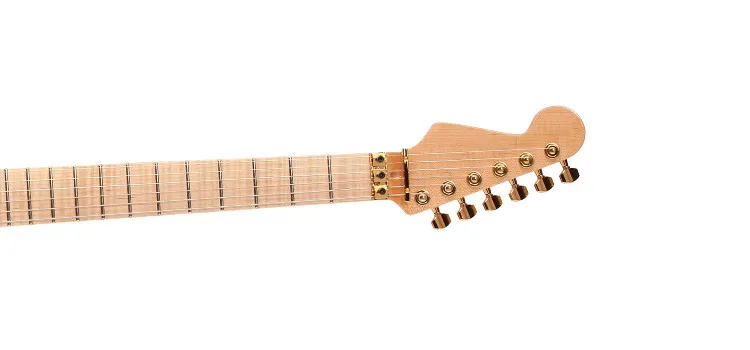
Your new neck arrived as bare wood, smooth enough that you could almost string it up as is. So why bother sealing it at all?
The catch is what happens over the months that follow. Unsealed wood trades moisture with the air, and that slow swelling and drying can warp or crack a neck that played fine on day one.
A finish stops that exchange. Skip it and you risk wrecking an otherwise solid neck.
This guide explains the damage bare wood invites and walks through four finishes worth using, from a satin coat to polyurethane. Let’s start with why finishing is never really optional.
Why You Should Always Finish a Guitar Neck
Yes, you should always finish a guitar neck because that’s what keeps it from being susceptible to warping. The finish applied to the neck helps protect it from moisture and humidity issues like warping, cracking, and other damage over time.
Bare wood absorbs and releases moisture as the seasons change, and that constant movement is what leads to a twisted or bowed neck. A proper finish seals the surface and slows that exchange dramatically.
This is much different from how you’d finish a guitar body, where the priority is usually appearance and a thick protective shell. On a neck, feel and stability matter just as much as looks.
What Can I Use For Guitar Neck Finish?
Learning how to properly apply finishes to a guitar neck depends on the type of finish that you want to use. There are four common options, and each one balances feel, protection, and appearance a little differently.
Satin
A satin finish is really smooth and is what you’ll typically see on a set neck, bolt-on neck, or even Les Paul style guitars. A satin finish is an oil-based finish that won’t leave any residue when the guitar is finished, which is part of why it feels so fast under your hand.
Oil
I love the feel of a properly oiled guitar neck, like a guitar neck with tung oil or boiled linseed oil. You can still feel the wood, but you don’t get any of the stickiness that you can sometimes get with other finishes.
The main thing you want to concentrate on with oil-based finishes is getting the finish into the pores of the wood. This allows the finish to be completely absorbed and prevents issues like peeling.
If you’re looking for a great oil-based finish that’s simple to apply, Tru-Oil is a popular choice for guitar necks.
Nitrocellulose Lacquer
Nitrocellulose lacquer is easy to apply and will allow the wood grain to show through. It isn’t as flawless looking as some of the other finishes, but it can be buffed back to look like new in no time.
As with the others, the main thing with nitrocellulose lacquer is getting the finish into the pores of the wood.
Polyurethane
Polyurethane is one of the few finishes that won’t allow the wood grain to show through. It’s also known as a hard shell lacquer, and it has a smooth, almost slick feel.
If you’re looking to protect against moisture damage above all else, polyurethane is the way to go.
The important thing when using polyurethane is still getting it into the pores of the wood. Without that, the finish won’t be properly anchored and the neck could fail in the future.
This can be tricky because there are many different types of wood used when building a guitar neck, and each one accepts finish a little differently.
How Do You Finish A Guitar Neck?
In order to finish a guitar neck, you first have to sand the neck using a fine grit, then apply your chosen finish. Working through progressively finer grits gives you a smooth surface that the finish can grab onto evenly.
The exact steps change depending on which of the four finishes you picked.
Applying a Satin Finish
Sand the neck smooth, wipe it down to remove all dust, and apply the satin finish in thin, even coats. Because satin is oil-based, it soaks into the surface rather than sitting on top, so let each coat absorb fully before adding the next.
The result is a low-sheen surface with no sticky residue.
Applying an Oil Finish
Oil finishes like tung oil, boiled linseed oil, or Tru-Oil are the most forgiving for a first build. Wipe a thin coat on with a clean cloth, let it soak into the pores, then wipe off any excess so it doesn’t stay tacky.
Repeat for several thin coats, letting each one cure between applications, until the wood feels sealed and smooth. Focus on driving the oil into the pores rather than building a thick film on top.
Applying Nitrocellulose Lacquer
Nitrocellulose is usually sprayed in thin coats over a sanded, dust-free neck. Build up several light coats, allowing flash-off time between each so the lacquer doesn’t run.
Once it has cured, you can buff it to bring back a clean, even sheen while still letting the grain show through.
Applying Polyurethane
Polyurethane is applied in thin coats as well, and the key is making sure that first coat works into the pores before you build up the harder shell. Apply additional coats once each one has cured, then level and buff as needed.
Because poly forms a hard, slick film, take your time so the surface stays even and free of drips.
Frequently Asked Questions
Can you leave a guitar neck unfinished?
You can technically play a bare neck, but it isn’t a good idea for the long term. Unfinished wood absorbs moisture and dries out with changes in humidity, and that movement leads to warping and cracking.
A finish is cheap insurance against ruining the neck.
Is finishing a neck different from finishing the body?
Yes. A body finish is often a thick, glossy shell built mainly for looks and durability, while a neck finish has to balance protection with the way it feels in your hand.
That’s why thin oil and satin finishes are so popular on necks.
Which guitar neck finish feels the fastest to play?
Satin and oil finishes generally feel the fastest because they’re thin and don’t get sticky, so your hand glides along the back of the neck. Glossy polyurethane can feel slightly grabby to some players, especially when their hands get warm or sweaty.
Do you need to finish the fretboard too?
Maple fretboards are typically finished along with the neck, while rosewood and ebony are usually left bare and conditioned with a little oil instead.
Always match the treatment to the specific fretboard wood.
Final Thoughts
Finishing a guitar neck isn’t optional if you want it to last. The finish protects the wood from moisture, which is the main cause of warping, cracking, and other long-term damage.
Whether you choose satin, oil, nitrocellulose lacquer, or polyurethane, the common thread is working the finish into the pores so it bonds properly with the wood.
There are several good options, so pick the one that best matches the feel and look you want. A well-finished neck will play comfortably and stay stable for years to come.
If you want to dig deeper into what goes wrong with bare or poorly cared-for wood, take a look at our article on dealing with a common guitar neck wood problem.