D was one of the first open chords I ever learned, and I played it the same way for years. Then I noticed it sometimes sounded a little thin in the middle of a song.
That open shape is great, but it isn’t the only D on the neck. Move higher up the fretboard and the same chord can ring out fuller or brighter to fit what you’re playing.
The CAGED system is the trick that unlocks all those positions. Once it clicks, you stop being stuck with a single shape.
Below I’ll walk through five ways to play it, from the easy open version up to barre shapes, and if chord diagrams still look like a puzzle, my guide to reading beginner guitar chords breaks them down. First, the notes inside a D chord.
What Notes Make Up a D Chord?
The three notes that make up a D major chord are D, F#, and A. Every D major shape on the neck, from the open triangle to the highest barre, is just D, F#, and A stacked in different ways.
Each D shape just reshuffles D, F#, and A into a different stacking order, which is why the open version sounds chimey while the barre sounds thick, despite being the same chord.
Understanding that D major is built from D, F#, and A also makes it easier to find new shapes on your own. Learn where D, F#, and A live on the fretboard and you can assemble a D chord in any position you like.
5 Ways to Play the D Guitar Chord
1. The Open D Chord
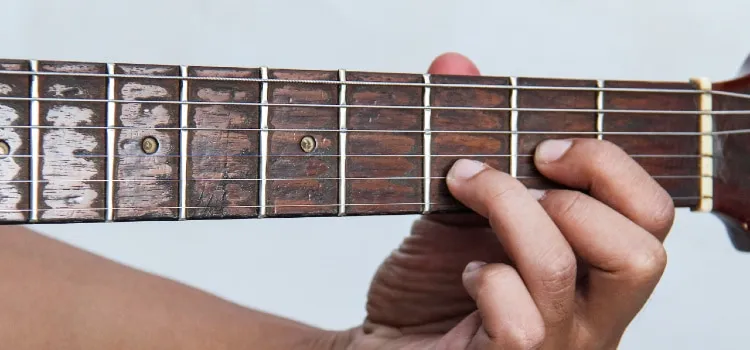
This first version is an open chord; the unfretted D string rings as your root while the other notes sit on the top strings. For this shape you play the top four strings and leave out the two lowest strings, since those notes aren’t part of the D chord.
It’s usually one of the first three chords a guitarist ever learns, and it anchors thousands of campfire standards alongside G and A.
The open D chord sits in the first few frets, so it’s comfortable to reach and easy to switch to and from other open chords like A, G, and E.
2. The D Barre Chord at the 5th Fret
The next D chord variation is played at the fifth fret, and this one is a barre chord. Your index finger flattens across the fifth fret like a movable nut, and the familiar A-shape stacks on top of it.
The barre versions of D ask more of your hand than the open triangle, but they free the chord from the first three frets.
This shape is essentially an open A-style chord moved up to the fifth fret, which is a great example of the CAGED system in action.
3. An Alternate 5th-Fret Voicing
You can also play the D chord around the fifth fret with a different fingering. This alternate voicing uses the same region of the neck but stacks the D, F#, and A notes in a slightly different order, giving you another texture to reach for without moving your hand very far.
Keeping both versions in reach lets you match the chord’s weight to the song, fuller when D is the centerpiece, thinner when it’s passing by.
4. The D Barre Chord at the 10th Fret
You can also move up to the tenth fret and play a D chord there. This is another barre shape, this time based on an open E-style chord moved up the neck.
It sits higher and brighter than the open D, which works well for solos, fills, and adding variety to a chord progression.
5. A Higher Voicing Up the Neck
Higher up on the neck, you can play yet another version of the D chord. Played up here, D loses its low-end thump and turns glassy, which is perfect for doubling another guitar or adding a part that cuts without crowding the mix.
How to Practice These D Chord Shapes
I’d recommend learning and memorizing each of these D chord shapes and working them into your playing one at a time. Start with the open D until it’s clean and buzz-free, then add the fifth-fret barre, and so on up the neck.
Any of these D shapes can stand in for any other. Wherever there’s a D chord in a song you’re playing, you can substitute any of the shapes above.
Run a G-D-A progression and trade the open D for the fifth-fret barre on the repeat; the harmony doesn’t move, but the texture does.
Cycling through D voicings doubles as technique work: your hand learns the tight finger spacing barre chords demand, and your ear starts recognizing D major wherever it appears on the neck.
Frequently Asked Questions
Why are there so many ways to play a D chord?
A D major chord is just three notes, D, F#, and A, and those notes appear in multiple places across the fretboard. The CAGED system organizes these repeating patterns into five movable shapes, so the same chord can be played in the open position, at the fifth fret, at the tenth fret, and higher.
Each version doubles and reorders those three notes differently, which is why they sound slightly different even though they’re all a D chord.
Which D chord shape should a beginner learn first?
Start with the open D chord. It sits in the first few frets, doesn’t require barring, and switches easily to and from other common open chords like A, G, and E.
Once the open D feels comfortable and rings out cleanly, move on to the fifth-fret barre version to start exploring the rest of the neck.
What’s the difference between D major and D minor?
D major is built from D, F#, and A, while D minor lowers the middle note to F, giving you D, F, and A. That one-note change is what makes D major sound bright and D minor sound darker or sadder.
On the open chord, the difference is just a single finger moving down one fret on the high E string.
Do these D chord shapes work on both acoustic and electric guitar?
Yes. D major works exactly the same on acoustic and electric; the only difference is that lighter electric strings make the stretches feel easier.
The fifth-fret D barre takes less effort on a typical electric thanks to lighter strings and lower action, but the grip itself is identical on both instruments.
Final Thoughts
The D chord is one of the very first chords most guitarists learn, but as you’ve seen, there’s far more to it than a single shape in the open position. From the open D to barre chords at the fifth and tenth frets and beyond, each voicing gives you the same three notes, D, F#, and A, in a new spot on the neck.
Learning all five shapes pays off quickly. Knowing several D shapes means you stop diving for the open position every time, your rhythm parts gain variety, and the CAGED map of the neck starts to click.
Take your time with each one, keep the open D as your home base, and reach for the higher voicings whenever a song could use a brighter or fuller sound. Before long, playing a D chord anywhere on the guitar will feel completely natural.