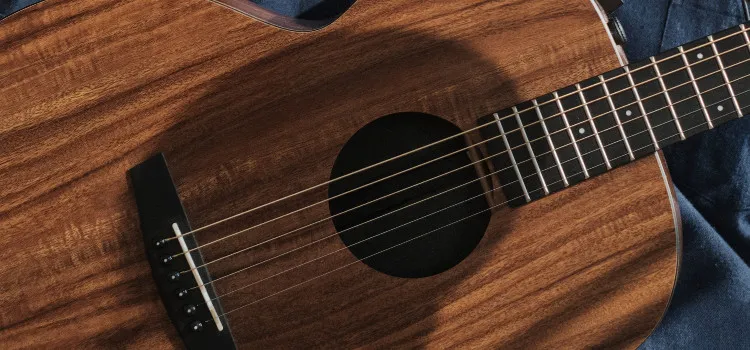
Most guitar shops are wall to wall spruce tops and mahogany backs. A koa guitar is a rarer find, and the reddish grain is what stops people first.
But you’re not buying koa for looks. The way it shapes your tone is the part that decides whether it’s worth the spend.
This guide covers how koa actually behaves under your fingers. You’ll learn what gives it such resonance, the role the finish plays, and where it lands next to myrtlewood.
Koa trees grow in Hawaiian rainforests and take roughly 25 years to mature. So let’s start with what all that dense, slow-grown wood does to the sound.
What Does a Koa Guitar Sound Like?
Koa guitars produce an almost otherworldly kind of sound - lower in volume, but warm and resonant. As the name suggests, koa wood comes from only a handful of islands in the world, including Hawaii, Molokai, Kauai, and Oahu.
The koa tree has to be over 25 years old before it can be used to make a guitar. The wood is reddish in color and is considered one of the best woods for making guitars, particularly well suited for creating warm but full-sounding acoustics.
If high strings on other guitars tend to ring out bright and sharp, koa softens that top end. The result is a sweeter, fuller tone that flatters fingerstyle and vocal-led playing.
Great Examples of Koa Guitars
Plenty of respected builders offer koa instruments, whether as a solid-koa body or a koa top over another tonewood. These models are a good starting point if you want to hear the wood for yourself:
- Godin A6 Ultra Koa
- Taylor GS Mini Koa
- Takamine GN77-KCE
- Martin D-12E
- Breedlove Pursuit Exotic Koa
- Taylor K24CE
- Martin GPC
Trying a few side by side is the fastest way to learn what koa adds, since the same wood behaves differently across body shapes and bracing patterns.
Why Are Koa Guitars So Powerful?
If you’re wondering what makes a koa guitar so powerful, it comes down to the construction of its body. The wood used to build the guitar is what gives it that amazing sound.
As mentioned, koa trees have to be at least 25 years old before they can be harvested, so the wood is incredibly dense and resonates beautifully. That density also means koa guitars are extremely durable and can withstand a lot of wear and tear.
Because of this reputation for excellence, koa guitar makers are increasingly sought after, especially those who use only native koa woods in their instruments.
Does the Finish Change a Koa Guitar’s Sound?
Koa guitars are very smooth sounding, but because the wood is so dense, it can be prone to uneven tone. To manage that, some builders use a smooth coating that keeps the wood from absorbing moisture out of the air, which helps the instrument stay even.
The end result is that koa guitars produce a rich, resonant sound that’s ideal for many styles of music, including jazz, blues, and folk. A thin, well-applied finish protects the wood without dampening the natural resonance that makes koa special in the first place.
Myrtlewood vs. Koa for Guitar Sound
Myrtlewood is a tonewood often used to build classical guitars. Just like koa, it doesn’t require any treatment for its natural color and sound, and it carries the added benefit of being extremely hardy.
While koa is considered an excellent piece of wood, myrtlewood is quite a bit sturdier and lasts a long time. Of course, that doesn’t mean you can’t get a great koa guitar built from quality wood - the two simply trade off slightly, with myrtlewood favoring durability and koa favoring that signature sweet, warm voice.
Frequently Asked Questions
Is koa good for acoustic guitars?
Yes, koa is one of the most desirable acoustic tonewoods. Its naturally low frequencies and harmonic richness give acoustics a warm, full-sounding character that suits folk, blues, and jazz.
Because the wood is so dense, it also projects well and holds up to heavy playing over the years.
Does a koa guitar’s sound change over time?
Koa is known for opening up as it ages and gets played. New koa guitars can sound a little tight or focused, then gradually become warmer and more resonant.
This is one reason players prize older koa instruments, since the tone tends to mature in a flattering direction.
Is koa better than mahogany?
Neither is strictly better - they just sound different. Mahogany is warm with a strong midrange, while koa adds more sweetness and harmonic complexity on top of that warmth.
Koa is also denser and more figured, which is part of why it commands a higher price than mahogany.
Why are koa guitars so expensive?
Koa only grows in Hawaii, and the trees must reach roughly 25 years of age before the wood is usable for instruments. That limited supply and long growth time make the raw material costly.
Add in the wood’s striking reddish grain and its reputation as a premium tonewood, and koa guitars sit at the higher end of the market.
Final Thoughts
A koa guitar sounds lower and sweeter than most steel-strings, with a lot of harmonic richness that makes it an excellent tone for folk, blues, and jazz. The density that comes from those slow-growing Hawaiian trees is exactly what gives koa its warmth, resonance, and durability.
If you want maximum toughness, myrtlewood is even sturdier than koa and shows up often in classical guitars. But for a warm, full, harmonically rich voice that only gets better with age, koa is hard to beat - and well worth seeking out the next time you can play one in person.