A tung-oiled neck feels fast and broken-in from the very first time you wrap your hand around it. That’s why so many builders skip thick gloss and reach for oil instead.
The tricky bit is the coats. Too few and the wood stays thirsty, too many or rushed and the neck turns tacky under your palm.
This guide gives the coat count that gets it right, along with a simple wipe-on routine. We also cover how long to leave each layer to dry and cure.
None of it’s hard, but it does reward a slow hand. First, here’s why tung oil makes such a good neck finish.
Advantages Of Using Tung Oil For Your Guitar Neck Finish
The main advantage of a guitar neck finished with tung oil is that it’ll feel better than a guitar neck finished with a gloss finish. Gloss necks are stickier and not as easy to play in my opinion.
If you want a neck that you can glide up and down the fretboard with ease, an oiled neck is the way to go.
Tung oil will give you a natural amber hue that looks beautiful on a guitar neck.
How To Finish A Guitar Neck With Tung Oil
Before starting, make sure you get the right tung oil. Some products are more like tung oil mixtures that include other ingredients like solvents and additives to help with drying, durability, and shininess.
Get a good pure 100% tung oil.
- Make sure the neck is clean and removed from the body of the guitar.
- Remove any hardware like string trees and machine heads.
- Wipe the neck with a slightly damp cloth.
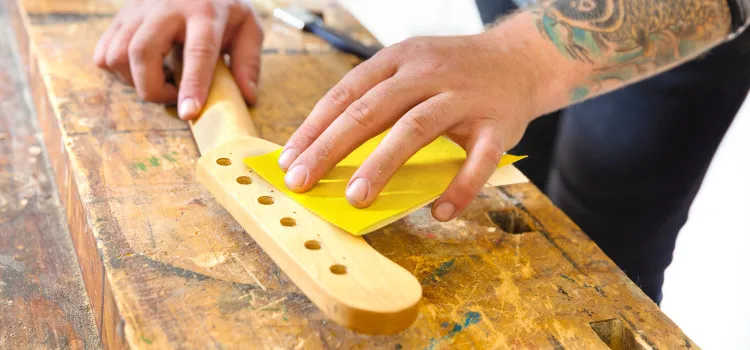
This will help raise the grain of the wood. 4. Lightly sand the neck with 220 and then 320 grit sandpaper. 5. Using a rag, apply a very thin coat on the neck. 6. Let it dry for a few minutes and then wipe it down with a dry cloth and steel wool. 7. Wait 24 hours and then add a second coat. 8. After another 24 hours, add the last coat.
Three light coats should be enough.
Should You Sand Between Coats Of Tung Oil?
I prefer to just buff the neck with a dry cloth after each coat. If you prefer a shinier neck, then I’d suggest sanding between coats.
I find that a tung oiled neck will be shiny enough without having to sand down in between coats.
You do have to be careful not to over-apply the tung oil. If you put too much on, it’ll start getting sticky, so err on the side of putting less oil on.
You can always add more if need be, but you can’t take it off once too much has been applied.
How Long Should Tung Oil Dry Between Coats?
My opinion is 24 hours. However, check your tung oil’s directions.
Some products suggest it should be dry to the touch in an hour while others say 24 hours. I’ve found that many products differ in their instructions.
When in doubt, give each coat the full 24 hours. Waiting longer between coats never hurts the finish, but rushing it can leave the next coat tacky and uneven.
How Long Does Tung Oil Take To Cure On A Guitar Neck?
Tung oil will usually take around 3 days to fully cure on a guitar neck. You can get your guitar back to normal use gradually after each day.
After the first day, you can play the guitar without any worries of damaging your new guitar neck finish.
Keep in mind that drying to the touch and fully curing aren’t the same thing. The surface keeps hardening for a couple of days after it feels dry, so go easy on it during that window.
How Long Does A Tung Oil Finish Last?
If it’s been applied properly, the tung oil finish should last many years. I’ve had tung oil finishes last me for 20 years before needing to be re-applied.
Also - How long do guitar necks last? - How many coats of Tru Oil on guitar body?
Frequently Asked Questions
Does tung oil darken wood?
Yes, tung oil will darken wood slightly, almost giving it a slight amber hue. The change is subtle and tends to bring out the natural grain rather than masking it.
If you want to preview the effect, dab a little tung oil on an offcut or a hidden spot first. That way you’ll know exactly how much the color will deepen before you commit to the whole neck.
Can you put too much tung oil on a guitar neck?
Yes. If you apply too much, the finish will start to feel sticky and take much longer to dry.
Tung oil is meant to go on in very thin coats that you wipe back, not flooded onto the surface.
If a coat does come out too heavy, wipe the neck down with a dry cloth and steel wool to remove the excess, then let it dry before adding the next thin coat.
Can you use tung oil on a maple fretboard?
Tung oil is most commonly used on the back of the neck, but a pure tung oil can be wiped onto an unfinished maple fretboard as well. Apply it in thin coats, wipe back any excess, and let each coat dry.
Avoid getting oil on the frets themselves, and keep the coats light so the board doesn’t stay tacky. As always, check the directions for your specific product first.
Is tung oil better than gloss for a guitar neck?
It comes down to feel. Many players, myself included, prefer tung oil because the neck feels smoother and faster than a sticky gloss finish.
A gloss neck is more reflective but can drag against your hand.
If you value a natural look and an easy glide along the neck, tung oil is hard to beat. If you specifically want a high-shine, sealed surface, a gloss finish may suit you better.
Final Thoughts
I personally think that when it comes to guitar necks, you should keep it simple. If you just want a nice-looking natural finish that feels good when you play, then tung oil is the way to go.
Sand and clean the neck first, apply at least 3 thin coats, and give each one enough time to dry before the next. Avoid over-applying, since too much oil only makes the surface sticky and slow to cure.
Personally, I don’t like gloss necks very much, so I use tung oil on my guitars to give them the natural finish I like. Take your time with the coats and you’ll end up with a smooth, fast-playing neck that lasts for years.