 guide
guide Multiscale Fanned Fret Guitars: A Detailed Guide for Curious Players
Multiscale fanned fret guitars angle each fret to give every string its own scale length, improving intonation and feel. Here's how they work and who they're for.
Reviews, comparisons, and guides for every electric player, from first guitar to gigging rig.

We may earn a small commission through links on this page, at no extra cost to you. As an Amazon Associate, we earn from qualifying purchases. Ratings reflect our own editorial evaluation.
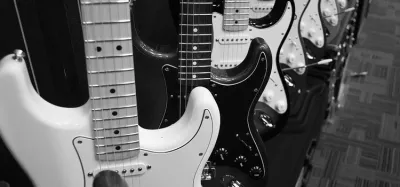
Electric guitars divide into three primary construction categories: solid body, semi-hollow body, and hollow body. Solid body guitars handle everything from blues to metal with zero feedback concerns, semi-hollow designs add warmth and resonance, and hollow body models deliver the richest acoustic-like clean tones.
Choosing the right electric guitar shape and construction type matters more than almost any other buying decision. Body style determines tone, playability, weight, and which genres the instrument handles best.
Dozens of variations exist under each construction type, from classic designs that haven't changed in 70 years to modern extended-range instruments built for progressive metal and djent. This guide covers every major electric guitar type and helps you match a category to your goals.
If you just want the shortlist, these three came out on top of our hands-on ranking.
| # | Product | Our Rating | ||
|---|---|---|---|---|
| 1 |  | PRS S2 Custom 24 | ★★★★★ | Check Price |
| 2 |  | Fender Player Stratocaster | ★★★★★ | Check Price |
| 3 |  | ESP LTD Eclipse EC-256FM | ★★★★☆ | Check Price |
See how all ten stack up in our full guide to the best electric guitars.
Put simply, how a guitar's body is built (solid, semi-hollow, or hollow) shapes its tone and feedback behavior more than any other single feature.
Body construction is the broadest way to categorize any electric guitar. It controls natural resonance, feedback response, and how sustain behaves at different volume levels.
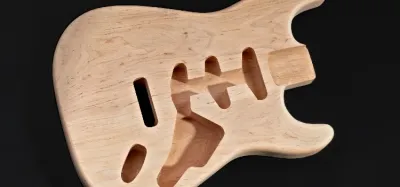
Solid body guitars are built from a single piece of wood or laminated wood with no internal chambers or sound holes. That dense build eliminates acoustic feedback, which is why they're the standard for high-gain and heavily amplified playing.
Fender introduced the first commercially successful solid body with the Telecaster in 1950, followed by the Stratocaster in 1954. Gibson answered with the Les Paul in 1952, and these three designs still define the category seven decades later.
Sustain is a major advantage of solid body construction. Because the body doesn't absorb string vibration into an air cavity, notes ring longer and more evenly across the frequency spectrum.
Common body woods include alder, ash, basswood, and mahogany. Each wood contributes subtle tonal differences, though pickups and amplifiers shape the final sound more than any single material choice.
Semi-hollow body guitars feature a solid center block running through an otherwise hollow body shell. The block cuts feedback while keeping some of the open, airy resonance you'd hear from a fully hollow guitar.
Gibson's ES-335, released in 1958 under president Ted McCarty, defined what a semi-hollow should sound like, and it's still the benchmark. Epiphone, Ibanez, and PRS all produce modern semi-hollow models based on similar construction principles.
The tonal sweet spot sits between solid body punch and hollow body warmth. You get enough clean headroom for jazz voicings and enough feedback resistance for blues overdrive without uncontrollable squeal.
Semi-hollow guitars tend to weigh less than solid bodies and resonate more freely against the player's chest. B.B.
King's Lucille, a modified ES-355, demonstrated that semi-hollow guitars could hold their own in electric blues at any volume level.
Hollow body electric guitars have a completely empty internal chamber with no center block, producing the most acoustic-like resonance of any electric design. Their warm, rounded tone with pronounced midrange is exactly why jazz players worldwide reach for them.
Gibson's L-5 CES and ES-175 set the standard for jazz archtops. Gretsch and Rickenbacker hollow bodies carved out separate lanes in rockabilly, country, and jangle pop with brighter, twangier voicing, while Epiphone's Casino gained fame through The Beatles.
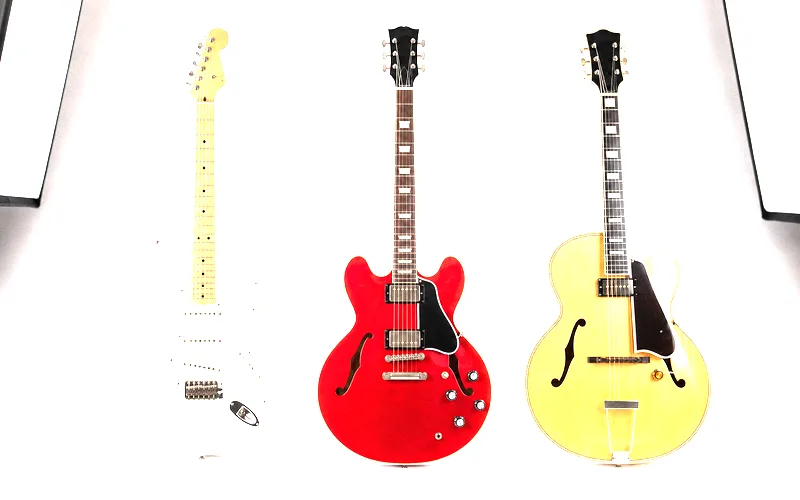
High-gain distortion is impractical on most hollow bodies because the open cavity amplifies feedback rapidly. Keep gain levels moderate, and these guitars reward you with a tonal depth that no solid body can replicate.
Construction type defines the internal build, but shape determines everything else: weight distribution, upper fret access, playing position, and visual identity. The majority of electric guitar shapes trace back to a handful of designs from the 1950s and 1960s.
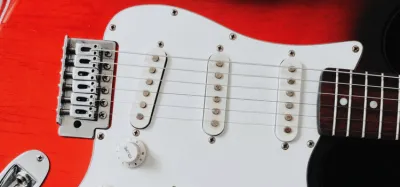
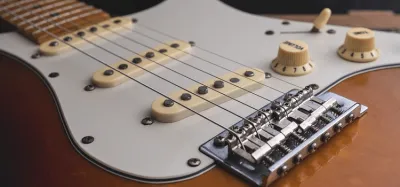
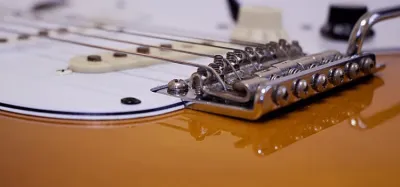
Leo Fender designed the Stratocaster in 1954 as an evolution of his own Telecaster, adding contoured body edges, a third pickup, and a synchronized tremolo bridge. The double-cutaway silhouette offers comfortable upper-fret access and fits naturally against the body whether sitting or standing.
Three single-coil pickups wired through a five-way selector switch produce a wide range of tones, from glassy cleans to singing leads. Positions two and four blend adjacent pickups for those distinctive in-between quack tones that define funk and R&B rhythm work.
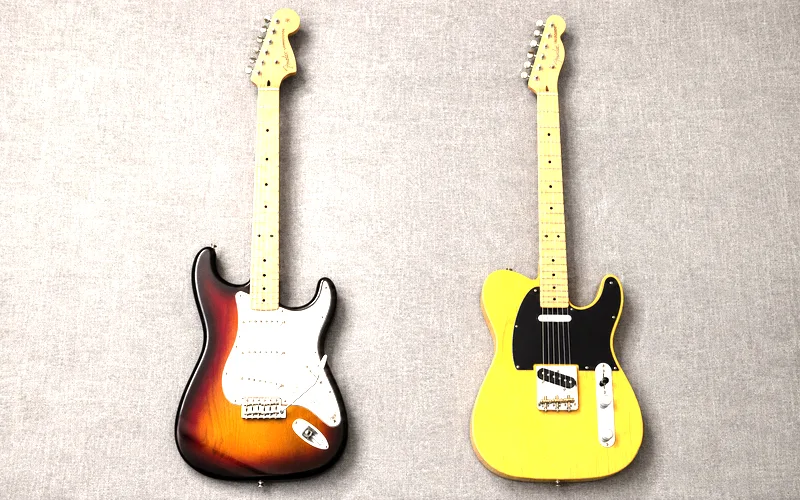
Jimi Hendrix, Stevie Ray Vaughan, David Gilmour, and John Mayer each found their signature tone through a Strat. Modern variants swap the bridge single coil for a humbucker in HSS configurations, broadening the guitar's range into heavier territory.
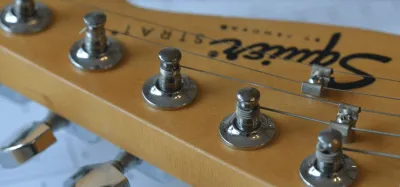
Fender builds Strat bodies from alder or ash with bolt-on maple necks. Squier makes budget-friendly versions using the same core design.
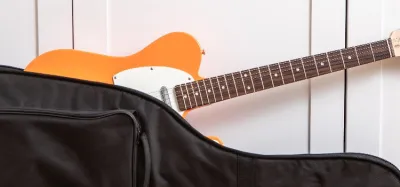
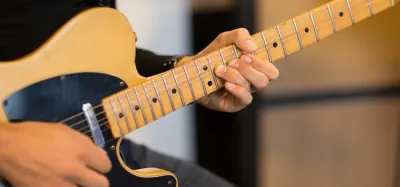
The Telecaster predates every other solid body electric guitar still in production. Leo Fender released it in 1950 as the Broadcaster before a trademark dispute forced the name change.
Its simple slab body, single cutaway, and two single-coil pickups make it one of the most straightforward electric guitar designs ever built. The bridge pickup delivers a sharp, bright twang that became the signature sound of country music.
Keith Richards, Bruce Springsteen, Joe Strummer, and Jonny Greenwood represent just a fraction of the Telecaster's roster across rock, punk, indie, and Americana. The guitar's rugged simplicity means fewer components and fewer points of failure.
Most Telecasters feature an alder or ash body with a bolt-on maple neck and a fixed bridge with through-body string routing for added sustain.
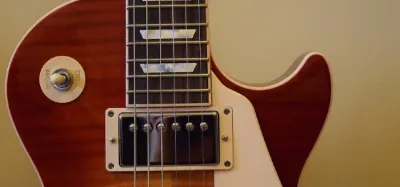
Gibson brought the Les Paul to market in 1952 as a collaboration between company president Ted McCarty and guitarist Les Paul. Its carved maple top bonded to a mahogany body produces a dense, warm tone with exceptional sustain.
The maple cap adds brightness and snap to the fundamentally warm mahogany foundation, creating a tonal balance that sits naturally in a band mix without additional EQ. Two humbucker pickups, originally the PAF units designed by Seth Lover in 1955, push a thick midrange with reduced high-frequency noise compared to single coils.
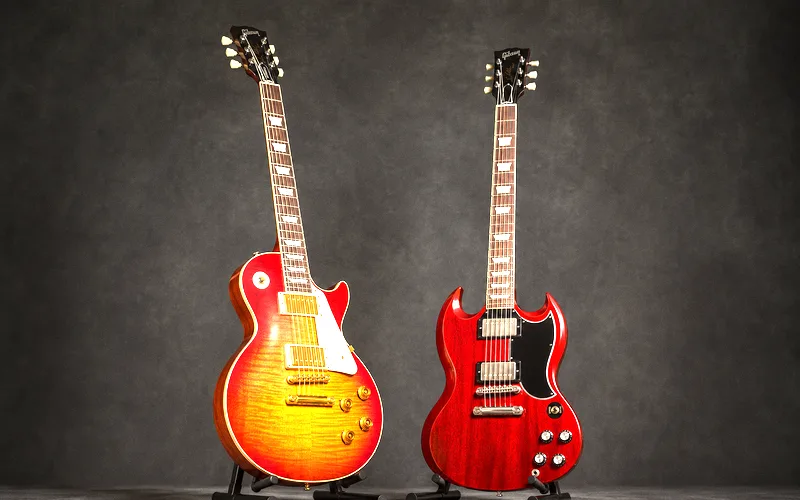
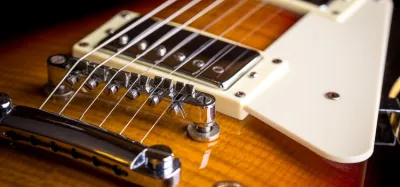
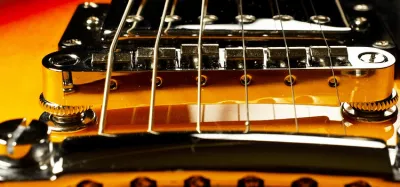
A tune-o-matic bridge paired with a stopbar tailpiece gives precise intonation adjustment. Weight can run between 8 and 11 pounds depending on the specific model and year, making chambered versions popular with touring musicians.
Jimmy Page, Slash, Duane Allman, and Peter Green all carved their sound with a Les Paul. Epiphone produces affordable alternatives that follow Gibson's blueprint at a fraction of the price.
The SG arrived in 1961 as Gibson's redesign of the Les Paul. It featured a thinner, lighter mahogany body with sharp double-cutaway horns.
Les Paul himself disliked the new design, and Gibson eventually dropped his name from it.
The thinner profile shifts the tonal balance slightly toward the treble side compared to a Les Paul while keeping the same humbucker pickup platform. Upper fret access reaches the 22nd fret without the heel obstruction found on Les Paul models.
Angus Young, Tony Iommi, and Derek Trucks turned the SG into a cornerstone of hard rock, heavy metal, and slide blues. Its lighter weight and aggressive styling continue to attract players who want Gibson tone without Gibson heft.
The Jazzmaster landed in 1958 and the Jaguar followed in 1962, both featuring Fender's offset waist contours that shifted the guitar's balance point for seated playing comfort. The Mustang followed in 1964 as a shorter-scale student model that later found a loyal following among alternative and grunge players.
Despite their intended jazz and surf markets, offset guitars found a permanent home in alternative rock, shoegaze, and indie music during the 1980s and 1990s. Kurt Cobain, Kevin Shields, J Mascis, and Thurston Moore picked up these once-ignored guitars and built entire sonic identities around them.
Jazzmaster pickups are wider and flatter than standard single coils, producing a darker, more complex tone with pronounced midrange warmth. Jaguar pickups are brighter and more focused, and both models feature unique rhythm circuits separate from the lead controls.
Modern reissues from Fender, Squier, and boutique builders have made offsets more accessible and more popular than at any point in their history.
The Flying V and Explorer hit the market in 1958 as Gibson's most radical design experiments. Ted McCarty oversaw both projects, aiming to push Gibson's image beyond traditional curves, but both models flopped commercially at launch.
Metal and hard rock players rediscovered them in the 1970s. The V's wide stance and angular body suited aggressive stage performance, while the Explorer's offset mass balanced naturally on a strap.
Michael Schenker, Dave Mustaine, and Randy Rhoads popularized the Flying V. James Hetfield and The Edge brought the Explorer into mainstream visibility, and modern versions from ESP, Jackson, and Dean extend both designs into extreme metal territory.
The Super Strat evolved in the early 1980s when guitarists began modifying Stratocaster bodies for heavier playing styles. Eddie Van Halen's Frankenstrat, a Strat body fitted with a single humbucker and a Floyd Rose tremolo, started the movement.
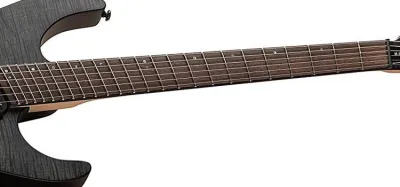
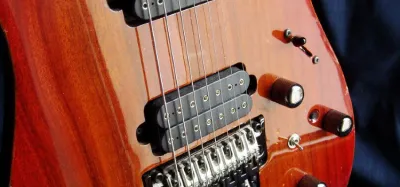
Modern Super Strats typically feature HSH or HSS pickup configurations, 24-fret fingerboards, thin fast necks, and locking tremolo systems. Ibanez's RG series, Jackson's Soloist and Dinky, Charvel, and Schecter all built their reputations on this format.
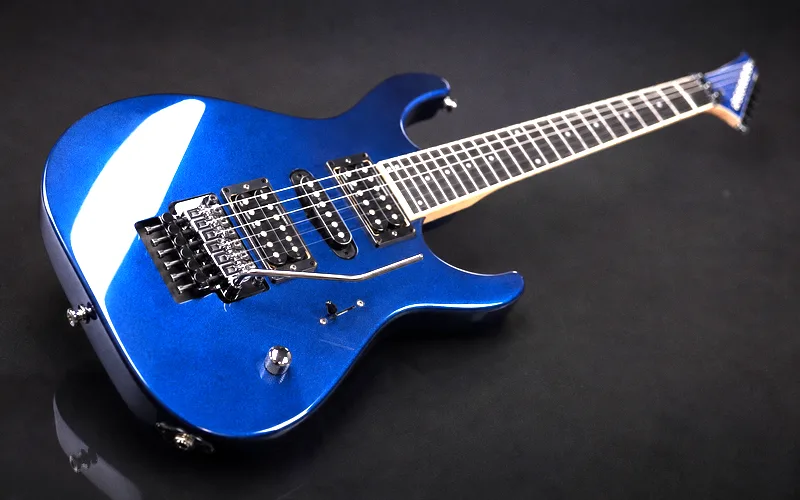
Steve Vai, Joe Satriani, and Kirk Hammett demonstrated what the design could do across shred, progressive, and thrash metal. The extended fret range and high-output pickups handle fast legato runs and dive bombs that traditional Strats cannot accommodate.
If you play metal, progressive rock, or fusion and need a wide tonal range with technical performance features, the Super Strat was designed for exactly that.
Standard electric guitars use six strings tuned E-A-D-G-B-E. Extended range instruments add strings below or above that standard tuning, opening access to lower registers and wider chord voicings that six strings cannot reach.
These guitars were once reserved for experimenters, but they've crossed into the mainstream across metal, progressive rock, djent, and ambient music. Pickup technology and multiscale construction have made them far more playable and refined than early models from the 1990s.
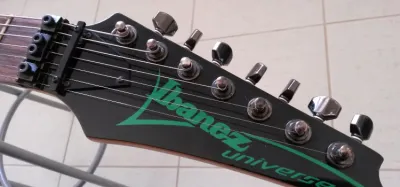
Seven-string guitars add a low B string below the standard sixth string, extending downward range by a perfect fourth. Ibanez popularized the format in the early 1990s with the Universe series, built for Steve Vai.
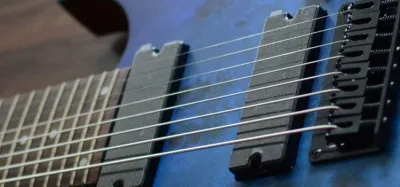
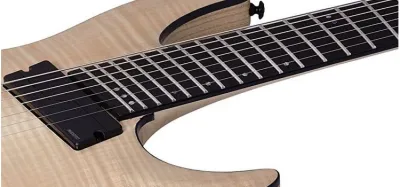
Modern 7-string models appear in the catalogs of nearly every major manufacturer. Scale lengths typically stretch to 25.5 or 26.5 inches to maintain string tension on that low B, and multiscale designs fan the frets to give bass strings even more tension while keeping treble strings comfortable.
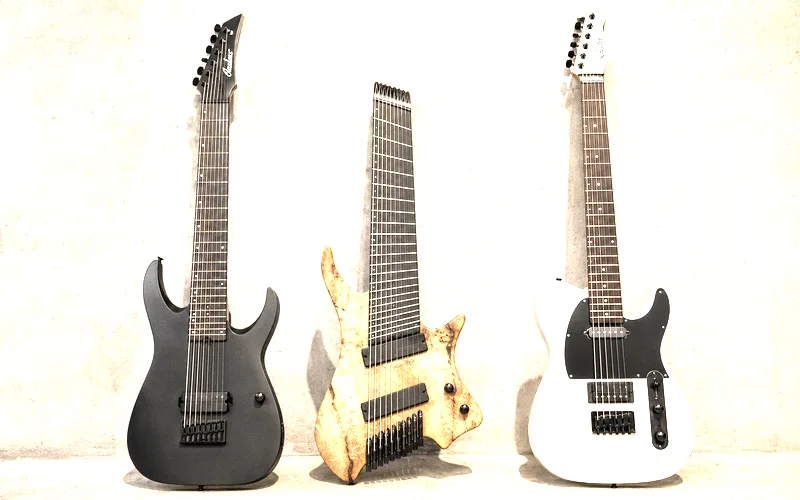
Korn, Meshuggah, and Dream Theater drove initial adoption in the 1990s and 2000s. Today you'll find 7-strings in any genre where that extra low end opens up writing possibilities beyond standard voicings.
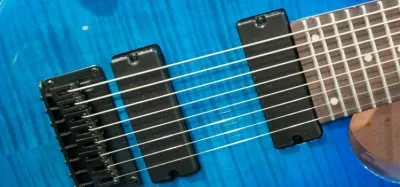
Eight-string guitars drop the range further with a low F# string, a full octave below a standard guitar's second string. Ibanez, Schecter, and ESP offer production 8-string models, while Strandberg pioneered ergonomic headless 8-string designs.
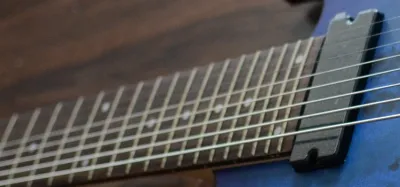
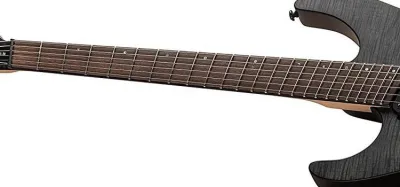
Multiscale construction, where each string gets its own optimized scale length through fanned frets, has become nearly standard at eight strings. Longer bass-side scale lengths maintain clarity and tension on the lowest strings while shorter treble-side lengths keep lead playing comfortable.
Finding the right string gauge requires more experimentation than on a standard 6-string.
Baritone electric guitars use a longer scale length, typically 27 to 30 inches, and tune lower than standard guitars without the added strings of a 7 or 8-string. Common tunings include B-to-B and A-to-A, a fourth and a fifth below standard respectively.
The extended scale keeps string tension firm at low tunings, producing a tight, defined bass response that gets muddy on standard-length instruments. Danelectro, Fender, PRS, and ESP all produce baritone models for genres ranging from doom metal to ambient post-rock.
The wider neck and extra strings do require adjustment, especially for fretting hand stretches. Most players adapt within a few weeks of consistent practice, and ergonomic features like multiscale frets and thinner neck profiles on modern models shorten that learning curve significantly.
The three main electric guitar pickup types are single coil, humbucker, and P-90. Each one produces a distinctly different tone.
Pickups turn string vibration into an electrical signal, and they shape your guitar's raw tonal character more than most players realize.
| Pickup Type | Tone Character | Output Level | Best Genres | Notable Examples |
|---|---|---|---|---|
| Single Coil | Bright, clear, articulate | Low to medium | Blues, country, funk, pop | Fender Strat and Tele pickups |
| Humbucker | Warm, thick, sustained | Medium to high | Rock, metal, jazz | Gibson PAF, Seymour Duncan JB, DiMarzio Super Distortion |
| P-90 | Gritty, midrange-forward, raw | Medium | Blues rock, punk, indie, garage | Gibson P-90, Lollar P-90 |
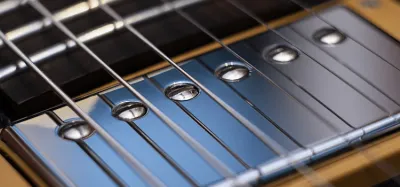
Single coil pickups use one magnet wrapped in copper wire. Their bright, glassy voice cuts through a mix with clarity, but they pick up electromagnetic interference that produces a 60-cycle hum.
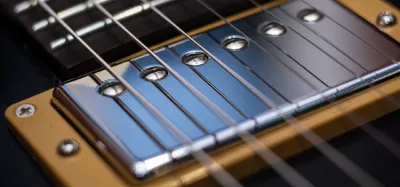
Humbuckers use two coils wired in opposite polarity to cancel that hum, which is where the name comes from. Seth Lover designed the original PAF humbucker for Gibson in 1955, and that dual-coil architecture produces a warmer, fuller tone with stronger output that drives amplifiers harder.
P-90 pickups sit between single coils and humbuckers in both physical size and output level. They deliver a raw, gritty midrange that single coils can't match, with more bite and aggression than most humbuckers.
Active pickups, powered by a 9-volt battery, deliver higher output with a tighter, more controlled frequency response. EMG and Fishman Fluence dominate the active pickup space for metal and progressive rock.
Many modern guitars offer coil-splitting wiring that lets a humbucker operate as a single coil, expanding tonal range from one instrument. Bridge hardware also influences sustain and resonance, working alongside pickups to shape the final output.
Yes, in most cases pickups have a larger measurable impact on an electric guitar's amplified tone than wood species does. Swapping a single coil for a humbucker changes your sound far more dramatically than swapping an alder body for mahogany.
Every electric guitar type has a sweet spot, and genres where it just doesn't shine. The table below maps common genres to the guitar construction, shape, and pickup combination that performs best in each context.
| Genre | Best Guitar Type | Pickup Style | Why It Works |
|---|---|---|---|
| Blues | Stratocaster, Les Paul | Single coil or humbucker | Expressive bends, singing sustain, dynamic response |
| Country | Telecaster | Single coil | Bright twang, clean note definition, snappy attack |
| Jazz | Hollow body, semi-hollow | Humbucker | Warm clean tones, rich chord voicing, smooth highs |
| Metal | Super Strat, 7/8-string | High-output humbucker | Tight palm mutes, fast tracking, aggressive crunch |
| Indie and Alternative | Offset, Telecaster | Single coil or P-90 | Jangly cleans, textured overdrive, sonic layering |
| Hard Rock | Les Paul, SG | Humbucker | Thick sustain, powerful rhythm crunch, lead presence |
| Funk | Stratocaster | Single coil | Percussive cleans, quacky in-between positions, tight rhythms |
| Progressive | Super Strat, 7-string | HSH configuration | Wide tonal range, extended frets, fast neck profile |
These pairings reflect decades of genre tradition, but no rule says you can't play jazz on a Telecaster or metal on a hollow body. The table represents where each type sits in its comfort zone.
Here's what matters most: neck feel, body weight, budget, and pickup layout.
Picking a guitar type comes down to more than just tone and genre. Your physical comfort, budget, and playing goals all influence which construction and shape will serve you longest.
Neck profile and scale length determine how a guitar feels in your hands more than any other spec. Players with smaller hands often prefer shorter scale lengths like Gibson's 24.75-inch standard, while longer Fender 25.5-inch scales provide tighter string tension and brighter tone.
Weight and balance matter for long practice sessions and live performance. Solid body guitars like the Les Paul can weigh over 10 pounds, while SGs, Strats, and offset models typically run lighter and balance better on a strap.
Budget range varies dramatically by guitar type. Squier and Epiphone offer entry-level versions of Stratocasters and Les Pauls under $300, while mid-range instruments from PRS SE, Ibanez, and Schecter run between $400 and $800.
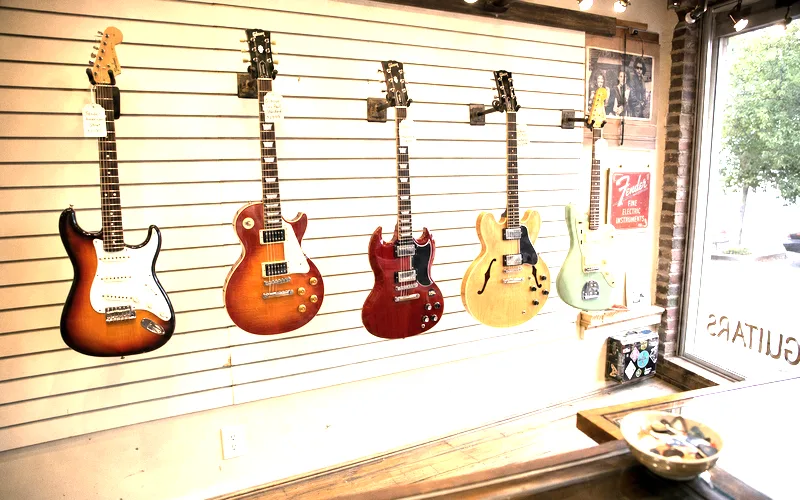
American-made Fenders and Gibson USA models start around $1,200 and climb quickly into the $2,000-plus range for premium finishes and hardware.
Pickup configuration locks in your tonal starting point. A guitar with two humbuckers sounds fundamentally different from one with three single coils, and swapping pickups later costs $100 to $300 in parts and labor.
Versatility versus specialization is the real tradeoff every buyer faces. An HSS Stratocaster or a semi-hollow with coil splitting covers the most tonal ground from one instrument.
A Flying V with active humbuckers excels at one thing and does it better than any do-everything guitar can.
The three main construction types are solid body, semi-hollow body, and hollow body. Within those categories, the most common shapes include the Stratocaster, Telecaster, Les Paul, SG, offset designs, Super Strat, and hollow body archtops.
Extended range models like 7-string and 8-string guitars form their own growing subcategory.
A solid body guitar with a comfortable neck profile and moderate weight gives beginners the easiest starting point. The Stratocaster and SG are popular first choices because they balance playability with tonal versatility.
Squier and Epiphone versions bring those same designs under $300.
Technically yes, but each guitar type has strengths and limitations that favor certain genres. You can play clean jazz licks on a Super Strat, but a semi-hollow body handles them with less effort and better natural tone.
Matching your guitar to your primary genre eliminates fighting against the instrument's natural tendencies.
A solid body guitar has no internal air cavity, producing tight sustain with zero acoustic resonance and no feedback issues at high gain. A semi-hollow guitar has a hollow body with a solid center block that allows controlled resonance while still resisting feedback better than a fully hollow instrument.
Semi-hollow models sound warmer and more open on clean settings, while solid bodies offer tighter, more focused distortion tones.
Electric guitars cover a huge range of construction types, body shapes, and tonal possibilities. Solid body instruments handle the widest spread of genres and playing styles with the fewest compromises, while semi-hollow and hollow body guitars trade some versatility for richer clean tones and greater acoustic character.
Start with the genre you play most, identify which construction and pickup type serves that genre best, and narrow from there. The right electric guitar type makes learning easier, playing more enjoyable, and your tone genuinely your own.
guide Multiscale fanned fret guitars angle each fret to give every string its own scale length, improving intonation and feel. Here's how they work and who they're for.
 guide
guide Suhr guitars cost more because each one is hand-built in California with premium woods, custom parts, and meticulous craftsmanship meant to last generations.
 roundup
 We tested 9 acoustic-electric guitars under $300, rated on tone, build quality, and onboard electronics. Find the best plug-in guitar for your budget.
 roundup
 10 Stratocaster pickup sets rated on tone, output, magnet type, and noise. Find the right single-coils to upgrade your Strat, from vintage Alnico to noiseless.
 roundup
 Six of the best 8-string guitar pickups rated on output, clarity, and low-end tightness. Find the right active or passive set for extended-range metal and djent.
 comparison
 Humbucker vs single coil pickups compared on sound, noise, history, and the guitars and players that use each so you can pick the right one.
 comparison
 22 vs 24 frets: do the added notes matter for your music? We weigh the real trade-offs in feel and sound so you know exactly which neck to buy.
 roundup
 9 affordable super strat guitars ranked for shred and metal by pickups, bridge, neck speed, and fret access. Find a budget HSS or dual-humbucker shredder that plays fast.
 listicle
 Open chords sounding bad on your electric guitar? Nine fixable culprits cover almost every case. Learn what to check first and how to clean up your tone.
 guide
guide Adding a whammy bar to your guitar is doable more often than you'd think. We break down Bigsby, Strat, and Floyd Rose installs so you know before you drill.
 guide
guide What's a neck-thru-body guitar? See how this premium construction works, the playing benefits it unlocks, and the drawbacks that come with the design.
 roundup
 Nine acoustic-electric guitars ranked by tone, build quality, onboard electronics, and value. Find the right plug-in acoustic for stage, studio, or home practice.