Those slanted frets catch your eye on a spec page, then leave you wondering if they’re worth the hassle. That’s the real question behind fanned fret, or multiscale, guitars.
The angled frets aren’t just for looks. They change how the strings feel and how tightly the low ones track, which is why downtuners keep gravitating to them.
Of course, the design asks something back. It costs more than a standard guitar, and your hands need a little time to settle in.
We’ll lay out the honest upsides and downsides so you can decide if one belongs in your case. First, a plain look at what a fanned fret guitar actually is.
What Is a Fanned Fret Guitar?
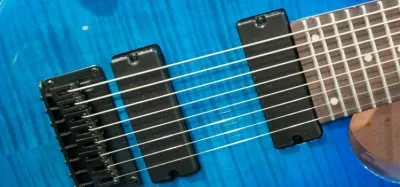
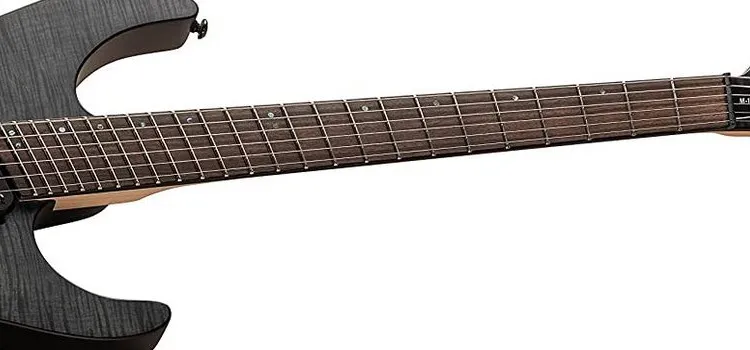
A fanned fret guitar, also called a multiscale guitar, uses a different scale length for each string instead of a single uniform scale. The frets fan out at an angle rather than sitting perpendicular to the strings, which is where the name comes from.
The idea is simple: lower strings get a longer scale length for tighter tension and clearer low notes, while higher strings get a shorter scale length so they stay comfortable to bend and fret. This design is common on extended-range instruments, but you’ll also find it on standard six-strings.
Pros of Fanned Fret Guitars
One of the main advantages is that string tension is more even across all the strings, and that balanced tension keeps tuning more stable. This is a big benefit, especially during live performances.
I’ve seen many guitars detune in the middle of a song, and it isn’t just the string that was played, it’s the whole guitar drifting. Fanned fret guitars are great for electric players who use a whammy bar, because there’s less pressure on each string when you dive or pull up high notes.
When playing lead and fingerstyle, I feel a big difference because the intonation is much easier to dial in. The string spacing allows for very precise tuning, so when you know what notes you want, you can find them among the strings quickly without overstraining your hand or wrist.
Another advantage shows up when you’re downtuning. Because the lower strings sit at a longer scale length, you can use lighter gauge strings and still get a tight, defined low end.
It’s much easier to play, and you don’t need as heavy a string to produce the same volume and clarity.
Cons of Multiscale Guitars
The main con is cost. Fanned fret guitars tend to be more expensive than regular guitars, and most people won’t notice a dramatic difference in the quality of sound between a fanned fret guitar and a non-fanned one.
Some players say they have a better tone, but I haven’t consistently heard enough of a difference to call that a fact.
If you’re shopping for the best multiscale guitar, the price can climb even higher. Multiscale instruments are costly because the angled-fret design is harder to manufacture and the market for them is relatively small.
The other disadvantage is the learning curve. If you move to a fanned fret guitar with little playing experience, it’ll take longer to find your way around the neck.
You’ve to adjust to the angled frets, and switching strings can feel confusing at first, especially if you’re also jumping from a six-string to a seven-string.
Who Should Buy a Fanned Fret Guitar?
Multiscale guitars make the most sense for players who downtune often, use extended-range instruments, or care a lot about even tension and clean intonation. Lead and fingerstyle players tend to appreciate the precise string spacing the most.
If you mostly play in standard tuning on a six-string and you’re happy with how your current guitar feels, a fanned fret model may not change your life. The smartest move is to try one in person before committing, because the angled frets are something you either click with quickly or need time to get used to.
Frequently Asked Questions
Are fanned fret guitars harder to play?
They aren’t harder to play in general, but they do feel different at first. The angled frets near the middle of the neck line up almost like a standard guitar, so chords and scales there feel natural fairly quickly.
The bigger adjustment is at the very low and very high frets, where the angle is most pronounced. Most players adapt within a few practice sessions.
Do fanned fret guitars stay in tune better?
They tend to hold tuning well because the string tension is more balanced from string to string. That even tension reduces the kind of whole-guitar drift you sometimes get when one string pulls the others slightly out.
Tuning stability still depends on quality tuners, a good nut, and fresh strings, but the multiscale design gives you a helpful head start, especially when bending or using a whammy bar.
Are multiscale guitars only for metal?
No. Multiscale guitars are popular in metal because the longer bass-string scale tightens up low tunings, but the design benefits any style.
Jazz, fingerstyle, and progressive players use them for the improved intonation and balanced feel.
The fanned fret concept simply optimizes each string’s scale length, and that’s useful regardless of genre.
Are fanned fret guitars worth the extra money?
For players who downtune, play extended-range guitars, or want the cleanest possible intonation, the extra cost is usually worth it. The improved tension and tuning stability solve real problems those players run into.
For a casual player in standard tuning, a quality standard-scale guitar may serve just as well for less money. It comes down to your playing style and how much the specific benefits matter to you.
Final Thoughts
For most players shopping for a high-quality instrument, the pros of a fanned fret guitar outweigh the cons. The even string tension, more stable tuning, and tighter low end are genuine benefits, and the higher price and short learning curve are the trade-offs you accept to get them.
I’ve enjoyed my fanned fret guitars for many years and wouldn’t want to be without them. That said, some players simply don’t like the feel, so it’s important to try one in person before you buy.
You’ll usually know right away whether a multiscale guitar is right for you.