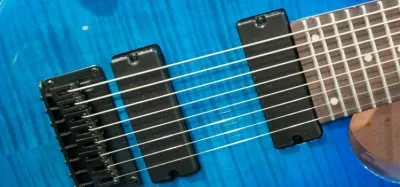
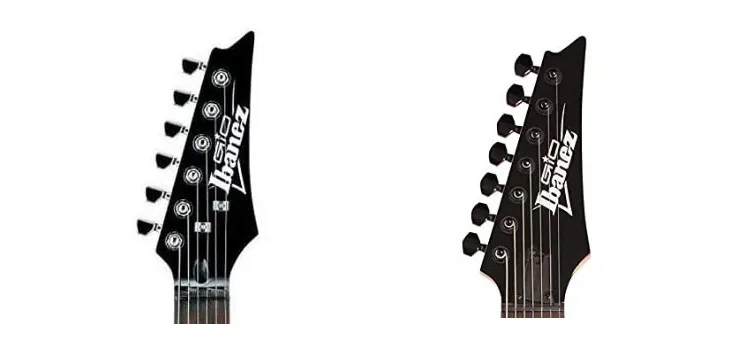
You can spot the extra string from across the room, but is that the only thing separating a seven from a six? Not quite, though the two are more alike than they look.
The seventh string drops your low range further, which suits heavier and more technical music. It also makes the neck wider, so your fretting hand has more ground to cover.
So the real question is about your style and your comfort. The songs you reach for matter as much as the spec sheet.
This article compares the two across range, neck width, and feel. Let’s start with the 6 string.
Quick Comparison
| Category | 6 String | 7 String | Winner |
|---|---|---|---|
| Range | Standard EADGBE | Adds a low B beneath | 7 String |
| Learning resources | Nearly all charts and lessons | Less material written for it | 6 String |
| Neck feel | Around 42mm nut, familiar | Closer to 48mm, bigger handful | 6 String |
| Heavier genres | Needs downtuning tricks | Built for deep riffs | 7 String |
| Playing 6-string songs | Native territory | Works fine, ignore the low string | Tie |
| Versatility | Widest pool of music | Metal, prog, modern styles | 6 String |
| Overall | Simpler and suits most players | Everything a 6 does, plus low B | Depends |
The 6 String Guitar: What Is It?
The 6 string is the standard guitar that most players learn on. In standard tuning, its strings run E, A, D, G, B, and high E from lowest to highest, and it’s the layout almost every beginner method, chord chart, and tutorial is written for.
Because it’s the most common format, the 6 string has a huge selection of models across every price point and style. Most of the songs you’ve ever heard on guitar were written and recorded on a six-string, so it’s the natural starting point if you want the widest range of music to learn from.
The 7 String Guitar: What Is It?
A 7 string guitar is essentially a six-string with an additional low string added. The extra string sits below the standard low E, and it’s most commonly tuned to a low B, giving you a deeper, heavier low end without changing how the other six strings work.
That extended range is why 7 strings are popular with metal and progressive players who want to reach lower notes for riffs while still keeping standard chord shapes higher up. While 7 strings are growing more popular, they still have a smaller selection of models than 6 strings do.
Is a 7 String Guitar Harder to Play?
It doesn’t take any more effort to play a six-string guitar than a seven-string one. Because it has an extended neck, the 7 can feel narrower string-to-string than you expect, and learning and playing a 7 string guitar is fundamentally just like learning and playing a 6 string.
A seven-string guitar may seem daunting if you’re new to playing an electric guitar. It might be difficult to reach your finger across the wider neck at first, or you could get lost among the extra strings.
However, this initial confusion soon passes once you start playing.
Width of 6 vs 7 String Necks
The most physical difference between the two is at the neck. The extra string means a 7 string needs a wider nut and fretboard to fit everything comfortably.
| Measurement | 6 String | 7 String |
|---|---|---|
| Nut width | ~42mm | ~48mm |
| Width at final fret | ~56mm | ~68mm |
These numbers vary by brand and model, but they show why a 7 string feels like a bigger handful at first, especially for players with smaller hands.
How 6 String and 7 String Guitars Compare
So we’ve looked at what each guitar is and how they feel. Here’s how they stack up head to head.
There isn’t much of a difference between a 6 string and a 7 string guitar in terms of core playing technique, since the standard six strings behave the same on both. The real gap is range: the 7 adds a low string, so it can do everything a 6 can plus reach deeper notes.
For repertoire, the 6 string wins on sheer variety because nearly any song can be learned on it, and most 6 string tunes can also be played on a 7 string. The catch goes the other way, though: you won’t be able to play any genuine 7 string songs on a 6 string, because that low string simply isn’t there.
If you can, try one out at a local music store to see which neck and sound you prefer before committing.
Should You Buy a 6 or 7 String?
The songs you want to play will determine whether you should buy a 6 or 7 string guitar. Purchase a guitar that’s compatible with the music you enjoy.
If you listen to a lot of music performed on 7 string guitars, you should consider buying one. If the majority of the music you listen to is played on a six-string, you might want to start learning on one.
You can always buy another instrument later, as practically any guitarist will tell you.
I recommend a 6 string to most beginners who are just getting started. The learning process is made easier by having one less string to worry about.
The only time I’d advise a total beginner to get a 7 string is if the majority of the music they listen to is played on a 7 string. If you mostly listen to 7 string music, it’ll be frustrating to own a 6 string and not be able to play any of it.
When I first started, I recall being irritated to discover that a song required a 7 string instrument, which I lacked.
Can You Play 6 String Riffs on a 7 String?
Of course you can play 6 string riffs on a 7 string. In fact, having the extra string nearby can actually help you improve your picking accuracy, since you learn to be more precise about which string you hit.
It’s still worth considering whether you truly need the extra range and scale length. The 6 string has far more model options, while 7 strings, though growing in popularity, come in a smaller selection.
Getting 7 String Tuning on a 6 String
If you want a 7 string sound but only own a 6, you can get close, though for best results you’ll want to take care of a few things. Put on larger gauge strings and tune them down to the desired tuning.
With significantly heavier strings, the instrument might need a few setup tweaks, but it’d undoubtedly sound the best that way.
In practice, you tune the guitar all the way down as if it were a seven string with a low B string, just without the high E string. You get the low-end depth, but you lose the highest notes that a true six-string layout normally gives you.
Frequently Asked Questions
What’s the extra string on a 7 string guitar?
The extra string is an added low string that sits below the standard low E. It’s most often tuned to a low B, which extends the guitar’s range downward for heavier, deeper riffs.
The other six strings stay in their familiar positions, so the additions only expand what the instrument can do rather than changing the basics.
Can a beginner start on a 7 string guitar?
A beginner can start on a 7 string, but most players are better off on a 6 string first. Having one less string to track makes the early learning curve simpler.
The main exception is if nearly all the music you want to play is written for 7 strings. In that case, starting on the instrument the songs were made for can keep you motivated.
Can you play 6 string songs on a 7 string?
Yes, most 6 string songs can be played on a 7 string with no problem, because the standard six strings are in the same place. You simply ignore the extra low string when it isn’t needed.
The reverse isn’t true: genuine 7 string songs that use the low string can’t be fully played on a 6 string.
Do 7 string guitars have a wider neck?
Yes, 7 string guitars have a wider nut and fretboard to make room for the extra string. A typical 6 string is around 42mm at the nut, while a 7 string is closer to 48mm.
That added width is the main reason a 7 string can feel unfamiliar at first, though most players adjust quickly.
Final Thoughts
The differences between a 7 string guitar and a 6 string really come down to range and feel. A 7 string gives you everything a 6 can do plus an extra low string for heavier, deeper riffs, while a 6 string keeps things simpler and opens the door to the widest possible library of songs.
For most beginners, a 6 string is the easier and more flexible place to start. If the music you love is built on that low seventh string, though, a 7 string will be far more satisfying from day one.
Either way, you can always add the other to your collection later, so pick the one that matches the music you most want to play.