Shopping for an 8 string means reckoning with a number most six string players ignore. The nut-to-bridge measurement decides how those big low strings feel under your fingers and how clearly they ring.
Match it to your tuning and the instrument snaps into focus. Miss it and you’ll fight a slack bottom string or a stretch that tires out your fretting hand.
Your style plays into it too. A player chugging drop tunings wants something different from someone trading clean chords for the odd low riff.
This guide walks through how each common scale length behaves and which one suits your playing. First, let’s look at the lengths you’ll actually run into while shopping.
What Scale Lengths Are Available for 8 String Guitars?
Most 8 string guitars are built in one of four scale lengths. Each one changes the string tension, feel, and low-end clarity of the instrument, so it helps to know what each option brings before you commit.
1. 25.5 Inches
This is the standard scale length used on most six string electric guitars, and a handful of 8 strings adopt it as well. It’s the most familiar and comfortable feel for players coming from a regular electric.
The trade-off is that the low strings can feel loose and floppy when tuned down, which can muddy your low notes. It works best if you keep the lowest strings tuned relatively high.
2. 27 Inches
A 27 inch scale is a popular middle ground for 8 string guitars. It adds enough tension to keep the low strings tight and articulate without feeling like a major stretch under the hand.
For many players this is the easiest extended scale to adapt to while still cleaning up the bottom end for lower tunings.
3. 28.5 Inches
At 28.5 inches you get noticeably more tension on the low strings, which improves clarity and definition for heavier, lower tunings. This length is a common choice for metal players who want their low F# or E to stay focused rather than flubby.
The reach is longer, so it takes some adjustment.
4. 30.2 Inches
This is a true extended scale, sometimes called a baritone-plus length, and it delivers the tightest low strings of the four. It’s favored by players who tune very low and need maximum string tension and articulation.
The longer neck and wider fret spacing demand the most adjustment, especially in the lower positions.
How to Choose the Right Scale Length
Picking a scale length comes down to three things: the instrument itself, the music you play, and your personal playing style. Weigh all three together rather than chasing one number.
The Instrument
This is partly a matter of preference. Many people want extended range guitars for metal, and those instruments are often built with a longer scale length by design.
If you’re buying an off-the-shelf 8 string, the scale may already be decided for you, so it’s worth checking the spec before you fall in love with a particular model.
The Music
This is the most important factor to consider when choosing a scale length. A longer scale length holds more tension and keeps lower notes tight and defined, which matters if you play death metal, power metal, or anything in heavily downtuned territory.
Scale length and string tension play big roles in how the guitar performs.
If you want to be a rhythm player laying down chunky riffs, a shorter scale length can feel more comfortable and forgiving. If you want the ability to play lead cleanly across the whole range, a longer scale length holds up better.
Think carefully about what kind of music you’re playing when choosing a scale length for your 8 string guitar.
The Playing Style
Your playing style matters just as much. Someone who uses tremolo picking often may prefer a shorter scale and slightly looser response, and these players tend to lean on tight one-finger patterns.
The reduced reach can make rapid picking runs feel more controlled.
On the other hand, a player who relies heavily on hammer-ons, pull-offs, and chord work may want a longer scale length. The extra tension gives chords and legato lines more clarity and range, so the lower strings stay distinct instead of blurring together.
Making the Final Decision
In general, the longer the scale length, the higher the string tension at a given pitch, which keeps low notes articulate but increases the reach across the neck. A shorter scale feels easier to play but can leave the lowest strings slack when you tune down.
Neither is objectively better. It’s about matching the instrument to the sound and feel you want.
This is ultimately a personal preference. Some players like a looser, mellower response from their strings, while others want a dense, tight low end the moment they dig in.
Try to play instruments in different scale lengths if you can before you buy.
To go deeper on how the extended range is laid out and tuned, learn more about 8 string guitar theory and the standard and alternative tuning for 8 string guitars. So keep your own preferences front and center when deciding which scale length suits you best for your 8 string guitar.
Frequently Asked Questions
What’s the most common scale length for an 8 string guitar?
The 27 inch and 28.5 inch scales are the most common on production 8 string guitars. They strike a balance between tight low strings and a neck reach that most players can adapt to fairly quickly.
A 25.5 inch scale shows up occasionally, while 30.2 inches is reserved for players who tune especially low.
Does a longer scale length make an 8 string harder to play?
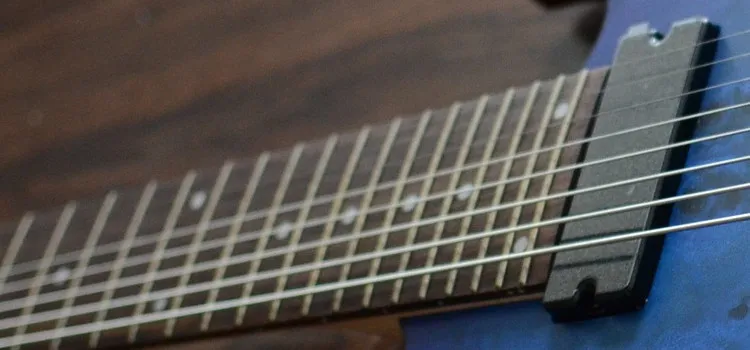
A longer scale spaces the frets farther apart, which means longer stretches in the lower positions and a bit more reach overall. Most players adjust within a few sessions, especially on a 27 or 28.5 inch neck.
The payoff is tighter, clearer low strings, which is usually worth the short adjustment period for anyone tuning low.
Do I need a multi-scale (fanned fret) 8 string guitar?
You don’t need one, but a multi-scale design can give you the best of both worlds. The lower strings get a longer scale for tension and clarity, while the higher strings keep a shorter, more comfortable scale.
If you find single-scale instruments either too floppy on the low end or too long under the fingers, a fanned fret 8 string is worth trying.
What scale length is best for a low F# string?
For a standard low F#, a 27 inch scale is the practical minimum to keep that string from feeling loose, and many players prefer 28.5 inches for extra definition. The right gauge string matters just as much as the scale.
If you tune below F#, lean toward 28.5 or 30.2 inches so the lowest string stays tight and articulate.
Final Thoughts
There’s no universal best scale length for an 8 string guitar. The 25.5, 27, 28.5, and 30.2 inch options each offer a different balance of tension, low-end clarity, and playing comfort, and the right one depends entirely on how low you tune and how you play.
For most players, a 27 or 28.5 inch scale is the safest starting point because it keeps the low strings tight without an extreme reach.
If you tune very low, lean longer. If you mostly stay in higher tunings or want a familiar six string feel, you can go shorter.
Keep your own tuning, music, and playing style at the center of the decision. Match the scale length to the sound and feel you actually want, and the instrument will serve you far better than chasing a number on a spec sheet ever could.