A delay records your notes and plays them back a moment later, turning one guitar into a rockabilly slapback or a vast ambient wash. What you get depends on the delay time, the circuit, and the controls for shaping each repeat.
The first fork in the road is analog versus digital. Analog boxes darken each repeat for a warm, organic feel, while digital units stay cleaner and add presets, tap tempo, and stereo outs.
Your playing should pick the side. A blues player chasing warmth wants a simple analog box, while an ambient or gigging player leans toward long digital delays with recall.
We ranked ten pedals on tone, delay time, controls, and fit, from a sub-budget workhorse to a studio flagship. The chart below sorts them at a glance.
Quick Comparison Chart
| # | Product | Our Rating | ||
|---|---|---|---|---|
| 1 | 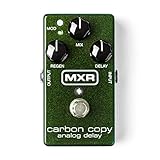 |
MXR Carbon Copy Analog Delay | ★★★★★ | Check Price |
| 2 |  |
TC Electronic Flashback 2 Delay | ★★★★★ | Check Price |
| 3 |  |
Boss DD-8 Digital Delay | ★★★★☆ | Check Price |
| 4 | 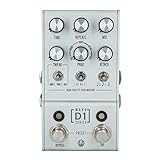 |
Walrus Audio MAKO Series D1 High-Fidelity Delay | ★★★★☆ | Check Price |
| 5 |  |
Source Audio Nemesis Delay | ★★★★☆ | Check Price |
| 6 |  |
Boss DD-500 Digital Delay | ★★★★☆ | Check Price |
| 7 |  |
Dunlop EP103 Echoplex Delay | ★★★★☆ | Check Price |
| 8 |  |
Behringer VD400 Vintage Analog Delay | ★★★★☆ | Check Price |
| 9 |  |
MXR Carbon Copy Mini Analog Delay | ★★★★☆ | Check Price |
| 10 |  |
NUX Atlantic Multi Delay and Reverb | ★★★★☆ | Check Price |
Analog Warmth Meets Digital Depth
The Carbon Copy holds the crown for pure analog repeats, while the Source Audio Nemesis stacks 24 engines and 128 presets at the other philosophical extreme.
The Dunlop Echoplex chases one specific sound, EP-3 tape preamp warmth with an age control, and the Behringer VD400 delivers true analog echo for the price of a dinner.
1. MXR Carbon Copy Analog Delay

MXR Carbon Copy Analog Delay
Rich all-analog delay with up to 600ms of bucket-brigade echo and a modulation switch for warm tape tones.
Pros
- Warm, tape-like bucket-brigade tone
- Up to 600ms of delay time
- Modulation controls emulate tape echo
- Simple three-knob layout
Cons
- No tap tempo or presets
- No digital or stereo modes
The Carbon Copy is the analog delay nearly every guitarist tries first, and for good reason. Its all-analog bucket-brigade path serves up to 600ms of warm, slightly darkened repeats, and the top-mounted modulation switch pushes those echoes into lush, tape-like territory.
With just three knobs for mix, regen, and delay, it’s the most intuitive way to add organic ambience to a clean tone or a solo.
2. TC Electronic Flashback 2 Delay

TC Electronic Flashback 2 Delay
Compact digital delay packing TC's full delay legacy plus MASH footswitch expression and TonePrint technology.
Pros
- Pressure-sensitive MASH expression switch
- TonePrint technology for custom delays
- Huge delay legacy in one small box
- Saves valuable pedalboard space
Cons
- Menu diving for deep tweaks
- Requires app for full TonePrint access
The Flashback 2 crams TC Electronic’s entire delay legacy into one compact, affordable stompbox built for now and the future. Its standout feature is the MASH footswitch, a pressure-sensitive switch that doubles as an expression pedal so you can ride feedback or mix with your foot.
Add TonePrint technology to load custom delays from your favorite players, and you’ve one of the most flexible digital boxes you can buy without sacrificing pedalboard space.
3. Boss DD-8 Digital Delay

Boss DD-8 Digital Delay
Eleven-mode compact digital delay with three delay types, full stereo I/O, and a built-in looper.
Pros
- Eleven delay modes in a compact box
- Three delay types including analog and tape
- Built-in looper for layering
- Full stereo input and output support
Cons
- Small controls for so many modes
- External footswitch needed for full control
The DD-8 packs eleven delay modes and three delay types, including analog, tape, and warm voicings, into the famous compact Boss enclosure. Full stereo input and output support lets it sit at the heart of a stereo rig, and the built-in looper records phrases for layering ideas on the fly.
It’s the do-everything digital delay for players who want one reliable box that covers vintage echoes through modern ambient washes.
4. Walrus Audio MAKO Series D1 High-Fidelity Delay

Walrus Audio MAKO Series D1 High-Fidelity Delay
High-fidelity stereo delay with five studio-grade programs, an attack knob, MIDI control, and onboard presets.
Pros
- Five tuned programs including reverse and dual
- Attack knob shapes ambient soundscapes
- Stereo in and out with MIDI control
- Onboard presets for quick recall
Cons
- Needs isolated power supply
- Deep features take time to learn
The MAKO D1 is a high-fidelity stereo delay with five studio-grade programs: Digital, Mod, Vintage, Dual, and Reverse. Each program can be sculpted with modulation, tone, age, and subdivision controls, and the unique attack knob adds a swell to every repeat that opens up a whole new world of ambient soundscapes.
With stereo in and out, MIDI control, and onboard presets, it earns its place as our pick for ambient and post-rock players.
5. Source Audio Nemesis Delay

Source Audio Nemesis Delay
Deep-editing delay with 24 engines, 128 recallable presets, stereo I/O, tap tempo, and full MIDI.
Pros
- 24 delay engines via wheel and app
- Up to 128 recallable MIDI presets
- Stereo jacks for ping-pong delays
- Tap tempo with beat divisions
Cons
- Neuro app needed for extra engines
- Steeper learning curve than simple pedals
The Nemesis is a deep-editing powerhouse, with 12 onboard delay engines and another 12 available through the Neuro Mobile App for 24 in total. You can store up to eight presets from the front panel or recall as many as 128 via MIDI program change, and the stereo jacks make dramatic ping-pong and phase-inversion delays easy to set up.
Tap tempo with quarter, dotted-eighth, and triplet divisions rounds out a pedal built for players who love to tweak.
6. Boss DD-500 Digital Delay

Boss DD-500 Digital Delay
Studio-grade flagship delay with 32-bit/96kHz processing, 12 modes, a graphic LCD, and patch memories.
Pros
- Studio-level 32-bit/96kHz processing
- 12 modes from vintage to modern
- Graphic LCD for easy editing
- Onboard patch memories and controls
Cons
- Larger footprint on the board
- Premium flagship price
The DD-500 is Boss’s flagship delay and one of the most powerful stompboxes ever made. Class-leading 32-bit AD/DA conversion, 32-bit floating-point processing, and a 96kHz sample rate deliver pristine studio-grade tone across 12 versatile modes that span vintage tape to complex modern textures.
A graphic LCD makes editing and recalling its onboard patch memories painless, so live players can jump between wildly different sounds in a heartbeat.
7. Dunlop EP103 Echoplex Delay

Dunlop EP103 Echoplex Delay
Vintage Echoplex EP-3 tape echo warmth with an Age control, 40 to 750ms delay, and tap tempo.
Pros
- Authentic Echoplex EP-3 tape character
- Age control sweeps pristine to dark
- 40 to 750ms of delay time
- Built-in tap tempo functionality
Cons
- No presets to save settings
- Single delay voice only
The Echoplex Delay captures the warm, organic modulation of the legendary EP-3 tape echo that shaped countless classic records. Its standout Age control sweeps the repeats from pristine and clean to dark, dirty, and saturated, letting you dial in vintage character on demand.
With 40 to 750ms of delay time and built-in tap tempo, it delivers genuine tape vibe in a road-ready box.
8. Behringer VD400 Vintage Analog Delay
Behringer VD400 Vintage Analog Delay
Budget all-analog delay with vintage slapback echo, up to 300ms, and noise reduction circuitry.
Pros
- Genuine analog and tape-style slapback
- Up to 300ms of BBD delay
- Noise reduction keeps signal clean
- Dedicated Intensity, Echo, and Rate knobs
Cons
- Plastic enclosure feels cheap
- Shorter delay time than rivals
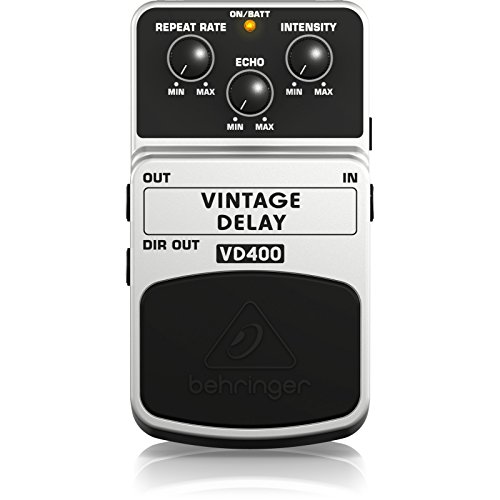
The VD400 proves you don’t need a big budget for genuine analog delay. Its vintage bucket-brigade devices produce up to 300ms of true analog echo and tape-style slapback, while an advanced noise reduction circuit keeps the signal clean.
Dedicated Intensity, Echo, and Repeat Rate knobs give you real sound-shaping control, making it the best way to get warm analog repeats for the price of a couple of cables.
9. MXR Carbon Copy Mini Analog Delay

MXR Carbon Copy Mini Analog Delay
Mini analog delay with 600ms of delay time, a modulation switch, and a bright toggle for clarity.
Pros
- Carbon Copy warmth in a mini box
- Up to 600ms of analog delay
- Modulation switch for tape-like shimmer
- Bright toggle adds clarity to repeats
Cons
- No tap tempo
- Tight controls in small enclosure
The Carbon Copy Mini delivers the same beloved analog warmth as its full-size sibling in a footprint built for crowded boards and travel rigs. It still offers up to 600ms of delay time along with the modulation switch for tape-echo shimmer, and adds a bright toggle that lifts the high end of each repeat for extra clarity.
It’s the obvious choice when pedalboard real estate is tight but you refuse to give up that bucket-brigade tone.
10. NUX Atlantic Multi Delay and Reverb

NUX Atlantic Multi Delay and Reverb
Combined delay and reverb pedal with three delay types, three reverbs, stereo I/O, and inside routing.
Pros
- Three delays: 70s analog, 60s tape, 80s digital
- Three reverbs including spring and hall
- Inside routing sets effect order
- Stereo input and dual outputs
Cons
- No deep editing or presets
- Reverb and delay share one box
The Atlantic combines three delay effects and three reverbs in one stereo-ready enclosure, covering 70s analog, 60s tape, and 80s digital delays alongside spring, plate, and hall reverbs. Its clever inside routing lets you choose whether delay or reverb hits first, and a 6.35mm stereo input with two outputs makes it easy to drop into a larger chain.
For ambient players who want delay and reverb in a single compact box, it’s hard to beat.
Video Reviews
More demos worth a watch:
Final Thoughts
The MXR Carbon Copy takes our top spot because it nails the thing most guitarists actually want from a delay: warm, organic, tape-flavored repeats that sit perfectly behind your playing. Its all-analog path, 600ms of delay, and one-switch modulation make it the easiest pedal here to plug in and love, which is exactly why it’s been a board staple for so long.
If you need more than analog warmth, the digital picks deliver. The TC Electronic Flashback 2 is the smartest value with its MASH expression switch and TonePrint sounds, while the Boss DD-500 is the no-compromise flagship for players who want studio-grade tone, 12 modes, and recallable presets on a screen.
Ambient and post-rock guitarists should look hard at the Walrus Audio MAKO D1 and its swelling attack knob.
On a tight budget, the Behringer VD400 gives you real analog delay for almost nothing, and the MXR Carbon Copy Mini frees up board space without losing the tone. Match the pedal to how you play, and any of these 10 will earn its slot on your board.