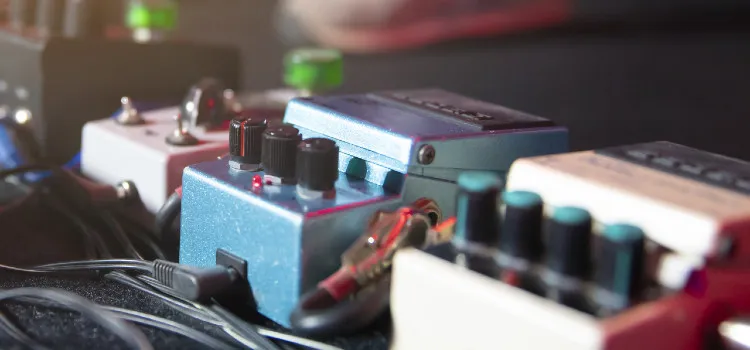
You’ve chased that warm, slightly grainy echo on old records, and a clean digital delay never quite gets there. Analog is the reason its repeats darken as they fade, with a bucket-brigade chip adding a touch of grit no algorithm copies.
That character costs you something. Analog delays usually top out near 600 to 900 milliseconds, the repeats stay a little hazy, and tap tempo is rare.
For most players that’s the whole appeal. The MXR Carbon Copy, with 600ms and onboard modulation, is where many people start.
We rated these eight pedals on repeat warmth, max delay time, modulation, build, and value, for the delay purist and the tweaker alike. The chart below lines them all up so you can compare them at a glance.
Quick Comparison Chart
| # | Product | Our Rating | ||
|---|---|---|---|---|
| 1 | 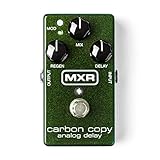 |
MXR Carbon Copy Analog Delay | ★★★★★ | Check Price |
| 2 |  |
Electro-Harmonix Deluxe Memory Man | ★★★★★ | Check Price |
| 3 |  |
JHS Panther Cub V2 Analog Delay | ★★★★☆ | Check Price |
| 4 |  |
Ibanez Analog Delay Mini Pedal | ★★★★☆ | Check Price |
| 5 |  |
Way Huge Supa-Puss Analog Delay | ★★★★☆ | Check Price |
| 6 |  |
Maxon Compact Series AD10 Analog Delay | ★★★★☆ | Check Price |
| 7 |  |
Supro Analog Delay Pedal | ★★★★☆ | Check Price |
| 8 |  |
Red Witch Reddelay Titan | ★★★★☆ | Check Price |
From Pedalboard Staples to Boutique Bucket Brigades
The spread here runs from the MXR Carbon Copy, the analog delay most players see on working pedalboards, to small-shop builds like the JHS Panther Cub V2 and the Red Witch Reddelay Titan. Price tracks that spread, but the warm, darkening repeats stay remarkably consistent across it.
Two specs do most of the separating. The Way Huge Supa-Puss is the only pick with both 900 milliseconds of delay and tap tempo, while the Ibanez Analog Delay Mini packs true bucket-brigade repeats into the smallest and cheapest box of the eight.
1. MXR Carbon Copy Analog Delay

MXR Carbon Copy Analog Delay
Rich all-analog delay with up to 600ms of delay time and tape-style modulation from genuine bucket-brigade chips.
Pros
- Warm, organic all-analog tone
- Up to 600 milliseconds of delay
- Modulation emulates tape echo
- True bucket-brigade technology
Cons
- No tap tempo on the standard model
- Modulation depth is set internally
The Carbon Copy is the pedal most guitarists picture when they hear the words “analog delay,” and it earns that reputation. Its rich all-analog circuit delivers up to 600 milliseconds of delay time, and the bucket-brigade technology gives the repeats that warm, slightly murky decay that sits perfectly behind a riff.
Flip on the modulation and you get an authentic tape-echo wobble that turns a simple slapback into something with real depth.
2. Electro-Harmonix Deluxe Memory Man

Electro-Harmonix Deluxe Memory Man
Legendary analog delay with lush chorus and vibrato, blend, feedback, and delay time controls for spatial echo.
Pros
- Super organic analog delay tone
- Selectable chorus and vibrato
- Analog input gain control
- Power adapter included in box
Cons
- Large footprint on a pedalboard
- Higher price than most rivals
If the Carbon Copy is the everyday workhorse, the Deluxe Memory Man is the legend. This is super organic analog delay with blend, feedback, and delay time controls, plus selectable analog chorus and vibrato with depth control that pushes it from a clean echo to lush, swirling ambience.
The analog input gain control lets you drive the front end for a little extra character, and a power adapter is included so you’re ready to play out of the box. It’s larger and pricier than most rivals, but the tone is the stuff of pedalboard history.
3. JHS Panther Cub V2 Analog Delay

JHS Panther Cub V2 Analog Delay
Compact boutique analog delay with active tilt EQ, fully wet mix, and smooth, controllable self-oscillation.
Pros
- Half the size of the V1 model
- Fully wet mix now available
- Gain control sets overall volume
- Even smoother oscillation and runaway
Cons
- No onboard tap tempo footswitch
- Single delay voice only
JHS shrank this one down to half the size of the original Panther Cub while adding the kind of controls boutique players love. A fully wet mix is now available, the gain control sets overall volume, and the active tilt-style EQ lets you brighten or darken the repeats to sit in any mix.
Best of all, the oscillation and runaway feedback are even smoother on the V2, so chasing those self-oscillating swells feels controlled rather than chaotic.
4. Ibanez Analog Delay Mini Pedal
Ibanez Analog Delay Mini Pedal
Pocket-sized all-analog delay with true bypass, delay time, repeat, and blend controls for electric guitar.
Pros
- All-analog signal path
- True bypass switching
- Tiny pedalboard footprint
- Simple delay, repeat, and blend
Cons
- Shorter maximum delay time
- No modulation controls
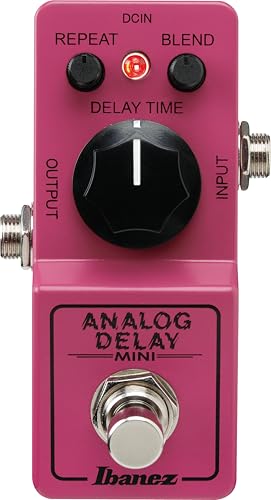
For players who want genuine analog tone without surrendering pedalboard real estate, the Ibanez Analog Delay Mini is hard to beat on value. It packs an all-analog signal path and true bypass switching into a tiny enclosure, with simple delay time, repeat, and blend controls.
There’s no modulation and the maximum delay time is shorter than the bigger boxes, but for a warm classic slapback at this size and price, it punches well above its weight.
5. Way Huge Supa-Puss Analog Delay

Way Huge Supa-Puss Analog Delay
Feature-rich analog delay offering 900ms of delay, tap tempo to three seconds, and subdivision Chase mode.
Pros
- 900 milliseconds of delay via knob
- Tap tempo extends to 3 seconds
- Subdivision control with Chase mode
- Tone, Speed, Gain, and Depth controls
Cons
- Larger than a standard compact pedal
- Deep feature set has a learning curve
The Supa-Puss is the feature monster of the analog world. You get 900 milliseconds of delay time via the knob and up to three seconds via tap tempo, which is enormous for a bucket-brigade pedal.
The subdivision control with Chase mode unlocks rhythmic, evolving patterns, and the full Tone, Speed, Gain, and Depth controls give you deep command over the modulation. It’s bigger than a standard compact, but no analog delay here’s more versatile.
6. Maxon Compact Series AD10 Analog Delay
Maxon Compact Series AD10 Analog Delay
Warm 600ms analog delay with special filtering to clean up repeats and rich self-oscillation effects.
Pros
- 600 milliseconds of analog delay
- Warm, organic delay tone
- Filtering reduces distortion on repeats
- Works in FX loop or front of amp
Cons
- No tap tempo or presets
- Harder to find in stores
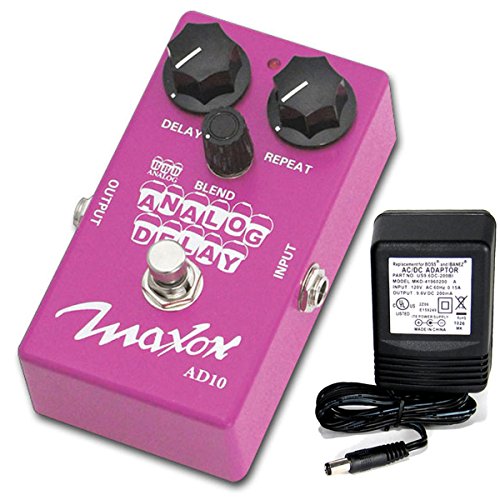
Maxon helped invent this category, and the AD10 carries that pedigree. It offers 600 milliseconds of warm, organic analog delay with special filtering that reduces distortion on the repeats, keeping things smooth as they fade.
It also creates lush self-oscillation effects and works equally well in an FX loop or at the front end of your amp. It lacks tap tempo and can be tricky to track down, but the core tone is the real deal.
7. Supro Analog Delay Pedal

Supro Analog Delay Pedal
All-analog delay with Level, Time, Filter, and Repeats controls plus an expression input for hands-free sweeps.
Pros
- Dedicated Filter tone control
- Expression input for live tweaking
- Simple Level, Time, and Repeats layout
- Genuine all-analog delay voice
Cons
- Less brand recognition than rivals
- Expression pedal sold separately
The Supro is a sleeper pick that gives you more control than its simple layout suggests. Alongside the standard Level, Time, and Repeats knobs, it adds a dedicated Filter tone control to shape the brightness of the echoes and an expression input so you can sweep delay parameters with your foot in real time.
It doesn’t carry the name recognition of an MXR or EHX, and the expression pedal is sold separately, but the genuine analog voice holds up nicely.
8. Red Witch Reddelay Titan

Red Witch Reddelay Titan
Boutique analog delay running on 9 volts with Mix, Velocity, and Depth controls for clean or chorused echo.
Pros
- Mix from clean to heavily chorused
- Velocity ranges from slow to fast
- Depth from flutter to deep swing
- Runs on standard 9 volt power
Cons
- Niche boutique availability
- Limited published spec details
The Reddelay Titan is the boutique oddball of the group, and it leans hard into modulation. Running on a standard 9 volts, it gives you a Mix control that goes from squeaky clean to heavily chorused, a Velocity control that sweeps from a stand-still slow wobble to a frantic fast warble, and a Depth control that ranges from a delicate flutter to a sickening swing.
It’s a niche, hard-to-find pedal with sparse published specs, which is why it lands at the bottom, but adventurous players will find plenty to love.
Final Thoughts
The MXR Carbon Copy is the analog delay we’d put on almost any board first. Its all-analog circuit, 600 milliseconds of warm delay, and authentic tape-style modulation cover the vast majority of what guitarists actually need, all in a compact, bombproof enclosure.
For most players, this is the easy answer.
If you want the most iconic tone in the category and have the board space, the Electro-Harmonix Deluxe Memory Man is worth the splurge for its lush chorus and vibrato alone. Players chasing maximum flexibility should look hard at the Way Huge Supa-Puss, whose 900ms of delay, tap tempo, and Chase mode make it the most feature-rich pick here.
And if budget or pedalboard space is tight, the Ibanez Analog Delay Mini proves you don’t have to spend big to get genuine analog warmth.
Whichever you choose, you’re getting that organic, naturally decaying echo that keeps players coming back to analog year after year. Pair any of these with the rest of your pedal lineup and you’ll hear exactly why bucket-brigade delay never went out of style.