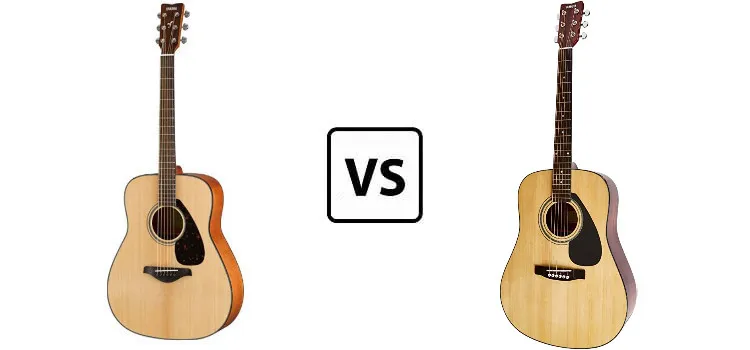
You want your first acoustic to be a real instrument, not a wall decoration. Yamaha gives beginners two solid-top dreadnoughts at a friendly price: the FD01S and the FG800.
Mahogany-family woods give the FD01S its warmth. The FG800 leans on scalloped bracing instead, pushing more bass and midrange out of the body.
This guide walks through how those choices change the tone, the feel, and the value of each guitar. We’re sticking to two of the better beginner acoustics Yamaha makes.
So let’s get into the parts that actually set them apart. The materials are where this comparison really begins.
Quick Comparison
| Category | Yamaha FD01S | Yamaha FG800 | Winner |
|---|---|---|---|
| Top | Solid Sitka spruce | Solid Sitka spruce | Tie |
| Bracing | Standard | Scalloped, richer bass and mids | Yamaha FG800 |
| Build | Clean Japanese consistency | The same standard | Tie |
| Neck | Slim and beginner friendly | Slim, 43mm nut | Tie |
| Projection | Solid | Larger body, more push | Yamaha FG800 |
| Factory setup | Action ships high | The same complaint | Tie |
| Overall | Budget solid-top starter | The fuller-voiced pick | Yamaha FG800 |
The Comparison and Difference in Materials
With the same manufacturer and roughly similar price points, you can expect the materials to be reasonably consistent across the board, with only a few notable differences. Both models feature a solid spruce top.
This is rare in the sub-$200 acoustic guitar category, where most budget guitars use cheaper laminated wood. The top wood has the most significant impact on the guitar’s acoustic sound, so it’s nice to see Yamaha making the effort to use high-quality material.
Both also have rosewood on the fretboard and a rosewood bridge, which provides smooth glides.
As for the other areas, such as the back of the dreadnought body, the sides, and the neck, Yamaha chose to use nato, also known as Eastern Mahogany. This is a low-cost option that produces a crisp tone emphasizing the mid frequencies.
However, it lacks the punch that solid mahogany can provide. Beginners are unlikely to notice the difference, so this shouldn’t be a deal-breaker.
For the nut and the saddle, the company went with urea, a form of plastic. More experienced players might want to replace these with bone to improve the looks and the tone.
Both guitars also use die-cast chrome tuning machines, which are excellent and have had no tuning stability issues.
Build Quality and Acoustic Guitar Woods
Japanese manufacturing has a reputation for being consistent, efficient, and reliable. That’s apparent in every guitar Yamaha produces and is a big reason they’ve such a loyal following.
Unlike cheap guitars, you won’t see rough edges or excess glue. The finish may be plain, but it’s delicate and smooth, with no odd bumps or other signs of unevenness.
You can play these guitars frequently without them breaking down or falling out of tune right away. You’ll love having either one in your hands.
However, the FG800 has a slight advantage over the FD01S. It features scalloped bracing underneath the top.
This reinforces the structure to give it added strength and durability, so you can be more confident taking it anywhere for practice or touring.
The bracing also enhances the resonant sound by increasing the response for low frequencies and producing richer harmonics around the mids. If you have a nearby store selling these models, give both a strum to appreciate the difference.
Playability and Neck Feel
As for playability, these beginner guitars feature slightly slimmer neck profiles than the average guitar, so they feel great in the hands. Even smaller players will have an easy time reaching the fretboard with their fingers.
Many beginners complain about straining too much when wrapping their hands around the neck to form chords. It’s challenging, especially when you aren’t used to it.
A slim neck removes a common obstacle so students can focus on developing their skills. The nut width is a comfortable 43mm for excellent accessibility.
One thing people might not like is the high action. It’s common for Yamaha to ship these out of the box this way.
High action means you need to press down harder on the strings to make contact with the fretboard, which requires finger strength that beginners might be lacking. You can take the guitar to a luthier and have it set up to improve playability if this bothers you.
For intermediate to advanced players, this might not be an issue, and they can pick these guitars up right away and be happy with the feel.
Either way, both guitars deliver a comfortable playing experience across many acoustic styles, including aggressive and continuous playing.
Sound Quality for the Price
The solid Sitka spruce top alone makes these Yamaha guitars sound better than the rest of the affordable guitars in the $150 to $200 price range. They sound rich and warm, with tones comparable to instruments that cost well above $1,000.
Both are dreadnoughts, so you can also expect the sound to be loud and heavy on the bass compared to smaller-bodied instruments. The FG800 is a little bit bigger, so it can project a slightly more audible sound.
If you aim to use it for performances later on, it’s a better purchase than the FD01S. However, if you’re only learning at home as a hobby, the cheaper model is perfectly adequate.
If you want to keep comparing models, our FG800 vs FS800 breakdown looks at how the dreadnought stacks up against Yamaha’s smaller concert-body sibling.
How the FD01S and FG800 Compare
So we’ve covered the materials, build, playability, and sound of both guitars. Here’s how they stack up when you put them side by side.
On materials, the two are closely matched: both share a solid spruce top, nato back and sides, and a rosewood fretboard, so neither pulls far ahead. On build quality, the FG800 edges it thanks to its scalloped bracing, which adds structural strength and durability for life on the road.
For playability, the two are nearly identical, with the same slim neck profile and 43mm nut width, and both ship with high action you may want a luthier to set up. The real separation comes on sound: the FG800’s slightly larger body and scalloped bracing give it better bass response, richer mids, and more projection, while the FD01S keeps things simple and a touch more affordable.
If you like better bass and mid response and might play out one day, the FG800 is the way to go. If you’re learning at home and want to save a little money, the FD01S is plenty of guitar.
Either way, you get a high-quality instrument for less.
Frequently Asked Questions
Is the Yamaha FG800 worth more than the FD01S?
For most players, yes. The FG800 adds scalloped bracing and a slightly larger body, which translate into stronger bass, richer mids, and more projection.
If you plan to perform or simply want the fuller voice, the small step up in price is easy to justify.
If you only play quietly at home, the FD01S delivers the same solid-top quality for a little less money.
Are these Yamaha guitars good for absolute beginners?
Both are well suited to beginners. They’ve slim neck profiles, a comfortable 43mm nut width, and reliable die-cast tuners that hold their tuning.
The build quality is consistent, so you aren’t fighting the instrument while you learn.
The only catch is the factory action, which can feel high until you’ve built up some finger strength.
Do the FD01S and FG800 have a solid top?
Yes, both feature a solid Sitka spruce top rather than laminate. That’s unusual at this price point and is the single biggest reason these guitars sound richer and warmer than most budget acoustics.
The back, sides, and neck use nato, also known as Eastern Mahogany, which keeps the cost down while still sounding good.
Should I get the action adjusted out of the box?
Many beginners benefit from a setup. Yamaha tends to ship these guitars with high action, which means pressing harder to fret notes.
A luthier can lower the action so chords are easier to form, especially early on.
Intermediate and advanced players often find the stock action acceptable and may not need any adjustment at all.
Final Thoughts
Both the Yamaha FD01S and the FG800 punch well above their price, offering a solid spruce top, consistent Japanese build quality, and a beginner-friendly neck that few rivals match under $200. You really can’t go wrong with either one as a first acoustic.
The deciding factor comes down to how you plan to use the guitar. The FG800’s scalloped bracing and slightly larger body give it the edge in bass response, mid-range richness, and projection, making it the better long-term choice if you might perform.
The FD01S keeps things simple and a little cheaper, which is ideal for learning at home.
Whichever you choose, plan on a quick setup to tame the factory action, and you’ll have a dependable, great-sounding instrument that grows with you as a player.