
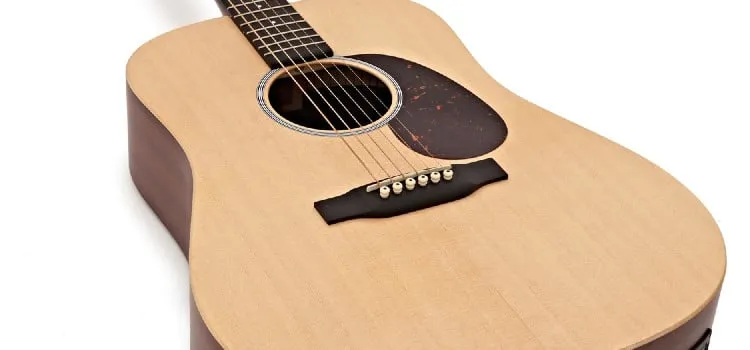
A Martin usually starts north of a thousand dollars. The DX1AE quietly breaks that rule, and the gap between its price and its name is what makes people suspicious.
So where did the money go? The top is solid Sitka spruce, while the back and sides switch to a tough mahogany-pattern HPL that shrugs off knocks and humidity.
This one is built for the gigging player, the songwriter, and anyone stepping up to a first proper acoustic. It still earns a spot on our list of the best acoustic guitars for a working budget.
The real test is what that mix sounds like once you strum it. Let’s get into the sound.

Martin DX1AE
Durable acoustic-electric dreadnought with a solid spruce top for gigging players on a budget.
Pros
- Solid Sitka spruce top with authentic Martin dreadnought projection
- Mahogany-pattern HPL back and sides resist humidity and temperature swings
- Onboard Fishman electronics make it gig-ready out of the box
- Loud, clear, balanced tone for well under $600
Cons
- HPL back and sides lack the depth of all-solid-wood Martins
- Accessing the battery requires loosening the strings
- Usually benefits from a professional setup to play its best
Sound and Playability
The DX1AE may not wear the fancy appointments of Martin’s flagship models, but strike a single chord and there’s no mistaking the heritage. This guitar has the deep, dominating dreadnought tone that Martin pioneered, and that’s exactly what most players are chasing at this price.
The solid Sitka spruce top is the star here. Spruce is the classic choice for a reason: it gives you that combination of punchy projection and a wide dynamic range that responds to how hard you dig in.
You get sweet, warm mids, shimmering treble, and a powerful low end with plenty of bass.
The D-14 fret dreadnought body moves a lot of air, so the DX1AE is loud and cuts through whether you’re strumming around a campfire or filling a small room unplugged.
Tone balance is the other strong point. The combination of the solid top and Martin’s tapered X-bracing keeps the sound even across the strings rather than letting the bass swallow everything.
It isn’t as complex or three-dimensional as a high-end all-solid Martin, but for a guitar in this class the projection and clarity genuinely beat most acoustics under $1,000.
Playability is comfortable straight away. The Performing Artist neck profile is a slim, modern shape that suits both flatpicking and chord work, and the Richlite fingerboard plays smoothly.
As with almost any factory acoustic in this range, a proper setup will sharpen the action and intonation, but the bones are excellent.
Build and Features
The model name isn’t random. The “D” stands for dreadnought, the “X” places it in Martin’s value-focused X Series, the “1” denotes a standard A-frame build, and “AE” means acoustic-electric.
Decode that and you already know most of what defines this guitar.
Here’s the core spec sheet:
- Body size: D-14 fret dreadnought
- Top: Solid Sitka spruce
- Back and sides: Mahogany-pattern high-pressure laminate (HPL)
- Fingerboard and bridge: Black Richlite
- Bracing: A-frame X-1 pattern
- Electronics: Fishman onboard pickup and preamp
- Finish: Hand-rubbed satin
The headline trade-off is the HPL back and sides. High-pressure laminate is a dense, layered material rather than solid tonewood, and Martin uses it to keep the price down without resorting to flimsy plywood.
The payoff is durability. HPL shrugs off humidity swings and temperature changes that would crack a solid-wood guitar, which makes the DX1AE a smart pick for gigging, travel, or a first serious instrument that’ll see some abuse.
It can still dent and scratch, so it isn’t indestructible, but it’s far more forgiving than all-solid construction.
Richlite handles the fingerboard and bridge. It’s a paper-composite material that’s stable, hard-wearing, and resistant to the same environmental stress that affects the body.
The neck joins the body with a mortise-and-tenon joint for a solid connection, and the chrome tuners hold pitch well enough that you aren’t constantly reaching for the headstock.
The Fishman electronics are the practical heart of the DX1AE. Fishman is a leading name in acoustic pickups, and the system here gives you a clean, usable plugged-in tone that makes this guitar stage- and studio-ready out of the box.
The one quirk worth flagging is the battery: accessing it means loosening the strings, so plan to swap it during a string change rather than mid-set.
Who It Is For
The DX1AE is built for the player who wants the Martin name and the Martin sound without the Martin price ceiling. If you’re a gigging or rehearsing musician who needs a dependable acoustic-electric that can take a knock and plug straight into a PA, this is squarely aimed at you.
It’s also an excellent step-up or first “real” acoustic. Intermediate players moving past an entry-level guitar will appreciate the solid top and authentic tone, and the rugged HPL build means you don’t have to baby it the way you’d a delicate all-solid instrument.
Anyone who travels with a guitar, plays outdoors, or simply doesn’t want to fuss over humidity will get a lot of peace of mind here.
Who should look elsewhere? If you want maximum tonal complexity and the resonance that only comes from all-solid-wood construction, you’ll eventually feel the limits of the laminate back and sides.
Pure fingerstyle players chasing nuanced overtones may prefer a smaller-bodied, all-solid guitar. But for strummers, songwriters, and stage players, the DX1AE hits a sweet spot that’s hard to match at this price.
Frequently Asked Questions
How does the DX1AE compare to all-solid-wood Martins?
The DX1AE shares the same solid Sitka spruce top that drives the tone on pricier Martins, so it has the right voice and projection. Where it differs is the HPL back and sides versus solid mahogany or rosewood, which means slightly less tonal complexity and resonance.
For strumming and live use the gap is small, but for nuanced fingerstyle, an all-solid model pulls ahead.
Are the Fishman electronics any good for live use?
Yes. Fishman is one of the most trusted names in acoustic amplification, and the system in the DX1AE produces a clean, natural plugged-in tone that holds up well through a PA or acoustic amp.
It makes the guitar genuinely stage- and studio-ready without an aftermarket pickup upgrade.
Is the HPL back and sides a dealbreaker?
Not for most players. HPL trades a bit of tonal richness for serious durability, shrugging off the humidity and temperature swings that crack solid-wood guitars.
If you gig, travel, or want a low-maintenance instrument, the laminate is a feature rather than a flaw. If you prioritize maximum acoustic resonance above all else, consider an all-solid guitar.
Does the DX1AE need a setup out of the box?
Like most factory acoustics in this price range, it plays well stock but performs noticeably better after a professional setup. A quick adjustment to the action and intonation makes the neck faster and the tuning more accurate, and it’s an inexpensive way to get the most out of the guitar.
Final Thoughts
The Martin name carries weight in the guitar world, and the DX1AE earns it. The solid Sitka spruce top gives you that unmistakable dreadnought projection, the Fishman electronics make it ready to plug in and play, and the durable HPL construction means it can handle real-world use without constant worry.
The laminate back and sides are the honest trade-off for the price, but the tone and reliability more than make up for it.
For under $600, this is one of the easiest acoustic-electrics to recommend to gigging musicians, songwriters, and anyone wanting genuine Martin quality on a budget. If that’s you, the DX1AE belongs on your shortlist.