You hear that dive-bomb or gentle warble and want it on your own guitar. Then you flip the instrument over and realize there’s no arm to grab.
Adding one ranges from a simple afternoon project to a job best left to a shop. What sits at your bridge decides which.
A hardtail Les Paul and a Floyd Rose Strat live in two very different worlds here. One can take a bolt-on unit, the other already commits you to routed wood.
This guide explains the systems and what each one asks of you. First, let’s answer whether a whammy bar can really go on any guitar.
Can You Add a Whammy Bar to Any Guitar?
Yes, most electric guitars are compatible with a whammy bar, but there are some things you may need to change in order for it to work. The main thing you’ll need is a tremolo bridge, which on some guitars means routing out the body to accommodate it.
Different types of tremolo systems require different things. Some bolt onto the top of the body with no modification at all, while others need a cavity cut into the guitar.
Picking the right system for your guitar is the key first step, so the rest of this guide breaks down each option.
Types of Guitar Tremolo Systems for Vibrato
There are several tremolo systems to choose from, and each one installs differently and sounds a little different. Here are the main ones you’ll run into.
Synchronized Tremolo (Strat Style)
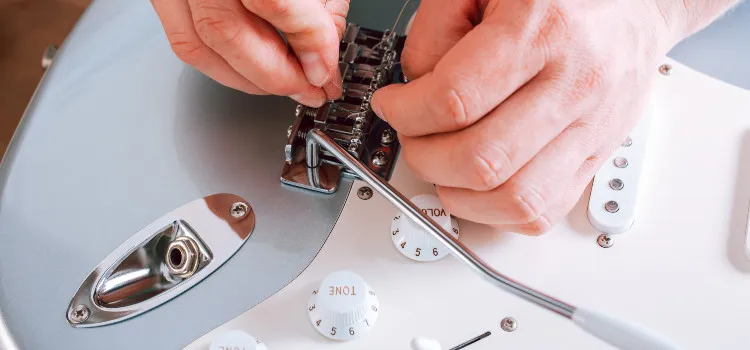
If you’ve ever played a Strat or a Strat copy electric guitar, you probably have seen this option. The bridge connects to springs inside a routed area of the guitar body.
The springs allow the player to move the whammy bar up and down to get the effect.
These tremolo systems can be set up in two different ways. One way is to keep it flush with the body, which lets you only push down on the bar.
Or you can float the bridge to allow both up and down motion of the whammy bar.
The whammy bar just screws into the bridge. The downside is that if you break a string, you’ll have tuning issues due to the drop in tension on the tremolo bridge.
Bigsby
A Bigsby is a classic vibrato tailpiece design and makes for some great retro style electric guitar vibes. It’s designed to sit on top of the body and clamp down with screws to hold it in place.
Nothing needs to be routed out of the body to install it.
You usually see these types of tremolo systems on Gretsch, Gibson, and other guitars that typically don’t have a vibrato system.
A Bigsby has a beautiful and subtle sound, but they’re known to have tuning stability issues. They also don’t have as much range as other tremolo systems.
Floating Jazzmaster Style
The floating Jazzmaster trem is quite unique. The strings don’t go through the body like a Strat electric guitar - they’re strung through the bottom of the bridge.
It also has a locking feature that lets you lock the trem or keep it floating, depending on how you want to use it.
These are fairly popular in the surf guitar world because you get a combination of the subtle aspects of a Bigsby but with a bit more range.
Maestro Vibrola
If you’ve ever seen a whammy bar on a Gibson SG, chances are you saw a Maestro Vibrola tremolo system. These types of vibrato systems are installed similar to a Bigsby, mounting on top of the body without routing.
The tone is also similar to a Bigsby, with a gentle, vintage-flavored vibrato rather than a wide pitch range.
Floyd Rose
A Floyd Rose has the biggest range and is best known among metal players. The whammy has a ton of range compared to other options.
It was invented by Floyd D. Rose, and guitarists like Eddie Van Halen are known to use these.
To install one of these, your guitar body needs to be routed out to fit it in properly. The strings lock into the bridge, and there are fine tuners at the bridge to help with minor tuning adjustments.
The disadvantage is that these are very difficult to set up.
How to Attach a Whammy Bar to a Guitar
Attaching a whammy bar or tremolo arm to a guitar is going to depend on the type of bridge you’ve. The most common tremolo bridge design is what’s referred to as a synchronized tremolo.
With these types of bridges, the strings go through the body and are stabilized at both ends by saddles that sit on springs.
When you use your whammy bar, that pushes down on the bridge, which causes the springs to flex farther than they were designed to, and that throws off your tuning until the bridge settles back.
My recommendation would be to check the type of bridge you’ve and decide from there how to add the whammy bar. Some bars just pop into the bridge and others screw in.
Can You Whammy Without a Whammy Bar?
There are a couple of ways to do this:
- Slightly bending or shaking the guitar neck while playing - Bending the guitar neck slightly while playing will tighten or loosen string tension. This changes your pitch, so you can move back and forth to create a vibrato effect.
- Using a whammy pedal - a whammy pedal is a pedal that attaches to your signal chain and lets you bend notes by rocking back and forth on it, similar to how a wah works. This is a great option if you have a guitar with no whammy bar because it won’t require any installation or modification. A popular choice is the DigiTech Whammy DT Drop Tuning Guitar Pitch Shift Effect Pedal.
Frequently Asked Questions
Is a whammy bar and a tremolo bar the same thing?
Yes, they’re basically the same thing. Sometimes you’ll see one referred to as a trem bar and the other as a whammy bar.
Whether you call it a whammy bar or a trem bar, you’re talking about the same piece of hardware that attaches to your tremolo bridge.
Is a whammy bar worth it for beginners?
If you’re just starting out with guitar, you probably don’t have much use for a whammy bar yet. Whammy bars are more commonly used by intermediate and experienced players for expressive techniques like dive bombs and vibrato.
So if you’re getting into playing guitar or just starting out as a hobbyist, it may not be worth the time and effort to install one. You can always add it later once your playing develops.
Can a whammy bar break strings?
A whammy bar can actually help in some instances when it comes to broken strings. Broken strings are always frustrating in the middle of a live performance or song.
They’re inconvenient and can cause you to miss notes if you aren’t careful.
A whammy bar adds and removes tension as you use it, so aggressive dive bombs and heavy use can stress strings over time, especially at the bridge and nut. Fresh strings and a properly set up bridge reduce the chance of a break.
Why does my guitar go out of tune when using a whammy bar?
When you use a whammy bar, it changes the tension on the strings and alters tuning slightly until everything settles. If your guitar won’t return to pitch, it could be a couple of issues:
- The bridge isn’t going back to its exact initial position after you release the whammy bar. This could be a setup problem, or the springs may need to be replaced.
- The nut could be pinching the strings and causing them to hang up. You may just need to lubricate your guitar nut to resolve this issue.
Final Thoughts
Adding a whammy bar to a guitar is a really cool project, and for most electric guitars it’s entirely possible. The deciding factor is the bridge: a Bigsby or Maestro Vibrola can bolt on top with no woodworking, while a synchronized tremolo or a Floyd Rose usually means routing a cavity into the body.
Before you start, figure out which tremolo system fits your guitar and your playing style, then plan the install around that. A subtle, vintage vibrato has very different requirements from a metal-ready dive bomb setup.
We hope you can use this post as a valuable resource to guide you in the right direction. Take your time with the setup, keep your nut and springs in good shape, and your new whammy bar will stay in tune and sound great.