A volume pedal earns its spot on a board, but only if you put it in the right place. Move it a few slots up or down the chain and the same pedal behaves like a different tool.
That’s why there’s no one-size rule for where it goes. The sweet spot depends on the pedal you own and whether you want gain control, clean level riding, or smooth swells.
The honest answer is to try a few positions and trust your ears. First, though, let’s cover what a volume pedal actually is.
What Is a Volume Pedal?
A volume pedal is exactly what it sounds like: a pedal that controls your volume. If you’ve seen a wah pedal, picture something shaped just like it.
The difference is that rocking the treadle up and down adjusts your volume level instead of producing a wah sound.
There are two types of volume pedals, and the difference matters for placement:
- High impedance - better suited for the beginning of the chain, where you can control how much signal passes through your effects (overdrive, distortion, delay, and reverb) before it reaches the amp or PA.
- Low impedance - designed to go closer to the end of the signal chain, behaving more like an amp’s master volume.
Knowing which type you’ve tells you roughly where it wants to live. If you’re also wondering how to connect a wah pedal to your amp, the same front-of-chain-versus-effects-loop thinking applies.
How Does a Volume Pedal Work?
A volume pedal is very simple. It’s basically a volume knob in pedal form.
Rock the treadle back and the volume drops. Rock it forward and the volume increases.
That foot control is the whole point. It frees up your hands so you can fade in and out, even out your levels, or kill your sound between songs without ever reaching for a knob.
Do You Need a Volume Pedal on Your Pedalboard?
That depends on how you play. A volume pedal is a great thing to have on your board because it gives you more tools to work with and feeds the creative process.
Who doesn’t love volume swells?
It’s also genuinely practical for live playing. You can fade in pads, balance your rhythm and lead levels, or mute your signal silently between songs.
If you’re deciding where it fits alongside everything else, it helps to sort out your pedalboard order first, then slot the volume pedal into the position that matches the job you want it to do.
Do Volume Pedals Affect Your Tone?
Yes, and this is exactly where placement matters relative to your other pedals. Where the volume pedal sits changes how it interacts with the rest of your chain.
Think about a distorted tone coming from your amp. You’ve probably rolled back your guitar’s volume knob to clean it up and shave off some of the distortion.
A volume pedal placed early in the chain does the same thing - it changes your gain and tone, not just your loudness. Placed late in the chain or in the effects loop, it mostly just changes how loud you’re without reshaping the gain.
That single difference is why position is worth thinking through.
Where Should the Volume Pedal Go in Your Signal Chain?
It comes down to the pedal type and what you want it to do. Here are the practical guidelines:
- If your guitar has passive pickups and you go straight from the guitar into the pedal, you want a high-impedance volume pedal there at the front.
- If you place it after buffers or inside the effects loop, you want a low-impedance volume pedal.
- If you don’t want to change the gain or tone at all and only want to vary the volume, the cleanest option is to put a low-impedance volume pedal (or another expression-style pedal) in the effects loop.
In short: front of the chain for tone-shaping volume that behaves like your guitar’s knob, and end of the chain or effects loop for transparent master-style volume.
Where to Put a Volume Pedal for Swells
If you’re chasing a specific technique like swells, placement gets more deliberate. My approach is to put the volume pedal after your gain stages - overdrive and distortion pedals - so the swell shapes a tone that’s already driven.
If you also run modulation and time-based effects, place the volume pedal before them. That means setting it ahead of a delay pedal, ambient reverb pedal, looper, chorus, octave, compressor, boost, or tuner.
Placing it before these effects lets the delay trails and reverb tails bloom naturally as you fade the note in, which is what makes a swell sound smooth and lush instead of choppy.
A Volume Pedal Recommendation
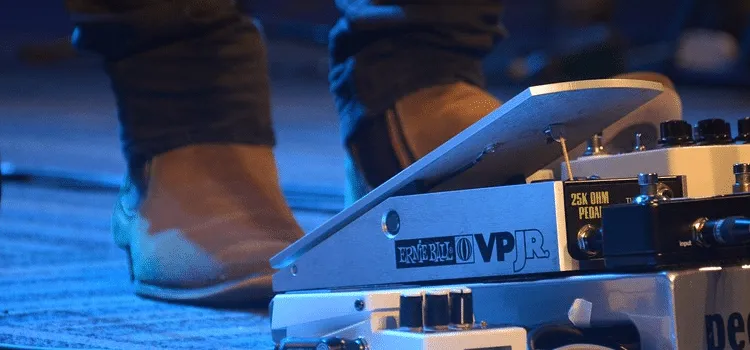
An easy pick is the Ernie Ball VP Jr.. It’s decently priced, fairly compact compared to other options so it won’t eat up too much pedalboard space, and it has two settings for the rate of volume change that give you a couple of different swell options.
The one thing I don’t love about this pedal is that the jacks sit on top instead of on the sides, which makes routing your cables a little awkward on a tight pedalboard.
Frequently Asked Questions
Does a volume pedal go before or after distortion?
Place it before distortion (near the front of the chain) when you want the pedal to act like your guitar’s volume knob and shape the gain and tone.
Place it after distortion when you want clean volume control or smooth swells over an already-driven sound.
For swells specifically, after your drive pedals but before delay and reverb is the sweet spot.
What’s the difference between a volume pedal and an expression pedal?
A volume pedal contains its own potentiometer and directly controls the level of the audio signal passing through it. An expression pedal sends a control voltage to another device and adjusts a parameter, such as a delay’s mix or a synth’s filter, rather than your overall volume.
Many low-impedance volume pedals can be repurposed in an effects loop for transparent level control, which is why the two get mentioned together.
Can I put a volume pedal in the effects loop?
Yes. Putting a low-impedance volume pedal in your amp’s effects loop is a great way to control overall volume without changing your gain or tone.
It behaves much like an amp’s master volume in that position.
Just make sure you’re using a low-impedance pedal there, since a high-impedance model is designed for the front of the chain.
Do I need a buffer with my volume pedal?
Not always, but it can help. A high-impedance volume pedal at the front of a passive signal works fine on its own.
If you place a low-impedance pedal after your guitar without a buffer in front of it, you may notice some tone loss, so adding a buffer earlier in the chain keeps your signal strong.
Final Thoughts
There’s no wrong place to put a volume pedal, only different results. A high-impedance pedal at the front of your chain shapes gain like your guitar’s volume knob, while a low-impedance pedal toward the end or in the effects loop gives you transparent, master-style volume control.
For swells, the reliable starting point is after your drive pedals and before your time-based effects, so the delay and reverb tails can bloom as you fade each note in. From there, dial it in to taste.
The best move is still to experiment with your own setup. Try the pedal in a couple of spots, listen to how it interacts with your gain and effects, and keep whatever sounds best to your ears.