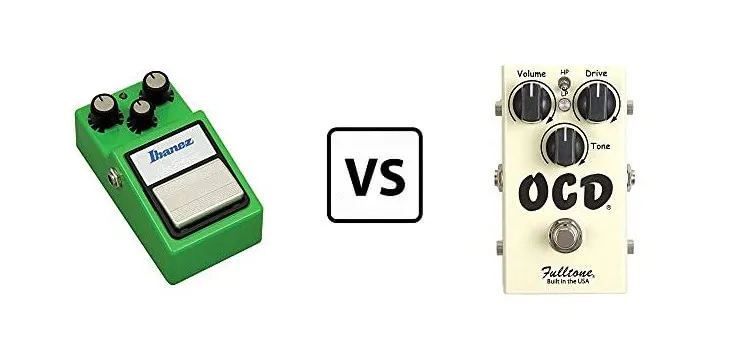
You want to add some grit to your tone and keep landing on the same two names. The Ibanez Tube Screamer and the Fulltone OCD sit on countless boards, yet they do fairly different jobs.
The Tube Screamer is the green classic that lives in that glassy, edge-of-breakup zone and famously tightens up a driven amp. The OCD covers a lot more ground, running from light crunch all the way into thick, gnarly distortion.
This comparison lines up these two popular overdrive pedals on tone, gain range, and feel. By the end you’ll know which one fits your sound, or whether you want both.
First up is the Tube Screamer.
Quick Comparison
| Category | Tube Screamer | Fulltone OCD | Winner |
|---|---|---|---|
| Legacy | Set the overdrive standard | The boutique benchmark | Tube Screamer |
| Voice | Mid-hump, tight and focused | Open, amp-like, wider EQ | Depends |
| Gain range | Mild to moderate | Crunch into near-distortion | Fulltone OCD |
| Heavier styles | Mostly boost duty | Can carry them alone | Fulltone OCD |
| Stacking | The classic tightener | A strong primary drive | Tie |
| Signal character | Preserves fidelity | Adds aggressive color | Depends |
| Overall | The benchmark mid boost | The wider-range drive | Depends |
Ibanez Tube Screamer
To call the Ibanez Tube Screamer an icon would be an understatement. Before the original TS808 came along in the late ’70s, overdrive was pretty much a myth.
Sure, there were a few fuzz and distortion pedals that could function as ODs, but only if you knew how to coax the genie out. The easier alternative was to literally overdrive a valve amp, a privilege of the lucky few who could afford one.
To the rest of the masses, OD was the musical equivalent of a unicorn.
And then came the Tube Screamer. This little seasick-green stomp box somehow nailed perfect OD, mimicking a tube amp at the edge of breakup while still maintaining tonal integrity.
Guitarists the world over were wowed, and the Tube Screamer went on to become a bestseller, and perhaps the most imitated pedal in history.
So influential are the original Tube Screamers that even Ibanez themselves have released copycats. Or are they actually copycats?
Seasoned shredders will attest that this isn’t the case. The latest lineup of TS pedals is every bit as authentic as their ancestors.
While there have been a few changes in the circuitry on some models, you still get the glassy OD and overall sonic integrity.
On that note, here’s what’s on the menu for those who want a piece of the TS mojo:
- TS808 Reissue: As the name indicates, this is a faithful reproduction of the original TS808, featuring the same square footswitch and JRC-4558D op-amp chip under the hood.
- TS9 Reissue: Again, this is a rendition of the “9-Series” pedals produced by Ibanez in the early ’80s. The model features the same sonic stamp that set the original TS9 apart from the 808.
- TS9DX: A TS9 remake with three additional modes (+, Hot, and Turbo). There’s also the TS9B, yet another TS9 variant that has been revoiced for more low-end crunch.
- Tube Screamer Mini: This is the original 808 squeezed into a downsized case, available for a cheaper price too, but with no sacrifices in performance whatsoever.
Fulltone OCD Overdrive
As splendid as Ibanez’s Tube Screamers were, they had their fair share of shortcomings. Or, rather, there are certain tonal needs that no Screamer in any configuration can fulfill.
The propensity of these pedals to maintain fidelity in the signal can, for instance, prove a hindrance if you’re aiming for a slightly-roughed-up type of OD.
Just to be fair to Ibanez, the TS was never meant to be a jack-of-all-trades. But it’s from such gaps that great concepts are born.
Concepts like Obsessive Compulsive Drive, or OCD as most people know it.
The Fulltone OCD was devised as a pedal that could bridge the gap between docile overdrive and comparatively-unhinged distortion. It came with the usual controls (Drive, Volume, and Tone), plus an HP/LP toggle for accessing different sound profiles.
HP increases girth on the bottom end while sharpening the mids, giving your guitar more presence. LP is a subtler effect that retains the incoming signal’s character.
And so, the original OCD quickly became recognized as one of the most versatile stompboxes on the market. Keen to stay atop this enviable perch, Fulltone has continually refined the pedal over the years, releasing the second generation dubbed OCD V2.
With a switchable true-bypass and a slew of upgrades in the circuitry, Obsessive Compulsive Drive is as good as it has ever been.
Like the original, the OCD V2 lets you traverse the tonal spectrum from low-gain crunch to gnarly, fuzzy distortion, with all manner of possibilities in between. The tone stays warm and consistent throughout, and the headroom is ever so ample.
It’s an incredibly dynamic response that lets you explore your way to the sweet spot on your favorite amp.
But perhaps the most intriguing thing about this pedal is its humility. Even with all its talents, the Fulltone OCD V2 remains affordably priced.
And it still has the same user-friendly demeanor as its predecessors.
How the Tube Screamer and OCD Compare
It certainly wasn’t the first stompbox to see the light of day. But the original Tube Screamer, with its unprecedented ability to emulate an over-driven tube amp, went on to set the gold standard for what OD should feel and sound like.
It’s pleasing to see that all the reissues and variants that have followed retain their ancestor’s overall pedigree.
Fulltone’s OCD concept has been compared to the Tube Screamer in lots of ways, with some even claiming that it’s a copycat of the latter. Admittedly, there’s a bit of logic behind this opinion.
No other pedal released in recent years has carved out a niche for itself quite like the OCD has. But that’s about as much as it has in common with the Tube Screamer.
The Screamer is meant to be an overdrive pedal through and through. Sure, you can get it to crank out some fuzzy filth if you dial in the right settings and push hard enough.
But the TS will strive to retain the signal’s character, and the result might not be what you hoped for. The OCD is also designed primarily to provide OD, but with more flexibility.
You can set it up to function more as a distortion box if you want. Its biggest selling point, however, is the ability to switch between the two and dial in hybrid effects.
Here’s a quick side-by-side of where each pedal lands:
| Feature | Ibanez Tube Screamer | Fulltone OCD |
|---|---|---|
| Core voice | Mid-focused, tube-amp-style overdrive | Open, transparent overdrive into distortion |
| Gain range | Low to medium | Low crunch to fuzzy distortion |
| Tone shaping | Drive, Tone, Level | Drive, Volume, Tone, plus HP/LP toggle |
| Best for | Pushing an amp, classic blues and rock leads | Players who want one pedal to span OD and distortion |
| Signal character | Preserves and tightens the original signal | Stays warm but lets more of the raw signal through |
Now, there’s nothing to keep you from adding both the Tube Screamer and OCD to your pedalboard. But if you’re like most players, you’re better off with the one that suits your style best.
Go with the Fulltone OCD if you like to play around with your sound and don’t mind a bit of color. If you prefer squeaky-clean, focused overdrive, on the other hand, the Ibanez Tube Screamer is your best bet.
Frequently Asked Questions
Is the Fulltone OCD just a Tube Screamer clone?
No. While both pedals are rooted in overdrive and are often mentioned in the same breath, they’re voiced very differently.
The Tube Screamer is famous for its pronounced midrange hump and its way of tightening and preserving your signal.
The OCD, by contrast, is more open and transparent, and it reaches further into distortion territory thanks to its HP/LP toggle. They scratch different itches even though they share the same broad category.
Which pedal is better for high-gain or metal?
The Fulltone OCD has the edge here. Its gain range stretches from light crunch into fuzzy, near-distortion territory, so it can carry heavier styles on its own or stack into an already-driven amp.
The Tube Screamer can still play a role in heavier music, but usually as a boost in front of a high-gain amp rather than the main source of saturation. Used that way it tightens the low end and pushes the mids forward for cutting leads.
Can I use the Tube Screamer and OCD together?
Absolutely, and many players do exactly that. A common approach is to use the OCD as the primary drive or distortion voice, then kick in the Tube Screamer as a mid-boost for solos.
Running the Tube Screamer last in the chain lets it tighten and focus whatever the OCD is producing. Experiment with the order to find which arrangement suits your tone.
Which Tube Screamer model should a beginner buy?
For most newcomers, the standard TS9 Reissue is the easiest place to start. It delivers the classic Tube Screamer voice at a sensible price and is simple to dial in.
If you want the warmer, slightly smoother original flavor, the TS808 Reissue is the way to go, while the Tube Screamer Mini offers the same core tone in a smaller, cheaper enclosure for tight pedalboards.
Final Thoughts
Both the Ibanez Tube Screamer and the Fulltone OCD earned their legendary status honestly. The Tube Screamer essentially invented the modern overdrive pedal and still sets the benchmark for a focused, mid-rich tone that pushes an amp into musical breakup.
The OCD took the concept further, offering a more flexible, dynamic voice that can swing from gentle crunch to full-on distortion.
If your priority is a classic, tight overdrive that flatters your existing tone, reach for the Tube Screamer. If you want a single pedal that covers more ground and rewards experimentation, the OCD is hard to beat.
Neither choice is wrong, and your own playing style is the deciding factor.
And of course, there’s always the option of owning both. On a well-planned pedalboard, the Tube Screamer and OCD complement each other beautifully, giving you the best of two of the most celebrated overdrive designs ever made.