
You switch the amp on with nothing connected, no cable and no guitar, and a thin hum is already sitting there. It feels backward, since an empty input jack should mean silence.
Plenty of players chase this for years. They swap between different guitar amps or tube amplifiers, or buy a box just to mask the buzz.
The truth is the noise isn’t coming from your guitar at all. We’ll show where it really starts and the simplest ways to quiet it down.
You’ll also see why the buzz is worse on certain amps. First, let’s pin down exactly what this hum is.
What Is the Hum?
The hum is the steady noise (and sometimes feedback from the guitar) that an amplifier emits when nothing is connected to it. The question most players ask is simple: if I plug in no pedals, no cables, nothing at all, and just turn the amp on, why does the high-pitched hum still come out?
It’s easy to blame your guitar or your humbuckers vs single coils, but with no cable plugged in, the guitar is out of the equation entirely. The sound is coming from inside the amp itself.
What Causes Amp Hum With Nothing Plugged In?
The most likely cause is the sensitivity of amplifiers to electricity. Capacitors are used throughout an amp, and one type used in guitar amps has many plates with air between them, so they don’t conduct electricity well.
These capacitors create an electric field around themselves that spreads through the amplifier as an electrostatic field. When electricity runs through the amp, it gets influenced by that field, which can show up as a small increase in electrical current.
So even when no signal is being produced, a high-pitched hum can still emanate from the amplifier because of this electric field.
Grounding plays a big role too. If the amp isn’t properly grounded through the wall outlet, or if it shares a circuit with noisy appliances, dimmer switches, or fluorescent lights, that interference rides into the amp and turns into audible hum.
Nothing in electronics is ever 100 percent guaranteed, but if you have an amp doing this with nothing plugged in, it’s almost always one of these two things rather than a fault with your electric guitar tone.
Why the Hum Is Louder on Some Amps Than Others
Now that we know what causes the noise, the next question is why it’s so intense in certain amps and barely noticeable in others. A few factors are usually at play.
- Amp design and shielding. Higher-gain and tube amps amplify the tiniest electrical noise, so the same stray field is far more obvious through a hot amp than a clean, low-gain one.
- Grounding quality. Older buildings, two-prong adapters, and ungrounded outlets all leave the amp more exposed to electrical interference.
- Nearby electronics. Light dimmers, refrigerators, computer monitors, and wireless gear in the same room can feed hum straight into a sensitive amp.
- Component condition. Aging or low-quality capacitors and worn parts can simply be noisier than fresh, well-made ones.
If you also notice your amp picking up radio stations, that points to the same root cause: the amp is acting as an antenna for the electrical noise around it.
How to Easily Eliminate the Hum
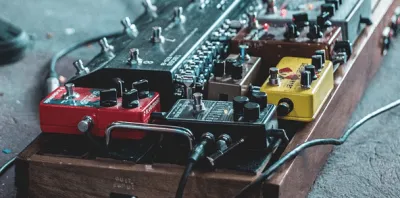
A simple, effective way to deal with hum is a noise gate pedal. A favorite is the BOSS NS-2, which you can see here on Amazon.
A noise gate controls the signal and stops the noise from reaching the amp output while leaving your other guitar controls accessible.
For the best results, set a long decay so you aren’t cutting off the tails of your notes, just eliminating the noise floor between them. The trade-off is that it adds a layer to your signal chain, which some players find less comfortable at first, but once it’s dialed in correctly it removes the hum almost entirely.
Before reaching for a pedal, also try these free fixes:
- Plug the amp into a properly grounded three-prong outlet, and avoid cheater plugs.
- Move the amp away from light dimmers, monitors, and other electronics.
- Try a different outlet or a different room to see if the hum follows the amp.
- Use good shielded instrument cables once you do plug your guitar in.
These steps fix the source of the noise where possible, and the noise gate cleans up whatever is left.
Frequently Asked Questions
Is amp hum with nothing plugged in normal?
A small amount of background hum is normal, especially on tube amps and high-gain settings, because the amp is amplifying tiny electrical fields in the room. A loud, intrusive hum isn’t normal and usually points to a grounding problem or interference from nearby electronics rather than a broken amp.
Do humbuckers or single coils make the hum worse?
With nothing plugged in, your pickups make no difference at all because the guitar isn’t connected. Once you plug in, single coils are more prone to picking up electrical hum than humbuckers, which are designed to cancel it, but that’s a separate issue from the amp humming on its own.
Can a bad power outlet cause amp hum?
Yes. An ungrounded or poorly wired outlet is one of the most common causes of amp hum.
If the amp isn’t getting a clean ground, electrical interference from the building wiring rides into the amp and becomes audible. Try a different, properly grounded outlet to test this quickly.
Will a noise gate completely remove the hum?
A well-set noise gate will remove most or all of the audible hum during playing by clamping down on the signal when you aren’t playing. It doesn’t fix the underlying electrical cause, so pairing it with a clean ground and moving away from interference sources gives the quietest results.
Final Thoughts
The most likely cause of guitar amp hum with nothing plugged in is the capacitors inside the amp creating an electrostatic field, combined with grounding and interference issues from your power source. The noise comes from the amplifier itself, not from your electric or acoustic guitar.
Start with the free fixes: a properly grounded outlet and some distance from other electronics. If a quiet hum remains, a noise gate pedal like the BOSS NS-2 will clean it up so your rig stays silent until you actually start to play.