You flip on your amp and a faint talk show or pop song drifts out of the speaker behind your guitar. It’s one of the strangest noises a rig can make, and it usually has nothing to do with the amp itself.
The real culprit is an unshielded guitar cavity and cabling that behaves like a radio antenna. Lining those cavities with conductive paint or copper foil tape blocks the electromagnetic interference at the source, and cleaner power helps with the hum that comes through the wall outlet.
This roundup covers five products that fix the problem, from the shielding materials that do the heavy lifting to a meter for checking your work. Each one targets a specific cause, so you can match the fix to your setup.
Here’s how they stack up at a glance.
Quick Comparison Chart
| # | Product | Our Rating | ||
|---|---|---|---|---|
| 1 |  |
StewMac Conductive Shielding Paint | ★★★★★ | Check Price |
| 2 |  |
Copper Shielding Guitar Tape | ★★★★☆ | Check Price |
| 3 |  |
Furman M-8Dx Power Conditioner | ★★★★☆ | Check Price |
| 4 |  |
Radial SGI Studio Guitar Interface | ★★★★☆ | Check Price |
| 5 |  |
AstroAI Digital Multimeter | ★★★★☆ | Check Price |
Fixes That Match the Cause
The cures map to entry points: shielding paint and copper tape seal the guitar’s cavity, the Furman conditioner filters interference arriving through the wall, and the Radial SGI balances long cable runs that act like antennas.
The multimeter earns its slot as the diagnostic, tracing which ground or cable is actually inviting the radio in.
1. StewMac Conductive Shielding Paint
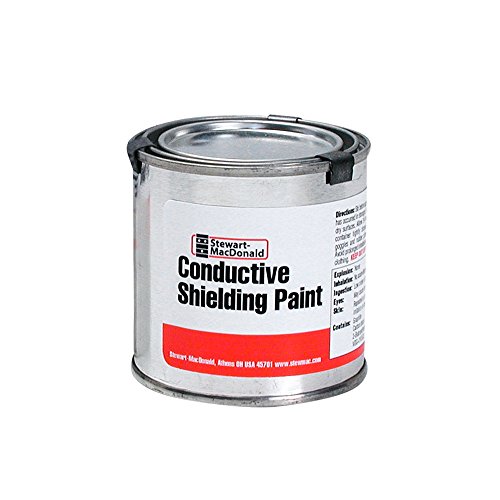
StewMac Conductive Shielding Paint
Water-based brush-on shielding paint that reduces hum, noise, and radio interference inside tight guitar cavities.
Pros
- Eliminates hum, noise, and radio interference
- Brushes into spaces copper tape can't reach
- Water-based and cleans up easily while wet
- Half-pint shields several guitars
Cons
- Must be connected to ground to work
- Needs two or more coats and overnight drying
StewMac is the name luthiers reach for, and this water-based shielding paint is the most foolproof way to silence radio interference. It brushes straight into pickup and control cavities where copper tape is too fiddly to fit, building a conductive layer that reduces hum, noise, and radio bleed once it’s tied to ground.
Two coats dry overnight, and a single half-pint can shields several guitars, so it works out cheaper than it looks for anyone who shields more than one instrument.
2. Copper Shielding Guitar Tape

Copper Shielding Guitar Tape
Conductive adhesive copper foil tape that blocks electromagnetic static and outside interference on single-coil guitars.
Pros
- Kills electromagnetic buzz on Strats and Teles
- Conductive adhesive needs no soldering
- Cuts to fit with ordinary scissors
- Affordable fix for single-coil hum
Cons
- Fiddly to measure and fit in tight cavities
- Aimed mainly at single-coil guitars
If you’d rather not wait for paint to dry, this conductive copper foil tape is the classic budget fix for single-coil guitars like Stratocasters and Telecasters that are most prone to electromagnetic static. The strong conductive adhesive means you can line the cavity without any soldering, just cut it to shape with ordinary scissors, stick it down, and play.
It takes a little patience to measure and fit the pieces neatly, but for the money it’s a genuinely effective way to kill buzz and stray radio signals.
3. Furman M-8Dx Power Conditioner

Furman M-8Dx Power Conditioner
Nine-outlet power conditioner whose AC noise filtering reduces radio frequency and electromagnetic interference to your rig.
Pros
- AC noise filtering cuts RFI and EMI
- Spike and surge protection keeps gear safe
- Nine outlets with wall-wart spacing
- Digital voltmeter shows incoming line voltage
Cons
- Doesn't fix shielding inside the guitar
- Rack-style unit takes up space
Sometimes the interference is riding in on your power, not your guitar, and that’s where the Furman M-8Dx earns its place. Its AC noise filtering is built specifically to reduce radio frequency (RFI) and electromagnetic (EMI) interference before it ever reaches your amp and pedals, and the spike and surge protection keeps your gear safe at the same time.
Nine outlets with wall-wart spacing and a digital voltmeter make it a tidy hub for a whole rig.
4. Radial SGI Studio Guitar Interface

Radial SGI Studio Guitar Interface
Transmitter and receiver system that sends guitar over long balanced cable runs without picking up RF noise.
Pros
- Balanced runs reject radio and hum over distance
- Class A active circuitry preserves tone
- Drag Control restores natural pickup load
- Heavy-duty road-ready construction
Cons
- Premium price for a two-box system
- Overkill for short studio cable runs
When the problem only shows up over a long cable run, the wire itself is acting like an antenna, and the Radial SGI fixes that with a transmitter-and-receiver pair that sends your signal balanced. A balanced line rejects radio interference and hum over distance, while the Class A active circuitry and Drag Control keep your pickups sounding natural rather than thin.
It’s a premium, road-ready solution that’s overkill for a short patch but invaluable for stage and studio runs.
5. AstroAI Digital Multimeter
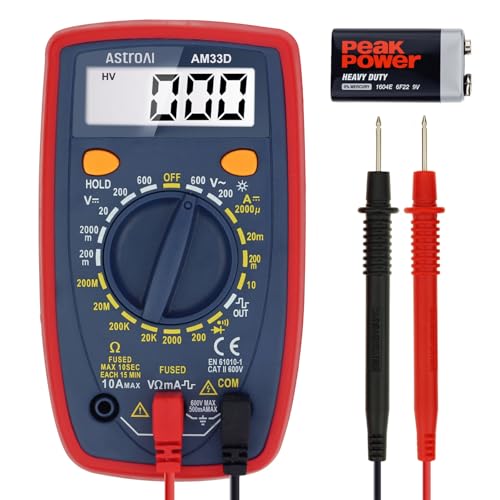
AstroAI Digital Multimeter
Affordable digital multimeter with a continuity buzzer for checking shielding connections and grounding inside your guitar.
Pros
- Continuity buzzer confirms your shielding is grounded
- Measures voltage, resistance, and diode
- Backlit screen reads in dim cavities
- Double fuse and test leads included
Cons
- A diagnostic tool, not a fix on its own
- Can't test all AC current ranges
Shielding only works if every cavity is connected and grounded, and the AstroAI multimeter is how you prove it. The continuity buzzer lets you confirm a solid path between your shielded cavities in seconds, and the backlit display is easy to read down inside a dark control route.
It also measures voltage, resistance, and diodes for general amp and guitar troubleshooting, so it stays useful long after the shielding job is finished.
Final Thoughts
For most players, the StewMac Conductive Shielding Paint is the answer. Radio interference is fundamentally a shielding problem, and a grounded conductive coat inside the guitar attacks it at the root in a way no outboard box can match.
It reaches the tight spots tape can’t, one can covers several guitars, and StewMac’s reputation means you aren’t gambling on the result.
The Copper Shielding Guitar Tape is the better starting point if you want a no-soldering, low-cost fix for a single-coil guitar, and it pairs naturally with the AstroAI multimeter so you can verify the connections before you button everything back up. If the noise is coming through your power or over a long cable, layer in the Furman M-8Dx to filter RFI from the wall or the Radial SGI to keep distant runs dead quiet.
Whichever route you take, remember that stopping radio interference is about cutting off the antenna, whether that’s an unshielded cavity, a dirty power line, or a long unbalanced cable. Shield the guitar first, confirm your grounding with a meter, and only then reach for the conditioner or interface if a station is still sneaking through.