A grand is real money for an amp, and the wrong one shapes your tone as much as the guitar plugged into it. With so many combos and heads in this range, narrowing it down is genuinely hard.
Start with power. It’s the spec people get wrong most, since a 100-watt stack with no attenuation is useless at home, and a tiny mini head can vanish on a loud stage.
The amps below mix tube and modeling, lunchbox heads and full combos, from a Fender ‘65 Princeton Reverb to high-gain machines. Every one lands under $1000 and earns its place on reputation, build, and real tone.
Whether you want clean studio sparkle, gig-ready crunch, or crushing gain, there’s a pick here for it. You can also browse our wider guitar amp picks at other prices, and the chart below stacks these up first.
Quick Comparison Chart
| # | Product | Our Rating | ||
|---|---|---|---|---|
| 1 |  |
PRS MT 15 Mark Tremonti | ★★★★★ | Check Price |
| 2 |  |
Boss Katana Artist MkII | ★★★★★ | Check Price |
| 3 |  |
Fender '65 Princeton Reverb | ★★★★☆ | Check Price |
| 4 |  |
Marshall DSL40CR | ★★★★☆ | Check Price |
| 5 |  |
Vox AC15C2 | ★★★★☆ | Check Price |
| 6 |  |
Peavey 6505 | ★★★★☆ | Check Price |
| 7 |  |
Fender Hot Rod Deluxe IV | ★★★★☆ | Check Price |
| 8 |  |
Orange OR15H 15-watt Tube Head | ★★★★☆ | Check Price |
| 9 |  |
Randall EOD88 Tube Amp Head | ★★★★☆ | Check Price |
| 10 |  |
Line 6 DT25 | ★★★★☆ | Check Price |
Lunchbox Heads and Legacy Combos
Two lunchbox heads punch hardest per pound: the PRS MT 15 with its 6L6 push and the Orange OR15H switching between 15 and 7 watts. The Peavey 6505 sits at the other extreme, 120 tube watts of metal heritage.
The Randall EOD88 is the spec oddity, running KT88 power tubes almost nothing else in guitar uses, and the Line 6 DT25 hides a Bogner-designed tube stage inside a modeler.
1. PRS MT 15 Mark Tremonti

PRS MT 15 Mark Tremonti
Two-channel 15/7-watt lunchbox tube head with 6L6 power tubes that punches like a 50-watt amp.
Pros
- Two fully independent, individually voiced channels
- 6L6 tubes deliver big volume from a small head
- Switchable 15/7W for stage or bedroom
- Includes footswitch and amp cover
Cons
- Head only, needs a separate cabinet
- Single-button footswitch is basic
Besides its smaller size, this lunchbox-style head is truly equivalent to a number of larger amps, pairing two completely independent, individually voiced channels with a feature set rarely found in this category. It’s versatile enough to be an ideal studio workhorse and powerful enough for the stage when run into a 2x12 or 4x12 cabinet.
The PRS MT 15 is rated at 15 watts, but its 6L6 power tubes (rather than the usual EL84 or 6V6 found in most compact amps) let it compete with full-sized 50-watt heads on volume and tone. Six JJ EC83S preamp tubes deliver remarkable gain that goes far beyond rival lunchbox amps, and the switchable 15/7-watt output keeps it usable at home.
Check out our full PRS MT 15 Mark Tremonti amp review for a deeper look.
2. Boss Katana Artist MkII

Boss Katana Artist MkII
100-watt combo with a Waza 12-inch speaker, five amp characters, and built-in effects for gigging.
Pros
- 100 watts is loud enough for any gig
- Five amp characters plus five variations each
- Booster, mod, FX, delay, and reverb onboard
- Custom Waza speaker nails British stack tone
Cons
- Solid-state, not a tube amp
- Deep editing needs the companion software
This professional 100-watt combo is sufficiently loud for any gig and is specifically designed to handle the tonal demands of a loud stage. Its custom Waza 12-inch speaker realizes classic British stack tone with increased power handling, while the Tube Logic design approach gives it class-defying punch and cutting presence.
The Katana Artist has been a massive hit because it offers impressive effects and tones at an affordable price in a giggable package. Five amp characters with five variations each, plus Booster, Mod, FX, Delay, and Reverb sections, mean this all solid-state amp debunks the idea that tube combos are the only serious option.
The semi-closed back keeps the low end tight and focused.
3. Fender ‘65 Princeton Reverb
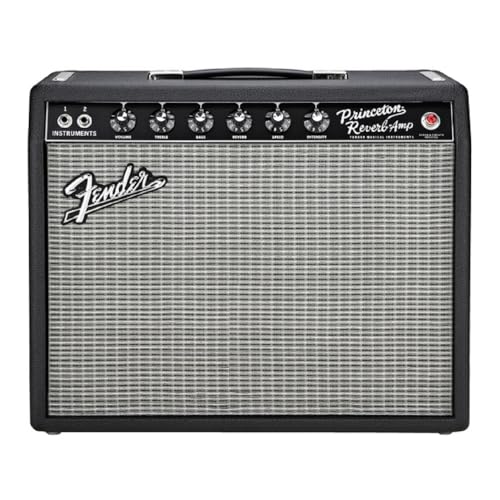
Fender '65 Princeton Reverb
15-watt all-tube combo with legendary Fender spring reverb and tube vibrato for stunning cleans.
Pros
- Among the best clean tones you can buy
- Legendary long-spring Fender reverb
- All-tube design with tube rectification
- Includes cover and 2-button footswitch
Cons
- No effects loop for outboard gear
- 15 watts may be light for loud stages
This amp is a faithful revamp of a legend, and Fender wisely kept everything pretty much the way it was. The control set is simple, with two instrument inputs, reverb, a modest two-band EQ, and a volume knob, so there’s nothing complicated to wrestle with here.
The core of this 15-watt all-tube combo is its complement of vacuum tubes, including tube rectification, feeding a 10-inch Jensen C-10R speaker. It’s equipped with some of the most amazing cleans you’ll ever hear, and the legendary long-spring Fender reverb and tube vibrato play beautifully with pedals.
It only produces 15 watts, so it shines brightest in the studio and on smaller stages. Read our Princeton vs Deluxe comparison if you’re torn between the two.
4. Marshall DSL40CR
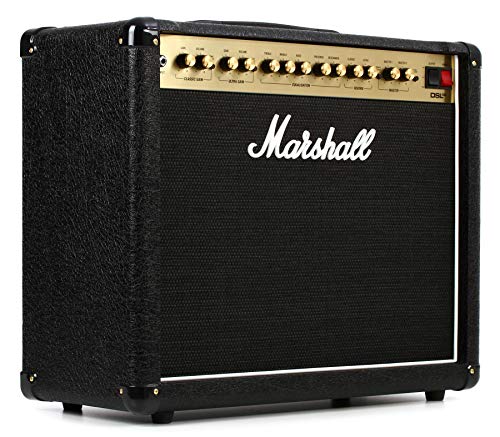
Marshall DSL40CR
40-watt all-tube combo with classic Marshall crunch, two channels, and a Celestion V-Type speaker.
Pros
- Iconic Marshall tone in a gig-ready combo
- Gain and volume on each of two channels
- Power reduction down to 20 watts
- Reverb and Softube emulated output included
Cons
- Lacks some features of pricier amps
- Heavy 1x12 combo to haul around
This beautiful and powerful amp is built to produce that classic, pleasing Marshall tone, and the fully tube-powered design keeps up in the studio and on stage. The Marshall DSL40CR puts 40 watts of tube power through a classically voiced 12-inch Celestion V-Type speaker, with a power-reduction option that drops it to 20 watts.
Four ECC83 preamp valves and two EL34 power valves drive a dual-channel design with gain and volume per channel, a dedicated resonance control, and two separate master volumes. The classic gain channel delivers smooth distortion, while the Ultra gain mode is made for blowing out windows, and the onboard reverb and Softube emulated output round out a genuinely gig-ready package.
5. Vox AC15C2
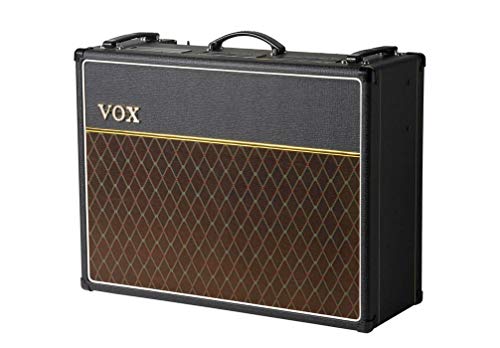
Vox AC15C2
15-watt tube combo with two 12-inch Celestion speakers and the classic Vox Top Boost chime.
Pros
- Iconic Vox chime and articulate cleans
- Two 12-inch Celestion Greenbacks project well
- Normal and Top Boost channels for versatility
- Built-in tremolo and reverb
Cons
- Fewer features than rival combos
- EL84 tubes get loud fast for home use
This amp offers impressive tonal quality and a vintage sound loaded with pedigree. The C2 designation means it’s a customized version of the AC15 with two 12-inch Celestion speakers, and that extra cone is a big part of its organic overdrive and impressive cleans.
Its 15-watt output is produced by EL84 power tubes and 12AX7 preamp tubes feeding the classic Top Boost circuit, with interactive treble and bass controls for dynamic tone shaping. Normal and Top Boost channels each get their own volume, and a Tone Cut control in the power stage adds further shaping.
Naturally sounding reverb and tremolo are built in, making this a quintessential choice for players who love that chiming British clean.
6. Peavey 6505

Peavey 6505
120-watt all-tube high-gain head with six 12AX7 preamp tubes and four 6L6 power tubes for metal.
Pros
- Crushing high-gain tone built for metal
- Three-band EQ on each channel
- Pre and post gain per channel for fine control
- Reliable, road-tested workhorse
Cons
- No footswitch included in the box
- 120 watts is overkill for home use
The Peavey 6505 delivers crushing high-gain sounds with plenty of power to spare and a tone that’s immediately recognizable whether live or in a recording. This 120-watt head uses six 12AX7 tubes in the preamp and four 6L6GC tubes in the power stage, and the tube quality here’s genuinely remarkable.
The defining features are its pre and post gain knobs for both channels, with a three-band EQ and resonance and presence controls per channel. The type of distortion it offers is relatively unique among tube amps, and it’s famously reliable and durable, taking abuse on the road and continuing to deliver.
Just note that no footswitch is included, so factor one in to get the most out of the channel switching.
7. Fender Hot Rod Deluxe IV

Fender Hot Rod Deluxe IV
40-watt all-tube combo with a Celestion A-Type speaker and modified circuitry for tighter overdrive.
Pros
- Fat, powerful tube tone for blues and rock
- Improved overdrive note definition
- Smoother spring reverb than prior versions
- Lightweight pine cabinet is easy to carry
Cons
- No built-in effects beyond reverb
- Notoriously bright clean channel
This all-tube, 40-watt amp is built around a single 12-inch Celestion A-Type speaker and a lightweight pine cabinet that’s sturdy yet easy to carry around the house or onto the stage. Forty watts may look modest, but this combo is more powerful than many solid-state 100-watt amps and comfortably fills larger venues with clarity and warmth.
The fourth-generation update brings modified preamp circuitry for tighter, more defined overdrive and a spring reverb tuned for improved smoothness even when cranked. It’s renowned for fat lows, relaxed mids, and sleek highs, and while it doesn’t pack the built-in effects of pricier amps, its core tube tone is hard to beat for blues and classic rock.
8. Orange OR15H 15-watt Tube Head

Orange OR15H 15-watt Tube Head
All-valve single-channel lunchbox head with switchable 15/7-watt output and a buffered effects loop.
Pros
- Rich all-valve tone in a compact head
- Switchable 15 or 7 watts for any room
- Buffered loop keeps pedals pristine
- Iconic Orange looks and build
Cons
- Single channel limits versatility
- Some find the voicing thin at low volume
This powerful portable head stands out in both looks and sound. It’s all-valve and can be operated at 15 or 7 watts, delivering the ideal amount of drive wherever you play, and its pics-only graphic gives it that unmistakable Orange aesthetic.
The boutique voicing sets it apart from other low-wattage valve heads.
The OR15H is as much about feel as it’s about tone, rewarding players who like to ride the volume control for everything from clean to crunch. It ships with a valve-buffered, low-impedance effects loop that lets you patch in pedals between the preamp and power sections without sacrificing tone, so your pedalboard performs at its best in the club, the studio, or at home.
9. Randall EOD88 Tube Amp Head

Randall EOD88 Tube Amp Head
All-tube KT88 doom head with three switchable gain modes and a built-in fuzz circuit for heavy metal.
Pros
- Massive all-tube tone for doom and metal
- Three switchable gain modes get angrier in turn
- Built-in fuzz circuit and footswitch included
- Eye-catching limited-edition red covering
Cons
- Heavy single-channel head
- Very loud and metal-focused only
This old-school, unapologetic tube head leans hard into heavy metal, right down to the skull on the front panel. The acronym EOD stands for Element of Doom, and the limited-edition bold red casing makes it as eye-catching as it’s loud.
This single-channel head is equipped with KT88 tubes pushing 88 watts and a built-in switchable fuzz circuit that captures the spirit of heavy metal. Three switchable gain modes each get a little angrier than the last, and the included footswitch controls both the gain modes and the fuzz.
A simple EQ section with depth and presence controls opens up the tone, and a master volume lets you really crank it. It’s heavy and unapologetically loud, but for doom and metal it absolutely delivers.
10. Line 6 DT25

Line 6 DT25
25/10-watt tube combo with Bogner-designed voicings and a custom Celestion G12H90 speaker.
Pros
- Four amp voicings cover most classic tones
- Real EL84 tube power, not just modeling
- Bogner-designed circuit sounds authentic
- Intuitive two-channel, reconfigurable design
Cons
- Footswitch costs extra
- Older platform with limited support
If tone is your thing, this portable all-tube combo is worth a hard look. The 25W/10W amp delivers four impressive amp voicings and serious versatility thanks to a circuit designed in partnership with Bogner, real EL84 tube power, and a 12AX7 preamp tube feeding a custom Celestion G12H90 speaker.
At the flick of a switch it moves from shimmering Fender-style cleans to modern high gain, classic Vox chime, and meaty Marshall crunch, with selectable operating class and power tube modes for further tailoring. In essence it’s a tidy, two-channel, great-sounding valve amp with a streamlined front panel that lets almost any guitarist dial in an inspiring tone.
Just note there’s no footswitch in the box if you want to switch on the fly.
Final Thoughts
The PRS MT 15 Mark Tremonti took the top spot for packing genuine boutique tone, two independent channels, and 6L6-driven volume into a lunchbox head that competes with amps twice its rated wattage. The switchable 15/7-watt output makes it just as usable at home as it’s on stage, and few amps near this price feel as refined.
If you need a do-everything gigging machine, the Boss Katana Artist MkII is the smarter buy. Its 100 watts, Waza speaker, and deep onboard effects cover nearly any style in one package, and it stays loud enough for any stage.
For pure clean tone, nothing here beats the Fender ‘65 Princeton Reverb, and metal players will find the Peavey 6505 and Randall EOD88 deliver the high-gain punch they’re after.
Ultimately, there’s no single definitive answer to the best guitar amp under $1000, because tone is deeply subjective. Match the wattage, channel count, and voicing to where and how you actually play, and any amp on this list will reward you for years.
For more picks across every budget, see our full best guitar amp guide.