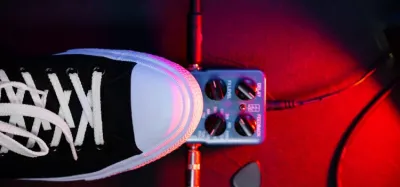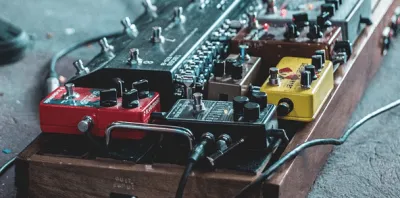
You think Fender, you think Strats and tube amps. The company’s stompboxes get far less attention, which leaves a real question: are its distortion pedals worth a spot on your board?
That’s the gap worth closing. A famous logo on a guitar tells you nothing about how a pedal is built or how it bites.
This article digs into Fender’s approach to its effects and which distortion boxes earn their place. We’ll cover the build, the sound, and models like the dual-effect Compugilist.
For more options, our best distortion pedals guide is a good next read, but let’s start with what makes a Fender distortion pedal good.
What Makes a Fender Distortion Pedal Good?
Well, it’s Fender. If you’ve never bought one of these guitar pedals before, you may not know much about the company’s effects line.
Fender has a long, glorious history in the guitar world, and it has taken the same approach to its pedals.
These pedals are classy, error-free in operation, and packed with practical touches. You get switchable LED positions, an easy-access magnetic battery door, and solid build quality throughout.
Those small details add up to a pedal that feels dependable on stage and at home, which is exactly what you want from gear you plug into night after night.
Which Fender Distortion Pedals Stand Out?
There are a lot of good options out there, and in my opinion Fender gets a little overlooked in this category. Here are a few of my favorites among the pedals they offer:
- Fender Pugilist Distortion Pedal
- Fender MTG: LA Tube Distortion
- Fender Compugilist Compressor-Distortion
- Fender Santa Ana Overdrive
- Fender MTG Tube Distortion
The Pugilist is a great starting point with its dual-circuit design, while the MTG models lean into tube-driven, higher-gain territory. The Compugilist adds a compressor for players who want two effects in one box.
There’s a Fender option for almost any style.
What Is a Distortion Guitar Effect?
To understand the best type for you, and whether a distortion pedal is even necessary, you first need to know what the effect actually does. Distortion comes into play whenever you want to add girth and tone control through your pedals.
You generally have two options here: distortion or overdrive. Although the two can achieve similar results, they’re different.
Overdrive is the older, more subtle approach, while distortion is a more modern, aggressive form of the effect. It squeezes the most sweetness out of your guitar, altering the tone significantly and adding tons of sustain.
If you want a deeper dive, our walkthrough on how to use a distortion pedal covers the basics of dialing it in.
What Qualities Make Any Distortion Pedal Good?
Gain is one of the most essential aspects a pedal can offer. It’s largely what makes the whole adventure of guitar playing so impressive.
Sometimes it’s hard to know which pedal is right for you, and when that happens the wisest move is to do your homework and read plenty of reviews to find the classic, reliable options.
When shopping for pedals, understand that there are several types, and getting the best one requires a thorough comparison. You want to identify the unique flavor that works for your style while making sure the gain level is right for the music you play.
Beyond gain, make sure the pedal doesn’t make your tone too muddy. Volumes that are too low or too high can work against your playing, so avoid those by all means.
One of the best ways to avoid a mistake is to choose pedals with plenty of positive reviews, because players rarely praise gear that let them down. A Fender distortion pedal is a frequent favorite in the market, and choosing one is a safe bet as long as you buy from a reputable outlet.
If you’re torn between pedal types, our comparison of amp distortion vs a distortion pedal is worth a read.
What Features Should You Look For?
One of the challenges many electric guitar players face is the gradual degradation of their sound quality over time, which can quietly hold back your progress. The right pedal solves this, and players who have used Fender’s distortion pedals will tell you they’re among the most impressive options on the market.
When shopping, features matter more than most people realize. Buyers who end up with the wrong pedal usually skipped the research on what each one actually does.
Look for true bypass, a boost switch, a reliable and robust battery, and useful controls such as recovery, blend, LEDs, and level. These features give you flexibility and keep your signal clean when the pedal is switched off.
Frequently Asked Questions
Are Fender pedals better than Boss pedals?
Neither brand is strictly better, because they serve different priorities. Boss pedals are known for rugged, no-nonsense reliability and a huge catalog, while Fender pedals lean into premium build quality, tube circuits, and a more boutique feel.
If you want a simple, bulletproof workhorse, Boss is a safe pick. If you want richer features and tube-driven character, Fender’s distortion lineup is a strong choice.
Is distortion or overdrive better for beginners?
Overdrive is often friendlier for beginners because it adds warmth and grit without overwhelming your tone. It reacts well to your picking dynamics and pairs nicely with a clean amp.
Distortion delivers heavier, more saturated gain, which is great for rock and metal but can sound muddy if you’re still learning to control your sound. Many players end up owning both.
Do Fender distortion pedals work with any amp?
Yes, Fender distortion pedals work with virtually any amp, whether it’s solid-state or tube. They’re designed to sit in front of your amp and shape your tone before it hits the amplifier.
For the cleanest results, run the pedal into a relatively clean amp setting so the pedal’s character comes through clearly rather than fighting your amp’s own gain.
Are Fender distortion pedals worth the price?
For most players, yes. Fender pedals sit at a mid-to-premium price point and back it up with solid build quality, thoughtful features, and genuine tonal range.
If you only need a basic, occasional crunch, a cheaper pedal may be enough. But if you value reliability and want a pedal that performs well on stage for years, the investment pays off.
Final Thoughts
We hope this article has given you some real insight into whether Fender distortion pedals are right for you. To make an informed choice, it helps to list a few pedals and compare them carefully before you pick the best one for your rig.
Talking to experienced players, reading honest reviews, and trying out a couple of distortion pedals before deciding means you’ll rarely go wrong. Knowledge is power, and when you have it you can be confident you’ll get the tone you’re after.
Fender’s reputation for quality carries straight into its pedals, so if you’ve been on the fence, you can buy with confidence and focus on the fun part: playing.