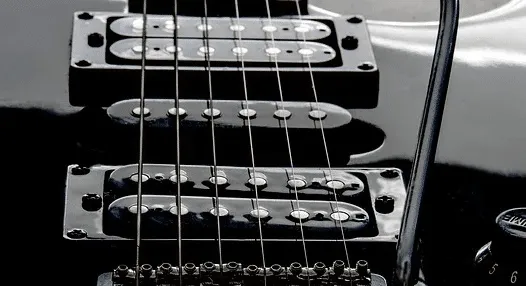
Flip the little switch on your guitar and the whole sound changes, from warm and round to bright and cutting. That’s the payoff of having more than one pickup.
Glance at almost any electric guitar and you’ll see two or three of them lined up between the neck and the bridge. They aren’t there for looks, and they aren’t spares.
This guide explains why builders use multiple pickups and how each spot shapes the tone. It also covers the main pickup types, including the kind you’d add to an acoustic.
First, here’s how a pickup turns string movement into sound.
How Do Guitar Pickups Work?
To create sound, an electric guitar electronically senses the vibration of the strings and sends that signal to an amplifier. The amp boosts the signal enough to drive a speaker, which converts the electronic signal back into mechanical energy and recreates soundwaves that mirror the movement of the string.
The sensing happens inside a magnetic pickup (like these best Stratocaster pickups) mounted beneath the strings on the body of the guitar. A pickup is built from a bar magnet wrapped with roughly 7,000 turns of fine wire.
Just as magnets and coils turn electrical energy into motion in electromagnetism, the same physics works in reverse here: the vibrating steel strings disturb the magnet’s field, which induces a matching flow of energy in the coil.
For a deeper look at the science and construction, see these guides:
- How Guitar Pickups Work - Yes, It’s Physics, But It’s Cool
- How Are Guitar Pickups Made and How To Make Them
Electric Guitar Pickup Types
There are several guitar pickup types, and each has its own sound. Pairing more than one creates an extra set of variations.
Some pickups extend a single magnetic bar beneath all six strings, while others use a dedicated pole piece for every string. Most electric guitars come with two or more pickups placed at different spots on the body.
Those multiple pickups have a big impact on a guitar’s overall sound signature, and you may already lean toward a particular tonal character before you ever pick the instrument up. As a rule, the more pickups you’ve, the more tonal possibilities are open to you.
There are two major pickup types to choose from: single-coil and humbucker, the humbucker using two coils.
Neither is right or wrong. It comes down to preference and the music you make.
A standard electric guitar has at least two pickups, but configurations vary. Some pair two single-coils with one humbucker, while others combine two humbuckers with a single-coil.
For a full breakdown, see the types of guitar pickups.
Also worth a read: what’s a microphonic pickup? and the best humbucker for blues.
Single-Coil Pickups
Electric guitar pickups arrived in the 1930s. As the guitar grew into a lead instrument, the single-coil pickup appeared.
These pickups behave like little antennas, and they can pick up electromagnetic interference that’s usually heard as a faint hum.
A single-coil pickup tends to have a crisper, brighter tone. Players often describe single-coils as having more attack and bite than humbuckers, and they can sound gritty when pushing a tube amp into overdrive.
Depending on the amp, your playing technique, and any effects in the chain, single-coils can also produce the chiming, glassy tones associated with classic 1960s pop guitar. With plenty of exceptions, single-coils are a favorite among surf and country players chasing maximum twang.
Humbucker Pickups
As guitarists turned up their amps and guitar volume knobs, the hum and buzz from single-coils grew louder too. The humbucking pickup was introduced in the 1950s to solve this.
A humbucker uses a pair of coils wired out of phase so that the hum produced by one coil is cancelled by the other.
Tonally, humbuckers usually sound thicker, and players tend to perceive them as warmer and rounder. They also tend to accentuate the sustain produced by the guitar’s tonewoods.
Jazz, metal, and heavy rock players often favor humbuckers, and with their midrange emphasis and wider distortion spectrum (like these top pickups for metal), they appeal to blues players and fans of overdriven tube sounds as well.
Because a humbucker (like a Stratocaster with humbuckers) has two coils, some designs let you split or isolate one coil for a sound reminiscent of a single-coil. A coil tap wires a specific point in the coil to a switch or button, chosen to deliver a distinct sound from the full winding and add versatility.
When humbuckers first showed up in guitars, they carried a sticker that read “Patent Applied For,” which is why they became known as P.A.F. pickups. The design has seen many variations over the last several decades, yet many professional players still prefer the original P.A.F. sound.
Nearly all double-coil pickups are called humbuckers, though some are wired to switch between humbucking and non-humbucking operation.
Why Single-Coil Pickups Still Matter
Even with the quiet performance and full sound of humbuckers, plenty of guitarists still prefer single-coils, mainly because they sound great in their own way. Single-coils are typically crisper and brighter with more note definition between strings, while humbuckers are usually darker, louder, and heavier.
Most Fender guitars use single-coils and most Gibsons use humbuckers, with an endless list of hybrids in between. Some hybrids use single-coils voiced to sound like humbuckers, and humbuckers voiced to recall single-coils.
Sometimes the choice between double- and single-coil simply comes down to whether the body was routed for a wider humbucker or a narrower single-coil.
Many guitarists are loyal to a particular type. The sounds of Stevie Ray Vaughan and Jimi Hendrix were created almost entirely with single-coils, while Joe Perry, Slash, Billy Gibbons, and Carlos Santana are closely tied to humbuckers.
Others have used both: Eric Clapton played humbuckers during his Cream and Bluesbreakers years, then moved to single-coils around the time of “Layla.”
Where Pickups Sit on the Guitar
Pickup placement is one of the most influential factors in electric guitar tone. As a general rule, the farther apart the pickups sit, the wider the range of sounds you can get from the instrument.
A pickup near the bridge captures a sharper, more focused signal, while a pickup nearer the neck produces a fuller, bassier tone.
Most electric guitars place two or more pickups at different points on the body, and the exact locations depend on the design. A Telecaster (not the Telecasters with humbuckers) uses two single-coils: one at the neck and one at the bridge, regardless of the electric guitar bridge type.
The neck pickup gives a mellower sound, while the bridge pickup, mounted on a metal plate, produces a sharp, twangy tone with pronounced treble.
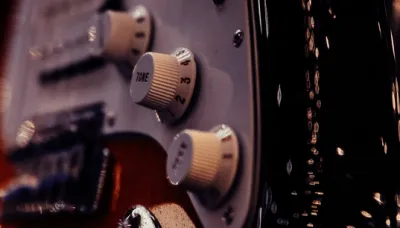
The standard Stratocaster uses three single-coils, and a lever switch selects each pickup or combination. The positions are called neck, middle, and bridge based on where they sit.
The neck pickup usually has the lowest output with the most bass and midrange. The bridge pickup has higher output and the most treble, with a noticeable twang.
The middle pickup sits in between, similar to the neck but with a little more treble and less bass. Modern Stratocasters give you five switch positions.
How Pickup Position Changes Your Tone
A pickup’s frequency response is shaped by its magnetic aperture and its physical position along the string. The table below summarizes the general tendencies you can expect from the common positions.
| Pickup position | Typical output | Tonal character | Common uses |
|---|---|---|---|
| Neck | Lower | Warm, full, more bass and midrange | Clean rhythm, lead melodies, jazz |
| Middle | Moderate | Balanced, slightly brighter than neck | Funk, in-between blended tones |
| Bridge | Higher | Bright, cutting, twangy treble | Lead, rock, country twang |
If you care about getting the widest possible variety of tones from a single guitar, look for designs that space the pickups as far apart as the body allows. The greater the distance between them, the more distinct each position will sound, which is the whole reason multiple pickups exist in the first place.
Frequently Asked Questions
How many pickups does a guitar need?
Most electric guitars have at least two pickups, and many have three. One pickup is enough to make sound, but two or three give you the ability to switch tones, which is why nearly every modern electric ships with more than one.
A single-pickup guitar can still be a great instrument for a focused sound, but adding pickups in different positions widens your tonal range considerably.
Are more pickups always better?
Not necessarily. More pickups add tonal options, but the best setup is the one that matches the music you play.
Some players thrive with a single bridge humbucker, while others want the five positions of a three-pickup Stratocaster.
Extra pickups mean more switching choices, not automatically better tone. Choose the configuration that gives you the sounds you actually use.
Can you mix single-coils and humbuckers on one guitar?
Yes. Hybrid configurations are common, such as two single-coils with a bridge humbucker (often called HSS).
They let one guitar cover bright single-coil tones and thicker humbucker tones.
Some pickups blur the line further: single-coils voiced to sound fuller, and coil-split humbuckers that mimic single-coils. See whether you can put a humbucker in a Strat for one example.
Which pickup should I use for which sound?
As a starting point, use the neck pickup for warm, full lead and clean rhythm tones, the bridge pickup for bright, cutting leads and twang, and the middle or blended positions for funk and balanced rhythm work. There are no fixed rules, so experiment.
If you play heavy styles, a bridge humbucker is a common choice. For surf and country twang, a bridge single-coil is hard to beat.
Your amp, technique, and effects all factor in too.
Final Thoughts
An electric guitar’s pickups are the heart of its voice. Each one captures the strings from a different position, so switching between them, or blending them, turns a single guitar into a tool that can cover many sounds.
That flexibility is exactly why two or three pickups became standard.
If you’re shopping for a guitar and are unsure which pickup type or layout to choose, trust your ears. Even if your favorite player uses humbuckers, there’s no reason to follow suit unless that sound appeals to you.
Let the music you want to play guide the decision: heavier styles often suit humbuckers, while bright, twangy styles lean toward single-coils.
Finally, remember that materials and proprietary construction methods vary between manufacturers, so two guitars with the same pickup configuration can still sound different. The pickup is only one piece of the puzzle, but it’s one of the most important ones.