
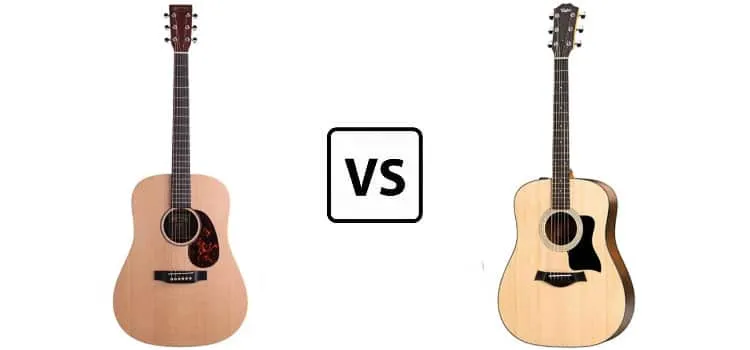
Shop for a mid-priced acoustic and two names keep surfacing: the Martin DX1AE and the Taylor 110. Both are dreadnoughts, and both turn up on lists of the best acoustic guitars for the money.
That’s exactly why the choice stalls. One brand pioneered the dreadnought, the other made modern acoustics feel easy under the hand.
Play them side by side and the resemblance fades fast. Each has its own voice, and the right pick depends on which one matches your playing.
We compare them on history, tone, playability, build, and value. First, a little background on where each guitar comes from.
Quick Comparison
| Category | Martin DX1AE | Taylor 110 | Winner |
|---|---|---|---|
| Tone | Warm, classic, low-end bloom | Bright, modern, crisp mids | Depends |
| Neck | Traditional build | NT bolt-on, easy adjusting | Taylor 110 |
| Beginners | Approachable once set up | Slightly easier barre chords | Taylor 110 |
| Heritage | Martin, founded 1833 | The modern innovator | Tie |
| Build | Traditional format | Precision modern design | Depends |
| Electronics | Onboard as standard | Available with electronics | Tie |
| Overall | Warm tradition | Bright modern playability | Depends |
The Background
When it comes to history, Martin holds an exceptional presence in the market. The company launched in 1833, and it’s considered among the oldest acoustic guitar makers on the globe.
Christian Frederick Martin founded the brand, and what has kept it on top is its design pedigree. The dreadnought body shape Martin pioneered has been copied by countless other builders, and the DX1AE carries that lineage forward.
The Taylor 110, on the other hand, stands out as a more modern acoustic. Taylor was established in 1974 by Robert Taylor, and the 110 has earned a reputation for being user-friendly, which makes it ideal for beginners.
Taylor acoustic guitars are known for clean, consistent builds and high quality.
The 110 is also credited with helping popularize the bolt-on maple neck, and its dreadnought body shape is close to the Martin DX1AE.
Sound and Tone
Because the two instruments are made from different materials, they produce different tones. When you compare the Martin DX1AE to the Taylor 110, the Martin delivers classic acoustic guitar sounds with a distinctive lower-frequency bloom.
You can hear that balanced, traditional voice across decades of records and albums. Notable artists who have played Martin guitars include Elvis, Hank Williams, Paul McCartney, Neil Young, and members of The Eagles.
The Taylor 110, by contrast, produces a more modern sound. The tones are brighter and crisp, with an emphasis on the upper mids.
Players associated with Taylor guitars include Chelsea Wolfe, Taylor Swift, and Mateus Asato, among many others. Both guitars can be plugged into an amp, and the onboard electronics on each let you push a clear, bright range into your mix.
Playability and Performance
Comparing how the Martin DX1AE and the Taylor 110 play, you’ll find only a slight difference. Both are exceptional once they’re set up correctly, and with the right skills you can play either comfortably.
A few minor adjustments are usually all it takes, and most of those can be made without an expert. One factor that affects feel is the fretboard radius.
The Martin DX1AE uses a standard 16-inch radius, while the Taylor 110 uses a 15-inch radius. Although the difference is small, a smaller radius can make barre chords slightly easier to fret.
Either way, both guitars are easy to play and are built from quality materials to high standards.
Build, Materials, and Bracing
The Martin DX1AE and the Taylor 110 are built differently, and that shows up in both structure and finish. Martin has kept a traditional format for well over 170 years, while Taylor has leaned into a modern design since its inception.
Taylor’s advanced neck construction, including the neck angle, makes adjustment easier to fit current needs. The New Technology (NT) neck on the 110 supports the fretboard and enhances stability by integrating the neck into the solid body.
Performing traditional neck adjustments on a Martin can be more involved and costly. The DX1AE neck isn’t designed to be adjusted the way the Taylor is, owing to its traditional nature, but in exchange you get the resonant, balanced tone depth Martin is known for.
Each Martin is built by specialists who focus on specific areas, so the person who shapes the neck does that job across guitars, and the person who builds the dreadnought body does the same. This division of expertise is part of how Martin’s factory maintains its quality.
Bracing is another point of difference. Most acoustic guitars use X-bracing, which carries a familiar trade-off: you often have to reduce volume to gain sustain.
Newer V-class bracing was developed to increase both sustain and volume without compromising tone quality. The takeaway is that bracing design directly shapes how loud and how long each guitar rings, and the two brands approach it from different traditions.
Value for the Price
Despite being the more traditional guitar, the Martin DX1AE offers a distinctive, crisp character that many players prize. The Taylor 110 gives you the familiar tones you hear across a lot of contemporary music.
Honestly, it’s hard to declare one flatly better than the other. Both produce high-quality sound, so the real value comes down to which voice and feel match your playing and your needs.
How the Martin DX1AE and Taylor 110 Compare
So we’ve walked through the history, tone, playability, build, and value of both guitars. Here’s how they stack up when you put them side by side.
| Feature | Martin DX1AE | Taylor 110 |
|---|---|---|
| Body size | Slightly smaller, more compact | Full dreadnought |
| Top wood | Sitka spruce | Spruce top |
| Body wood | Mahogany pattern (HPL) | Laminated walnut |
| Neck | Solid mahogany | Maple |
| Fretboard radius | 16 inches | 15 inches |
| Tone | Warm, classic, strong low-end bloom | Bright, crisp, upper-mid focused |
| Neck adjustment | Traditional, less easily adjusted | Modern NT neck, easier to adjust |
| Best for | Players who want a vintage Martin voice | Beginners and players who want modern brightness |
On tone, the Martin leans warm and traditional while the Taylor leans bright and modern. On playability, the Taylor’s slightly smaller radius and adjustable neck give it an edge for beginners, though both are easy to play.
On materials, the Martin’s solid mahogany neck and Sitka spruce top contrast with the Taylor’s laminated walnut body and maple neck. Both are well-built dreadnoughts, so the deciding factor is usually the sound you want in your hands.
Frequently Asked Questions
Is the Martin DX1AE or Taylor 110 better for beginners?
The Taylor 110 is often the easier pick for beginners. Its modern NT neck is simpler to adjust, and the slightly smaller 15-inch fretboard radius can make barre chords a touch more comfortable.
That said, the Martin DX1AE is also approachable once it’s set up properly, so it comes down to the tone and feel you prefer.
Can you plug both guitars into an amp?
Yes. Both the Martin DX1AE and the Taylor 110 are available with onboard electronics, which is what the “AE” in the Martin model name refers to.
This lets you plug into an amp or PA and push a clear, bright signal into your mix for live or recorded use.
Is the Taylor 110 neck adjustable?
The Taylor 110 uses a New Technology (NT) bolt-on neck that’s designed for easier adjustment of the neck angle. That construction is one of the practical advantages it has over the more traditional Martin.
The Martin DX1AE neck is built in a traditional style and isn’t meant to be adjusted in the same way, which is part of what gives it its resonant tone.
Which guitar has a warmer tone?
The Martin DX1AE has the warmer, more classic tone, thanks to its Sitka spruce top and solid mahogany neck and its distinctive low-frequency bloom.
The Taylor 110 sits on the brighter end of the spectrum, with crisp upper-mid tones that suit a lot of modern music.
Final Thoughts
If you want a classy dreadnought acoustic, both the Martin DX1AE and the Taylor 110 can deliver a remarkable experience. The debate over which is better has run for years, and every player tends to land somewhere different.
In the end, suitability comes down to your own preferences, your budget, and the tone you’re chasing.
If a warm, traditional voice with a strong low end appeals to you, the Martin DX1AE is the natural choice. If you want a brighter, modern sound and a neck that’s easy to adjust, the Taylor 110 is the better fit, especially for beginners.
For more on how these two heritage brands stack up overall, see our deeper breakdown of Taylor vs Martin guitars.