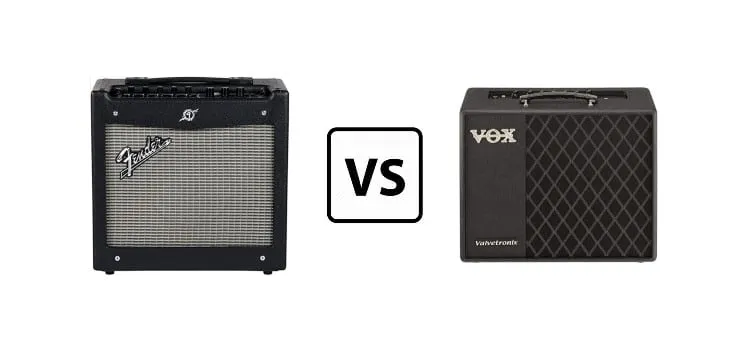
On paper these two look like twins. Both pack 40 watts and a pile of amp models, and both court the same bedroom-to-small-gig player.
Plug in, though, and they pull apart fast. One leans on a real valve circuit for warmth, while the other is happiest wired into a laptop for recording.
This guide weighs what each amp does well and where it slips, so you can match one to your rig. We’ll start with the Vox VT40+ and what it brings.
Quick Comparison
| Category | Vox VT40+ | Fender Mustang II | Winner |
|---|---|---|---|
| Tone engine | 12AX7 Valve Reactor tube | Pure digital modeling | Vox VT40+ |
| Presets | 99 presets plus 33 song presets | 8 onboard, more via USB | Vox VT40+ |
| Recording | No USB output | Speaker-emulated USB out | Fender Mustang II |
| Speaker | 10-inch Vox | 12-inch Fender | Fender Mustang II |
| Extras | Built-in tuner, headphone cab sim | Ableton Lite and AmpliTube bundled | Depends |
| Power | 40W, 60W maximum | 40W | Tie |
| Overall | Tone and feel | Home recording | Depends |
Vox VT40+: What Is It?
The Vox VT40+ is a hybrid modeling combo sought after by guitarists across nearly every style. It pairs a 12AX7 preamp tube with a deep library of amp models and a unique power level control, so it behaves like a real valve amp while still offering the flexibility of digital modeling.
At the heart of the amp is the Vox Valve Reactor circuit. This tube-driven design reproduces the response, subtle picking nuances, and tonal character of a classic tube amp, which is what separates the VT40+ from purely solid-state modelers in its class.
In short, it’s a fusion of genuine tube-amp sound and cutting-edge modeling technology.
The cabinet measures 16-1/2 inches wide by 8-3/4 inches high by 16 inches deep and weighs 24 lbs. Onboard you get a broad set of amp models, including US Blues, Cali Clean, US 2x12, Clean, Vox AC30, Vox AC15, Boutique Metal, UK Rock, US High Gain, UK Metal, and US Metal, each available in Standard, Special, and Custom versions.
The effect library covers room, hall, and spring reverbs, a full pedalboard of drives and modulation, and delays from tape echo to chorus.
The Advantages of the Vox VT40+
The VT40+ leans into tone and tweakability. Here’s where it pulls ahead.
True Tube Tone
The Vox Valve Reactor circuit uses a 12AX7 vacuum tube to put out a true tube tone rather than a purely modeled imitation. Combined with the unique power control, the amp delivers an optimum output of 40W and a maximum output of 60W, so you can dial in tube-style compression and feel at usable volumes.
Deep Preset Library
The amp ships with 99 expertly voiced presets and 33 song presets that are spot-on recreations of tones used on classic tracks. You also get 8 user programs for saving your own custom settings, plus Gain, Volume, and Master Volume controls and a 3-band EQ for shaping the sound.
Built-In Tuner and Controls
A built-in automatic tuner means you can stay in tune without a separate pedal. The dedicated headphone output simulates the acoustics and character of a full speaker cabinet, which makes quiet practice far more enjoyable than a typical line-out.
The Disadvantages of the Vox VT40+
No amp is perfect, and the VT40+ has a couple of trade-offs worth knowing before you buy.
Smaller Speaker
The VT40+ uses a 10-inch Vox original speaker. It sounds great for its size, but a 10-inch driver moves less air than a larger cone, so it can feel slightly tighter in the low end compared with a 12-inch combo.
Footswitch Sold Separately
The amp is compatible with a VFS5 footswitch for changing programs, toggling effects on and off, and setting the Tap Tempo function. The catch is that the footswitch is optional rather than included, so hands-free control is an extra purchase.
Fender Mustang II: What Is It?
The Fender Mustang II is aimed at nearly every guitarist, from beginners all the way to weekend warriors. It offers highly accurate amp modeling, a stellar collection of effects courtesy of its DSP platform, and a number of hidden features and capabilities that reward exploration.
In practice, the amp produces great sounds that can be experimented with in endless ways, which makes it handy for players of all skill levels. The cabinet measures 17.25 inches high by 18.25 inches wide by 8.7 inches deep and weighs 24 lbs.
On the modeling side, the Mustang II includes 8 amp models and 24 effects that combine to build 24 presets, spanning tones from vintage cleans to modern metal.
The Advantages of the Fender Mustang II
The Mustang II is built with the home studio in mind. Here’s where it stands out.
Built for Home Recording
The Mustang II has a speaker-emulated USB output that’s genuinely handy for recording directly into a computer. USB connectivity also works with the included Fender FUSE editing software, so you can tweak and save tones from your desktop rather than squinting at the front panel.
Bundled Software
The amp comes with Ableton Live Lite 8 Fender Edition and IK Multimedia AmpliTube Fender LE. That gives a new player a recording DAW and an amp-modeling plugin out of the box, which adds real value if you’re setting up a home studio.
Larger 12-Inch Speaker
The Mustang II uses a 12-inch Fender specially designed speaker. The larger cone helps it project and fill a room a little more easily, which is useful when a solo player or band performs at small to medium-sized venues.
The Disadvantages of the Fender Mustang II
The Mustang II makes a few compromises to hit its price and feature set.
Solid-State Modeling Only
The Mustang II relies entirely on digital modeling with no preamp tube in the signal path. The modeling is accurate, but players who want the genuine feel and response of a tube circuit will notice the difference next to the tube-equipped VT40+.
Fewer Onboard Amp Models
With 8 amp models on board, the Mustang II offers fewer ready-to-go amp voices than the Vox. You can expand the selection over USB, but that means leaning on a computer rather than having everything available from the amp itself.
How the Vox VT40+ and Fender Mustang II Compare
Both amps share the same 40W power rating and the same 24 lb weight, so the decision really comes down to tone versus studio features.
| Feature | Vox VT40+ | Fender Mustang II |
|---|---|---|
| Power output | 40W (60W max) | 40W |
| Speaker | 10-inch Vox original | 12-inch Fender designed |
| Preamp | 12AX7 tube (Valve Reactor) | Solid-state DSP |
| Amp models | 11 voices, 3 versions each | 8 (expandable via USB) |
| Presets | 99 presets + 33 song presets | 24 presets |
| Built-in tuner | Yes (automatic) | No |
| USB recording | No | Yes (speaker-emulated out) |
| Bundled software | None | Fender FUSE, Ableton Lite, AmpliTube LE |
For pure tone and feel, the VT40+ takes it thanks to that tube-driven Valve Reactor circuit, the deeper preset library, and the built-in tuner. If your priority is recording and learning, the Mustang II answers with a USB output, a bigger 12-inch speaker, and a software bundle that turns it into a home-studio starter kit.
Neither is a wrong choice, and both belong on a list of solid guitar amps for players on a budget.
Frequently Asked Questions
Is the Vox VT40+ a real tube amp?
It’s a hybrid. The VT40+ uses a 12AX7 vacuum tube inside its Valve Reactor circuit to produce true tube tone, but the bulk of its sounds come from digital amp modeling.
That combination is why it feels more like a tube amp than a fully solid-state modeler such as the Mustang II.
Which amp is better for recording?
The Fender Mustang II is the stronger recording tool. Its speaker-emulated USB output lets you plug straight into a computer, and the bundled Ableton Live Lite and AmpliTube software give you a DAW and modeling plugin to get started.
The VT40+ has no USB output, so recording it cleanly takes extra interface gear.
Are these amps loud enough for a band?
Both are rated at 40W, which is plenty for practice and small to medium venues. The Mustang II’s 12-inch speaker projects a little more easily in a room, while the VT40+ can reach a 60W maximum through its power control.
For larger stages you’d typically mic either amp through a PA.
Which amp is better for a beginner?
A beginner who wants to record and learn at home will get more out of the Mustang II’s software bundle and simple USB workflow. A beginner chasing classic tube tone and a huge bank of ready-made presets, including song presets, will likely prefer the VT40+.
Final Thoughts
Both the Vox VT40+ and the Fender Mustang II are capable 40-watt modeling combos that punch above their size, and you’d be well served by either one for practice and small gigs. They simply prioritize different things.
For an overall better sound in both tone and feel, the VT40+ comes out ahead. Its 12AX7 Valve Reactor circuit, 99-plus presets, and built-in tuner make it the more satisfying amp to play through day to day.
That said, the Mustang II is no slouch. Its USB recording output, 12-inch speaker, and bundled software make it an excellent choice for home recording and for newer players building a setup, and it remains genuinely handy for small and medium-sized venues.