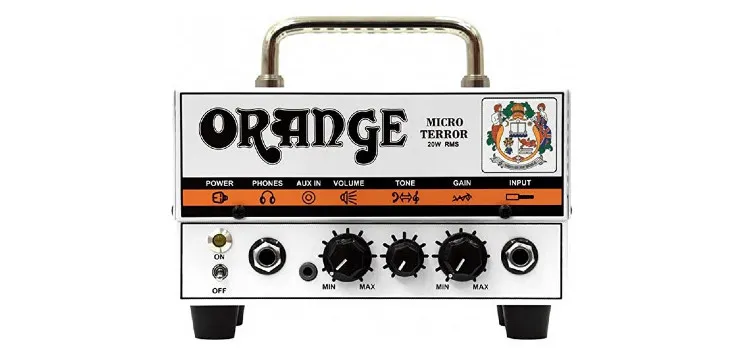
Hauling a heavy head to every practice gets old quickly. The Orange Micro Terror was built for players who’d rather grab their rig and go.
It looks almost like a toy. Inside, though, a real 12AX7 valve handles the preamp, and that tube is where the gritty, mid-forward Orange character comes from.
What you’re really weighing is whether something this small can do real work. This is a single-channel head, so the question lands on tone and output, not features.
We walk through the build, the controls, and where its 20 watts starts to run out of room. If you’re comparing it against other small tube amp options, the sound is the place to begin.

Orange Micro Terror
A 3.5 lb tube-preamp amp head for practice, recording, and small gigs.
Pros
- Genuine 12AX7 tube preamp for authentic Orange grit
- Ultra-light and portable at the size of a lunchbox
- Aux input and line-out are great for practice and recording
- Sturdy all-metal build
Cons
- Single channel with limited tonal versatility
- 20W is modest for keeping up with a loud band
Sound and Playability
The heart of the Micro Terror is a single 12AX7/ECC83 preamp valve, and that real tube is the reason this amp punches so far above its size. Orange calls the preamp section the “Tiny Terror” because it shares much of the tonal DNA of that classic, even though the circuit isn’t identical.
Here the valve does double duty. First it acts as a preamplifier, converting the high-impedance signal from your guitar into a low-impedance signal suitable for driving the power stage.
Second, it provides the overdrive tone itself. Orange replaced the original first-channel tone stack with a second gain stage, and that’s where the signature grit, sustain, and bloom come from.
In practice that single Gain knob covers a huge range. Roll it back and you get a usable, slightly hairy clean.
Push it to noon and you land in Orange’s classic mid-forward crunch. Crank it and the amp delivers thick, saturated distortion that loves power chords and lead lines alike.
A simple Volume and Tone control round out the front panel, so dialing in a sound takes seconds rather than menu-diving. It’s a one-channel amp, so you set the character with the Gain knob and ride your guitar’s volume from there, the way a good tube amp is meant to be played.
Build and Features
The Micro Terror runs 20 watts RMS through a solid-state power section, which is how Orange keeps the weight at 3.5 lbs and the footprint roughly the size of a lunchbox. The tube handles the tone, and the solid-state stage handles the muscle.
The feature set is smarter than the price tag suggests:
- Auxiliary input for an MP3 player, phone, or backing track, so you can jam along without a second device.
- Effects loop for slotting time-based pedals like delay and reverb after the preamp, where they sound their cleanest.
- Line-out wired into the effects loop, so your tone isn’t degraded on the way to a larger guitar amp, a recording interface, or a mixing console.
- Standard speaker output for driving an external cabinet.
Because the line-out and effects loop sit before the speaker output, you can use this little head purely as a preamp into a bigger rig or straight into a DAW. That flexibility is unusual at this size and makes the Micro Terror a legitimate recording tool rather than just a toy.
The all-metal construction and chunky knobs feel built to survive gig bags and rehearsal-room abuse.
Who It Is For
This amp is built for the player who needs real tube character without the bulk. If you’re a bedroom practicer, a student in a dorm, a commuter who rehearses across town, or a guitarist who records direct, the Micro Terror fits your life.
Pair it with a good speaker cabinet and it becomes a genuinely giggable rig for small rooms and acoustic-sized venues.
It’s also a great second amp. If you already own a big tube amp for the stage, the Micro Terror is the head you throw in a backpack for writing sessions, vacations, and quiet late-night practice.
Beginners shopping for their first electric guitar and amp will appreciate how few controls there are to learn, while experienced players will respect the tone for the money.
Frequently Asked Questions
Is the Orange Micro Terror all tube?
No. The Micro Terror uses a real 12AX7/ECC83 vacuum tube in the preamp, which shapes the tone and overdrive, but the power section is solid state.
That hybrid design is exactly what lets Orange deliver tube character in a 3.5 lb package.
How loud is the Orange Micro Terror?
It puts out 20 watts RMS, which is plenty for bedroom practice, recording, and small gigs through a decent cabinet. It isn’t designed to dominate a loud band without support, so for bigger stages you’d typically mic it or run the line-out to the PA.
Can you use headphones with the Micro Terror?
The Micro Terror doesn’t have a dedicated headphone jack, but its line-out is wired into the effects loop, so you can route it into an audio interface or a headphone-equipped mixer for silent practice. Combined with the aux input for backing tracks, it makes a strong quiet-practice setup.
Do you need a cabinet for the Micro Terror?
The Micro Terror is an amp head, so it needs an external speaker cabinet to make sound through a speaker. If you only plan to record or practice silently, you can use the line-out into an interface instead, but for live playing you’ll want a cab.
Final Thoughts
The Orange Micro Terror does something genuinely clever: it shrinks a real tube-preamp voice down to backpack size without gutting the tone. The Gain knob spans clean to full distortion, the aux input and line-out turn it into a serious practice and recording tool, and the 3.5 lb weight means you’ll actually take it places.
The single channel and modest 20 watts are the only real trade-offs, and for the price they’re easy to forgive. For practice, writing, recording, and small gigs, this is one of the best grab-and-go amps you can buy, and it earns our highest recommendation.