A chorus pedal makes one guitar sound like a few playing at once. That thick, shimmering wash is why so many players want one on the board.
The trouble starts when two pedals wear the same badge. The MXR Analog Chorus and the Micro Chorus both chase classic analog tone, yet they ask for very different things from you.
We compare the pair on build, sound, outputs, and price. The fork in the road is how much control you want over the effect versus how fast you want to set it and forget it.
Both come from MXR, the Dunlop-owned name behind decades of pedal classics. You can check current pricing on the MXR Analog Chorus (M234) and the MXR Micro Chorus (M148), then let’s look at how each one is built.
Quick Comparison
| Category | MXR Analog Chorus | MXR Micro Chorus | Winner |
|---|---|---|---|
| Controls | Low, High, Level, Rate, Depth | One rate knob | MXR Analog Chorus |
| Stereo | Mono plus Thru outputs | Single output only | MXR Analog Chorus |
| Simplicity | More to dial in | Set it and stomp | MXR Micro Chorus |
| Bypass | True bypass | Classic MXR switching | MXR Analog Chorus |
| Stage visibility | Light blue box | Spot-it-anywhere yellow | Tie |
| Price | Now wallet-friendly | The cheaper mini | MXR Micro Chorus |
| Overall | Flexibility and stereo | Minimalist simplicity | Depends |
MXR Chorus Pedal Build
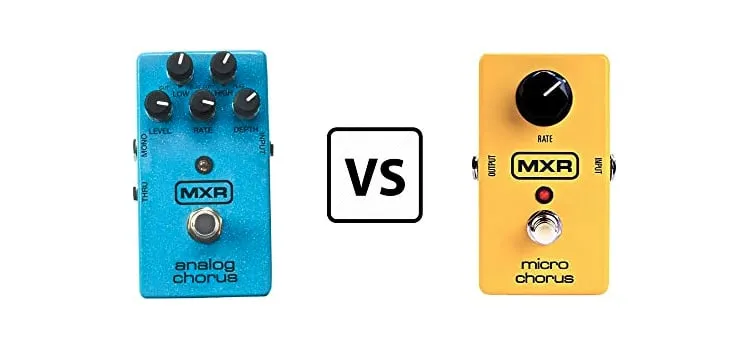
The MXR Analog Chorus, also known as the Dunlop M234, comes in an iconic light blue box. The brand name sits in the middle while the model name is at the bottom.
The right side has an input port while the left side has two output ports labeled mono and thru. It has generous controls with five knobs: Low, High, Level, Rate, and Depth.
The pedal switch is a small metal protrusion, a characteristic of MXR pedals. Other pedals such as Boss models tend to have a wider platform to step on, so try both to see which you prefer for your guitar tone.
It’s all a matter of personal taste.
The MXR Micro Chorus, on the other hand, comes in a pale yellow box. This one is also known as the Dunlop M148.
The size and contours of the enclosure are quite similar to the Analog Chorus, and build quality is arguably the same since they come from the same factories and use similar materials. Aside from the color, you can spot the Micro quickly because of its single knob, which controls the rate.
The ports are fewer too, with only one input and one output. It’s a simple build, but it works well, which is why this model has so many fans.
The pedal switch uses the same design as the Analog Chorus. It’s hard to complain about something this straightforward when it just works.
Wet/Dry Guitar Effect Outputs
As mentioned, the MXR Analog Chorus has two outputs, which makes stereo mode possible. The port labeled Mono carries the wet audio colored by the effect, which you can tweak using the knobs.
The other port simply lets the original dry signal pass through so the audience can still hear it. The result is like having a soloist plus a number of backup guitars adding texture to the music.
The MXR Micro Chorus doesn’t have this capability because it has only a single output. Without stereo mode, you can only listen to the signal with the effect on or off.
It’s one of the things you should weigh when choosing between the two chorus pedals.
Guitar Sound Quality
The sound quality of both pedals is hard to fault because MXR is known for meticulously tuning its products. You’ll get a good output whichever you choose, but a few minor differences may push you toward one or the other.
The limited Micro has a lot of happy users thanks to its clean sound, and the simplicity is something people appreciate because they don’t have to think about too many settings. They just step on and off the pedal, and the rate is easy to vary.
Sometimes a single knob really is a good thing. That said, some players report odd volume bumps with this model, so play it first in the store before committing.
The MXR Analog Chorus leans more toward old-school guitarists who miss the classic sound of the 80s. Digital circuits have advantages such as reliability and advanced features, but analog still rules when it comes to warmth.
This true bypass model also gives you multiple controls to shape the sound exactly how you want it, and the Level knob is particularly useful for keeping the effect from overpowering your signal.
On the downside, some players say this model can be noisy and that the sound can come across as blurry, though many are perfectly happy with the output. Try them yourself to hear the difference.
Pedal Price
The MXR Analog Chorus launched at a higher price but has since come down, making it far more wallet-friendly. If you want something small but powerful, it’s now a great deal.
Its original price sat at the upper end of this category alongside other highly regarded brands, and you’ll find Boss pedals in the same ballpark. There are cheaper options out there, but you may prefer to stick with a tried-and-tested name.
MXR is a specialist in effects pedals, and few companies can claim the same longevity while focusing on this niche.
The MXR Micro Chorus, on the other hand, is slightly cheaper, which makes it a solid option on a tight budget. It’s definitely pricier than the low-cost units out there like these best chorus pedals under 100, but you get what you pay for.
It features analog circuitry that uses bucket-brigade technology, similar to its more advanced sibling. Think of it as the little brother of the Analog Chorus.
You won’t be able to shape the sound much, but operation is stress-free and the tone is lush. For most guitarists that’s more than enough.
MXR Analog Chorus Summary
The MXR Analog Chorus is a classic unit with roots in the 1980s. Several notable musicians have used it over the years, and this reissue continues to enjoy a dedicated fan base.
It lets you play with low frequencies and high frequencies using the top knobs, while the Level, Rate, and Depth controls give you real power over the resulting sound.
If those controls are something you simply must’ve, this model and others with advanced controls will suit you best. Many experienced musicians will take nothing less because they’re particular about their output.
Not everyone loves it, however, since some players experience noticeable noise.
MXR M148 Micro Chorus Summary
The Micro Chorus looks and feels just like the M234 Analog in terms of the chassis but uses a different color for easy identification. Yellow is easy to spot on a dark, crowded stage, which is a nice advantage.
If you like to keep your setup minimal, this is a great pedal to have. The sound is excellent right out of the box, so you don’t have to tweak much, which is fortunate since the single rate knob is your only adjustment.
Some users report wild volume swings that can make the unit harder to rely on. You get rich textures when you step on the pedal and a clean signal when it’s bypassed.
It’s a nice tool for frequent travelers with simple needs.
How the MXR Analog and Micro Chorus Compare
So we’ve covered the build, outputs, sound, and price of both pedals. Here’s how they stack up when you put them side by side.
| Feature | MXR Analog Chorus (M234) | MXR Micro Chorus (M148) |
|---|---|---|
| Controls | Low, High, Level, Rate, Depth | Rate only |
| Outputs | Mono and Thru (stereo capable) | Single output (mono) |
| Circuit | Analog, true bypass | Analog, bucket-brigade |
| Best for | Players who want full tone control | Players who want plug-and-play simplicity |
| Price | Higher, but now wallet-friendly | Slightly lower |
Both pedals deliver the warm, classic analog chorus that MXR is known for, so neither is a bad choice. The Analog Chorus wins on flexibility and stereo capability, letting you fine-tune the effect across five knobs.
The Micro Chorus wins on simplicity and a slightly lower price, giving you great tone with almost no setup. If you crave control, reach for the Analog.
If you want to step on a pedal and play, the Micro is the easier pick.
Frequently Asked Questions
Is the MXR Analog Chorus or Micro Chorus better for beginners?
The Micro Chorus is usually the friendlier choice for beginners because it has a single rate knob and sounds good right out of the box. There’s very little to learn or dial in.
The Analog Chorus offers more control, which is great once you know what each knob does, but it can feel like more to manage when you’re starting out.
Are both MXR chorus pedals true bypass?
The MXR Analog Chorus (M234) is a true bypass pedal, which means your dry signal passes through untouched when the effect is off. This helps preserve your tone in a larger pedal chain.
The Micro Chorus uses MXR’s classic switching, so if true bypass is a priority for your rig, the Analog Chorus is the safer bet.
Can the MXR Micro Chorus do stereo?
No. The Micro Chorus has a single output, so it can’t run in stereo.
You only get the effect on or off through one signal path.
If stereo is important to you, the Analog Chorus is the one to choose because its Mono and Thru outputs let you split the wet and dry signals.
Do these pedals use real analog circuitry?
Yes. Both pedals are analog.
The Micro Chorus uses bucket-brigade technology, and the Analog Chorus is also an analog, true bypass design.
This is a big part of why players reach for these MXR units in the first place, since analog circuits are prized for their warm, rich character.
Final Thoughts
MXR is a reliable brand, so you shouldn’t have major problems whichever way you go. Both are good pedals that’ll make your music sound fuller thanks to the chorus effect, as if several similar instruments were playing in synchrony with you.
Choose the Analog Chorus if you want the final say over your sound, with control options for five different settings and the classic 80s analog circuit that produces warm, rich signals.
Choose the Micro Chorus if you’d rather get great results out of the box and never have to worry about dialing things in. You’ll also save a bit of money on the price, and you can pair it with a micro flanger for even more fun.
If you’re still weighing your options, it’s worth auditioning a few competitors too. Models like the Neo Clone, the Boss CE-2 stereo chorus, and the TC Electronic Corona Chorus are all worth a listen before you make your final call.