Want one guitar to sound like a few? That’s the trick chorus pulls off, and it’s what chorus pedals are used for in a solo set or a small band.
Two of the best chorus pedals you can buy both wear the Boss name. The CH1 and the CE5 split most players into two camps.
The real difference is how deep they go. The CH1 keeps things simple with excellent tone, while the CE5 adds more shaping for players who like to tweak.
Both copy your signal into extra voices and shift their pitch a touch. They just hand you different controls to do it, and we’ll compare them part by part below.
Quick Comparison
| Category | Boss CH1 | Boss CE5 | Winner |
|---|---|---|---|
| Build | Rugged Boss chassis | Identical construction | Tie |
| Controls | Level, rate, depth, EQ | Stacked dual high/low filter | Boss CE5 |
| Analog character | Fully analog classic | Filter-based ensemble | Boss CH1 |
| Ease of use | Hard to get wrong | Rewards experimenting | Boss CH1 |
| Price | Usually a little cheaper | Close, slightly more | Boss CH1 |
| Sound-shaping range | Classic chorus voice | Wider variety via the filter | Boss CE5 |
| Overall | The simple classic | The tone-shaper's chorus | Depends |
Pedal Build
Both pedals come from the respected brand Boss. The company has been around since 1973 with headquarters in Japan and a presence that spans the globe.
It’s a subsidiary of Roland Corporation, another well-established name in the music industry. The two pedals look quite similar in size, color, design, control placement, jacks, and build quality.
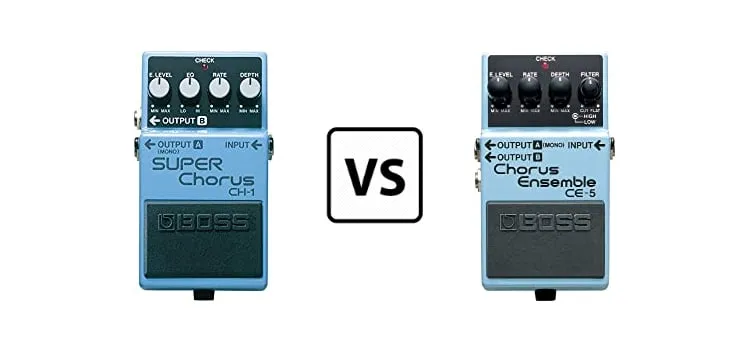
One might even get confused on first glance, because the markings for the brand, controls, input, output, and indicator light are the same down to the fonts. There are, however, a few subtle differences that let you tell them apart.
The most obvious is the model number located at the lower left in the middle of the pedal, just above the brand name. Another is the label above it, which uses different text and font sizes.
The CE-5 is labeled the Boss Chorus Ensemble, while the CH-1 is dubbed the Super Chorus. The knobs on the CE-5 are black, which makes them hard to see in the dark.
It’s worth testing each in the shop to get a better feel for the responsiveness of the controls. Both should hold up well to abuse even if you travel a lot.
Functionality and Controls
The CH1 Super Chorus is a classic that was first released in 1989 and has remained in production since. Many well-known musicians use it, and amateurs try to copy their sound by using the same gear.
It’s best to play around with the controls to learn what they do and how to produce certain effects. The four knobs cover effect level, rate, depth, and EQ.
Turn the rate to the right to add more vibration, and increase the depth to make the modulation more obvious. Level handles volume control, while the EQ can reduce treble.
This is a fully analog chorus pedal with a clear, pleasing sound and easy-to-use features.
The CE5, on the other hand, is a more recent design and the fourth in a respected line of Chorus Ensembles. Although it has the same number of knobs as the CH1 Super Chorus, one of them is quite different.
The level, rate, and depth knobs remain, but they’re joined by a special filter knob instead of EQ. Look closely and you’ll see this is actually two knobs stacked on top of each other for more functionality.
Use the inner knob to cut high frequencies or the outer knob to cut the low frequencies. Because you can filter the highs and lows separately, you can fine-tune the sound exactly how you want it, making it sharper or fatter depending on what feels right.
Wet and Dry Stereo Output
When it comes to outputs, the two models take the same approach, which most musicians will appreciate. There are two signal outputs, A and B.
This means you can connect the pedal to two amplifiers for lush stereo chorus output, with each amp receiving a different kind of sound.
The Output A port carries the wet signal with all the effects created. The Output B port gives you the straight dry signal for clean, crisp audio.
As a result, guitarists enjoy a more pleasing and colorful sound where the original signal still dominates while the chorus effect plays a supporting role instead of overpowering everything else.
Sound Quality
The chorus sound quality on both pedals is quite nice, so you really just have to try them to find the right pick. In this case it’s more a matter of preference than quality.
With the Boss CH-1 Super Chorus, you can make your music feel fuller and richer across all frequencies. If you play alone as a one-man band, this is indispensable because it can make it seem like several bandmates are up on the stage with you.
Rock bands loved it back in the day because they could infuse their solos with more character, and many of those tones have become iconic.
As for the Boss CE-5, the filter knob makes things more interesting. You can make it sound like the CH-1 Super Chorus by tweaking the settings, or you can make it sound completely different just by playing with the controls.
For example, you can cut the low frequencies to increase sharpness. Use this chorus effect with a distortion pedal to keep the notes clear and crisp instead of muddied.
You could also push the high frequencies so that guitar solos catch more attention, which is, after all, what they’re all about. Do whatever you want with the settings to achieve specific goals.
Guitar Pedal Price
In terms of price, neither model can claim to be the cheapest or the most expensive on the market. There are certainly lower-cost options if all you want is the effect and not many controls, and some of those have only one, two, or three knobs.
You can also find more serious options with even more controls and higher price tags, some with five or more knobs and other control options to truly customize the output.
The Boss CH-1 Super Chorus often costs a bit less in a bundle that also includes a patch cable, instrument cable, three picks, and a polishing cloth. It’s a solid addition to any collection and sounds great for virtually all genres.
The Boss CE-5 Chorus Ensemble usually comes with the same freebies at a slightly different price. The two aren’t far apart on pricing, and while neither is the most expensive out there, neither is far behind either.
Fans will argue they’re worth every penny, but it’s up to you to decide. If price is your main concern, check out our best chorus pedals under 100 options here.
Boss CE5 Summary
The Boss CE-5 is a versatile chorus pedal with a filter knob that sets it apart from the rest. The 2-in-1 knob controls the low and high frequencies separately, so you can achieve a wider variety of effects and even prevent common issues when mixing pedals.
Shape your tone to your liking with the filter, and change the rate, depth, and effect level with precision. You can connect it to a single amp or a dual-amp setup thanks to the two output ports, which offer wet and dry options that you can combine for a clearer signal.
Boss CH1 Summary
The CH-1 is an analog chorus pedal with a pleasing tone and a clean effect. It’s been around for a while and is still going strong because of its ease of use and repair.
If you’re the type who likes to tinker with effects pedals, you’ll probably like this model. Stereo mode is possible thanks to the dual output configuration.
The only downside is that it lacks features that advanced users may want. It’s a great pedal for beginners, but experienced musicians may prefer the Boss CE-5.
How the Boss CE5 and CH1 Compare
So we’ve covered build, controls, outputs, sound, and price for both pedals. Here’s how they stack up head to head.
On build quality and durability, the two are essentially even. They share the same chassis, footswitch, jacks, and rugged Boss construction, so neither has a meaningful edge for the gigging or traveling player.
On controls, the CE5 pulls ahead. Both pedals offer level, rate, and depth, but the CE5 swaps the CH1’s single EQ knob for a stacked dual filter that cuts highs and lows independently.
The CH1 wins on simplicity, while the CE5 wins on flexibility.
On stereo output, the two are identical. Both provide A and B outputs for a wet-and-dry stereo setup across two amplifiers, so this isn’t a deciding factor.
On sound, it comes down to preference. The CH1 delivers a classic, lush, full chorus that many iconic recordings relied on.
The CE5 can reproduce that voice and then go further, thanks to the filter, making it the better choice if you want to shape tone or pair chorus with distortion.
On price, the two are close, with the CH1 often landing slightly cheaper in a bundle. For most players the decision is about features rather than cost.
Comparing the Boss CH1 vs CE5, or even other brands like MXR, is hard because they share such an excellent pedigree.
Frequently Asked Questions
What’s the main difference between the Boss CE5 and CH1?
The CH1 Super Chorus is a straightforward analog chorus with level, rate, depth, and EQ controls. The CE5 Chorus Ensemble replaces the EQ with a stacked dual filter that cuts highs and lows separately.
That filter is the headline difference: it gives the CE5 noticeably more tonal flexibility than the simpler CH1.
Is the Boss CE5 or CH1 better for beginners?
The CH1 is the easier pedal to learn because its controls are simple and its sound is hard to get wrong. Beginners can dial in a great chorus quickly without overthinking it.
The CE5 is still approachable, but its filter knob rewards players who want to experiment and fine-tune their tone over time.
Are the Boss CE5 and CH1 analog pedals?
The CH1 Super Chorus is a fully analog chorus pedal, which is part of its appeal for players who like that classic, warm character. Both pedals deliver the smooth, lush chorus sound Boss is known for.
If a clean, traditional analog chorus tone is your priority, the CH1 leans into that voice.
Can you run the CE5 and CH1 in stereo?
Yes. Both pedals feature A and B outputs, so you can connect them to two amplifiers for a stereo setup.
Output A carries the wet, effected signal and Output B carries the dry signal.
This identical output design means stereo capability isn’t a reason to choose one over the other.
Which Boss chorus pedal is cheaper?
The two pedals are priced closely, and both are often sold in bundles that include a patch cable, instrument cable, picks, and a polishing cloth. The CH1 frequently lands a little cheaper of the two.
The gap is small enough that features, not price, should usually drive your decision. If budget is tight, our best chorus pedals under 100 guide lists more affordable alternatives.
Final Thoughts
Boss is a trusted brand, and a long line of impressive guitar products have made it a favorite among many musicians. Comparing the Boss CH1 vs CE5 is difficult precisely because both pedals share the same excellent pedigree, and you won’t be disappointed whichever you end up with.
Even the prices and build quality differ only slightly.
The real choice comes down to control. If you want a simple, classic, plug-and-play analog chorus, the CH1 Super Chorus is a fantastic pick, especially for beginners.
If you want to shape your tone with a dual filter and squeeze more variety out of a single pedal, the more versatile CE5 Chorus Ensemble is the stronger option.
Whichever way you lean, try both Boss options before you buy, either at the store or at a friend’s studio. Trusting your own ears is the best way to settle the Boss CE5 vs CH1 debate for your particular rig and playing style.