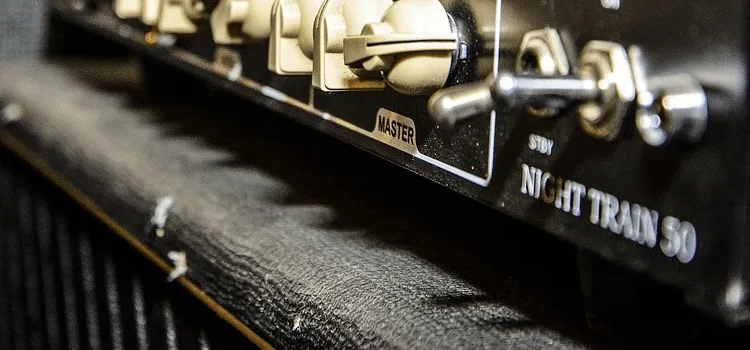
You flip your new tube amp on, strike a chord, and it sounds harsh or thin. The likely culprit isn’t a broken amp but the order you used those two front-panel switches.
Tube amps reward a slow start. The tubes inside need to warm up before full voltage reaches them, and skipping that step wears out parts that cost real money to replace.
That second switch, the one marked standby, controls the whole thing. Used in the right order, it’s the cheapest protection your amp will ever get.
Below we cover the exact power-up steps and why the warm-up matters so much. First, here’s what that standby switch is actually doing inside the amp.
What a Standby Switch Actually Does
A standby switch sits between your amp’s power transformer and its high-voltage circuit. Its job is to hold back the full plate voltage (often called B+) until the tubes are hot enough to handle it.
When you first power up, you leave the power switch ON and keep the standby switch in the standby position. This energizes the tube heaters so the filaments can warm up, while the standby switch blocks high voltage from reaching the tubes.
Once the tubes are glowing and warm, you flip the standby switch to play and the amp is ready to make sound.
On most amps the standby switch is wired to a solid-state rectifier or a rectifier tube with an indirectly heated cathode. That wiring is what allows it to cut the high voltage cleanly while leaving the heaters powered.
How to Turn On a Tube Amp Step by Step
The power-up sequence is short, but doing it in the right order is what protects your amp. Follow these steps every time:
| Step | Action | What’s happening |
|---|---|---|
| 1 | Set the standby switch to standby before doing anything else | High voltage stays blocked from the tubes |
| 2 | Flip the power switch to ON | Tube heaters energize and begin warming up |
| 3 | Wait 30 to 60 seconds (up to a couple of minutes) | Filaments reach operating temperature |
| 4 | Flip the standby switch to play | Full plate voltage reaches warm tubes safely |
| 5 | Bring up your volume and start playing | Amp is ready to perform |
The key idea is that the power switch and the standby switch are flipped at different times, not together. Power first, warm up, then standby off.
Doing it in this order means the high voltage only ever hits tubes that are already hot.
Why the Warm-Up Sequence Matters
Skipping the warm-up isn’t just about tone. Sending high voltage into cold tubes can physically damage them and stress the rest of the circuit.
Two things in particular are at stake.
Standby Switches and Capacitors
A standby switch keeps high voltage out of the circuit until the tube filaments reach operating temperature and the power supply voltage settles to a level the filter capacitors can safely handle. Because the capacitors never see a sudden switch-on voltage spike, they tend to last longer.
That’s also why standby switches exist as a design choice in the first place: they’re a low-cost feature that protects components and offers a cheaper path than over-speccing expensive capacitors. The rule of thumb is to make sure the amp is set to standby before you flip the power on, and not to leave it sitting in standby for more than 15 to 20 minutes.
Protecting Cold Tubes From High Voltage
If full plate voltage is applied before a tube’s negatively charged cathode is fully heated, electrons are pulled off the cathode’s oxide coating. This wears the coating away in a process called cathode stripping, and over time it shortens tube life.
The standby switch was invented to keep that high voltage off the plates until the tubes are glowing hot. By letting the tubes warm up first, their conduction becomes instantaneous when voltage is applied, the capacitors never see a high switch-on spike, and the cathodes are spared the bombardment that strips them.
How Long to Warm Up a Tube Amp
You generally only need about 30 seconds to a couple of minutes to fully warm up a tube amp before flipping off standby. Five minutes is plenty even for a cautious player.
Once the amp is warm, you can leave the standby switch alone and play.
What you shouldn’t do is leave the amp parked in standby for a long time as a substitute for turning it off. If the gap between soundcheck and the performance is more than about 20 minutes, switch the amplifier off completely rather than leaving it idling in standby.
For more on how warm-up affects a brand-new amp, see our guide on whether guitar amp tubes need to be broken in.
Using Standby for Breaks and Muting
One of the biggest practical benefits of a standby switch is that it can mute the amp without shutting it down. If you need to step away briefly, flipping to standby silences your guitar amp while keeping the tubes warm, so it’s ready to play the instant you return instead of starting the whole warm-up cycle over again.
That makes standby genuinely useful when you’re sharing a stage with other performers and don’t want your rig making noise during someone else’s part. It mutes cleanly and helps prevent unnecessary wear on the valves.
It’s worth being clear about what standby isn’t, though. It isn’t a “beer break” switch for long breaks.
For a quick pause, just turn your volume control down rather than using standby. Save standby for muting during a set or for the warm-up itself, and reach for the power switch when you’re done for more than 20 minutes.
How to Add a Standby Switch to an Amp
Some older or budget amps were built without a standby switch. If yours lacks one and you’re comfortable working inside an amplifier, the switch is added between the power transformer and the rectifier socket.
Because amps store lethal voltage in their capacitors even when unplugged, this is work for an experienced tech unless you fully understand how to discharge and service a tube amp safely.
The general approach looks like this:
- Drill a mounting hole in the chassis and fit a suitable switch (a 250V AC-rated switch is appropriate for this duty).
- Cut the wire running between the power transformer and the rectifier socket.
- Wire the switch in line so it can open and close that high-voltage path.
A more flexible option is to combine a DPDT switch with the standby function in a single control. Using one side of the switch for power and the other for standby, you can wire it so that in the standby position only the heater (alternating current) supply is active and the high-voltage direct current is cut, while the play position restores both.
This gives you a clean, single-switch power-up.
A Note on Cold-Amp Tone
You may have noticed that with high gain and loud volume settings, a cold amp sounds slightly different. There’s less swell and less tendency to feed back.
After about half an hour of playing, the tone tends to sweeten up. If that describes your amp, it’s another reason to use standby between sets rather than fully powering down.
When you bring the amp off standby it won’t be instantly as sweet as it was mid-set, but it returns to that warmed-up tone far faster than it’d if you forced it through a complete cold start every time.
For deeper dives on tube amps, check out our roundups of the best small tube amps and the best tube amps for the money, or read how valves stack up against transistors in tube amp vs solid state.
Frequently Asked Questions
Do I always need to use the standby switch?
For everyday playing it’s good practice, especially with larger amps that run high plate voltages. Powering up in standby and giving the tubes time to warm up reduces wear and helps your tubes and capacitors last longer.
On very small, low-voltage amps the benefit is smaller, but the habit never hurts.
Can I leave my amp on standby all night?
No. Standby is meant for short warm-ups and brief muting during a set, not as a parking mode.
Don’t leave an amp in standby for more than about 15 to 20 minutes.
If you’re done playing for a while, switch the amp off completely.
Should I use standby to power down?
A simple and gentle way to shut down is to flip the standby switch first, then the power switch a few seconds later. This removes high voltage from the tubes before the heaters lose power.
It isn’t strictly required on every amp, but it’s an easy, harmless habit.
Do all tube amps have a standby switch?
No. Many smaller and vintage amps were built without one, and they’re designed to be turned on with a single power switch.
If your amp has no standby switch, just use the power switch as intended. You don’t need to add one unless you specifically want the muting and warm-up control it provides.
Final Thoughts
Turning on a tube amp the right way comes down to a simple rhythm: power on with the standby engaged, wait 30 to 60 seconds for the tubes to warm up, then flip standby to play. That short pause is all it takes to spare your tubes from cathode stripping and keep sudden voltage spikes away from your capacitors.
Just as important is knowing what standby is for. Use it to warm up and to mute during a set, not as a long-term resting state.
If you’re stepping away for more than 20 minutes, turn the amp off completely instead of leaving it idling.
Treat the standby switch as the small, free insurance policy it’s. A few seconds of patience every time you power up rewards you with longer tube life, healthier capacitors, and an amp that’s warmed up and sounding its best when you’re ready to play.