
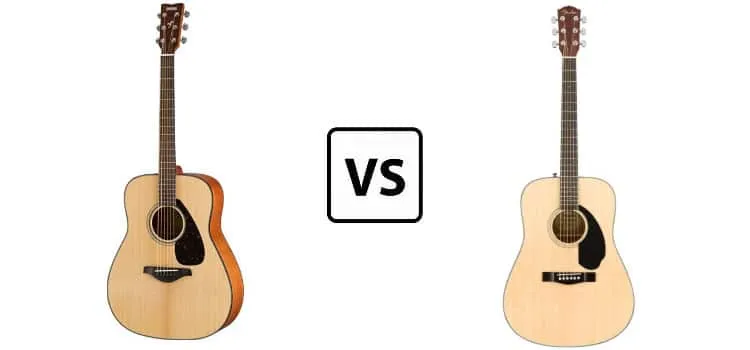
Ask for a good first acoustic and two names come back again and again: the Yamaha FG800 and the Fender CD-60S. They sit side by side on store walls and read almost the same on paper.
Look closer and they don’t feel or sound quite alike. The differences are small, but they nudge each guitar toward a slightly different player.
Picking one as a gift, you’ll want to know how they differ so it suits the person. The same details steer your own choice if you’re buying an acoustic to keep.
We line up both dreadnoughts so the right match for you is easy to spot. We’ll start with the Yamaha FG800.
Quick Comparison
| Category | Yamaha FG800 | Fender CD-60S | Winner |
|---|---|---|---|
| Top wood | Solid spruce | Solid spruce | Tie |
| Back and sides | Laminated nato | Laminated mahogany | Tie |
| Tone | Brighter, punchier projection | Warmer and more balanced | Depends |
| Beginner comfort | Solid playability | Rolled edges, slim C neck | Fender CD-60S |
| Bracing | Scalloped and resonant | Standard | Yamaha FG800 |
| Electronics | None on the base model | None on the base model | Tie |
| Overall | Punchy projection | Beginner-friendly comfort | Depends |
The Yamaha FG800 Guitar
This guitar is an upgraded version of the basic Yamaha FG700 model, and it’s a recent addition to Yamaha’s FG series of acoustic instruments. Along with its dreadnought body, it sports a larger, sturdy top that’s nicely crafted to deliver a good playing experience.
Scalloped bracing is a notable feature specific to the FG800, which gives it a forceful projection and excellent low end tones. This is precisely what you require for live gigs and recordings.
The Yamaha FG800 produces a punchy twang and is really fashionable, due to its rounded fingerboard edges and tapered neck. Because of its particular features and design, this acoustic guitar suits beginners but is also a good fit for professionals or anyone who can play competently.
The Fender CD-60S Guitar
As one of the most famous guitar brands in America, Fender is synonymous with rock music. For this reason, the majority of guitarists either start off with Fender guitars, or end up playing them at some point in their musical careers.
For novice players, Fender offers some great acoustic guitars and the CD-60S is part of the company’s Classic Design series. Although it’s mass produced, an impressive amount of attention and care has been put into this model.
The instrument is easy to play, so it’s ideal if you’re learning the ropes. In addition, you can develop your skills as a musician using the CD-60S, because this dreadnought guitar has everything required to take your playing to the next level.
Comparing the Two Guitars Head to Head
The Build and Features
Generally speaking, solid wood is a better material than laminate to build a beginner’s guitar from, however both have advantages and disadvantages. Laminate costs less, and it’s fair to say that, based on the engineering quality, it can be more robust.
In any event, a laminate build keeps the prices affordable, so the fact that both guitars use laminate on their sides and back isn’t an issue.
The Yamaha FG800 features ‘eastern mahogany’, or laminated nato wood, while the Fender CD-60S has solid spruce tops and laminated mahogany. In this regard, the Fender model really excels.
It boasts several features that are useful to players, like the rolled edges on the fretboard that make it easier to navigate. The neck design of the Fender also lends itself well to fluid playing, and will improve the sound produced by most guitarists.
Indeed, the C profile, slim taper neck on the CD-60S is designed for novices and people with smaller hands. Similarly, the C profile neck on the FG800 is nice and full, and fits the palm snugly.
Each guitar has an understated finish, which is good for an entry level acoustic instrument. With these types of guitars, it’s more important to concentrate on the feel, tone and fundamentals.
The FG series from Yamaha dates back to the 1960s, and has gradually developed over a couple of hundred models. The FG800 looks and feels extremely classy, with its stylish matt finish.
In 2016, Yamaha introduced an update to the FG800, with an interesting scalloped bracing design. This aimed to produce a dreadnought tone that was classically balanced, along with a juicy low to medium range boom.
This concept is reflected on the Fender CD-60S, which has a spruce top with scalloped, quarter sawn X bracing. This design pattern isn’t especially innovative.
Different X pattern versions have been used across the industry, since the idea was pioneered in 1843 by CF Martin. Scalloped bracing designs enhance the resonance by using less soundboard wood.
The Hardware of Both Instruments
The Yamaha FG800 hardware boasts outstanding consistency, dependability and performance. It includes a headstock complete with good quality, sealed die cast chrome tuners, as well as an urea saddle and nut.
At the bottom, it has a regular rosewood bridge.
The Fender CD-60S doesn’t have electronics, which is typical with guitars for beginners, because there’s no need for plugging in. Nonetheless, it does have a nice rosewood bridge, strings with a dura tone coating, and chrome die cast tuners.
Together, these hardware features allow the guitar to perform exceptionally well.
Examples of some accessories that might come with the instrument are a digital tuner, a hard case and plectrums.
How the Instruments Sound
The FG800 has a great sound, because its dreadnought body and scalloped bracing give it a nice resonance. Moreover, it produces heart warming tones that are pleasantly bright.
The quality of sound produced by this instrument rivals that of any budget acoustic guitar.
The combination of spruce and mahogany in the CD-60S enables you to create balanced, lively sounds with an appealing tenderness. Its dreadnought body projects the notes strongly and clearly.
Thanks to its solid spruce top, more warmth and volume is generated as you play the instrument.
How the Yamaha FG800 and Fender CD-60S Compare
So we’ve looked at each guitar on its own. Let’s talk about how they stack up against each other for the player trying to choose between them.
On build, both guitars share the same core recipe: a solid spruce top with laminated back and sides. The difference is in the laminate, with the FG800 using nato and the CD-60S using mahogany.
For playability, the CD-60S edges ahead thanks to its rolled fretboard edges and slim taper C profile neck, which make it especially welcoming for beginners and players with smaller hands.
On tone, the FG800 leans bright and punchy, with the scalloped bracing pushing a strong low to medium range boom that carries well for live gigs and recordings. The CD-60S is warm and balanced, with a tender character that suits players who are still finding their style at home.
On purpose, the CD-60S is squarely aimed at beginners, while the FG800 happily serves both newcomers and more experienced players moving toward performance. If you want to keep weighing options within the same lineup, it’s worth seeing how the Yamaha FS800 vs FG800 stack up, since the FS800 trades the dreadnought body for a smaller concert shape.
Frequently Asked Questions
Is the Yamaha FG800 or Fender CD-60S better for beginners?
Both are excellent beginner dreadnoughts, but the Fender CD-60S has a slight edge for new players thanks to its rolled fretboard edges and slim taper C profile neck. These features make chord shapes and fretting more comfortable, which matters a lot when you’re building hand strength.
That said, the FG800 is just as easy to learn on and gives you more room to grow if you progress quickly.
Are the Yamaha FG800 and Fender CD-60S solid wood guitars?
Neither is fully solid wood. Both use a solid spruce top paired with laminated back and sides, which is standard at this price point.
The FG800 uses laminated nato for its back and sides, while the CD-60S uses laminated mahogany. Laminate keeps the cost down and can actually be more durable against knocks and humidity changes.
Do either of these guitars have built-in electronics?
The standard CD-60S doesn’t include electronics, which is common for guitars aimed at beginners since there’s no need to plug in while you’re learning. The FG800 in its base form is also a purely acoustic instrument.
If you specifically want to amplify your guitar, look for a model with a built-in pickup rather than expecting one on these base versions.
Which guitar has the brighter, punchier tone?
The Yamaha FG800 is the brighter and punchier of the two. Its dreadnought body combined with the scalloped bracing produces a forceful projection and a strong low to medium boom that cuts through well.
The Fender CD-60S sounds warmer and more balanced, with a tender quality that many players find pleasant for fingerpicking and softer playing.
Final Thoughts
All things considered, both of these dreadnought acoustic guitars are good value for money. They’re simple to play and won’t break the bank, which makes either one a safe choice for a first guitar or a gift.
The key difference is intent. The CD-60S is aimed at beginners rather than guitarists who play live gigs, and its comfortable neck and warm tone reward players who are still learning the ropes.
The Yamaha FG800, by contrast, suits both less experienced players who are quick to learn and musicians moving toward performance.
If you want bright projection and scalloped bracing that produces lively acoustic notes for gigs and recordings, the FG800 is the stronger pick. If comfort and a warm, balanced voice matter most while you build your skills, the CD-60S is hard to beat.