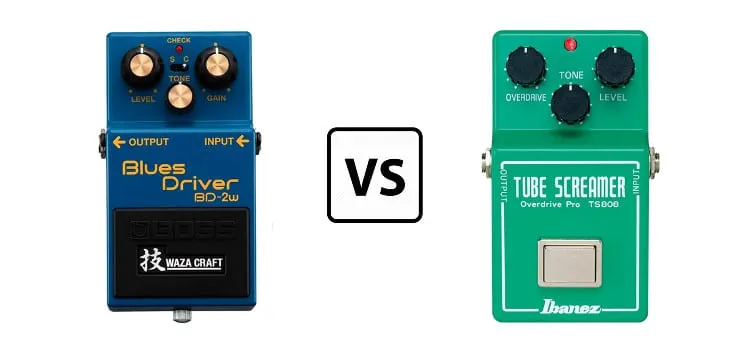
Two overdrives end up on more pedalboards than almost any others. The Boss Blues Driver and the Ibanez Tube Screamer have been gigging staples for decades.
Both chase the same goal. They push your signal into the kind of grit and sustain you’d get from a cranked tube amp, and both react to how hard you pick.
The split shows up in the tone. The Blues Driver runs warm and full, while the Tube Screamer is brighter and more cutting thanks to a strong mid boost.
We’ll break down how each pedal is built, how it sounds, and which fits your playing. Let’s start with a quick side-by-side.
Quick Comparison
| Category | Blues Driver | Tube Screamer | Winner |
|---|---|---|---|
| Build | Tour-ready, three knobs | Equally tough and simple | Tie |
| Core tone | Warm, full, tube-like | Bright, mid-focused bite | Depends |
| Standalone sound | Rich on its own | Harsh until it sits in a mix | Blues Driver |
| In a band mix | Can sit back | The mid hump cuts through | Tube Screamer |
| Recording | Shines for isolated tones | Less flattering solo | Blues Driver |
| Boosting a driven amp | A good boost | The classic tightener | Tube Screamer |
| Overall | Recording, blues, home playing | Gigging and cutting through | Depends |
Blues Driver vs Tube Screamer at a Glance
Both pedals are simply built stompboxes with three controls, so the real decision comes down to tone and how you intend to use the pedal. Here’s a quick side-by-side overview before we dig into the details.
| Feature | Boss Blues Driver (BD-2) | Ibanez Tube Screamer |
|---|---|---|
| Controls | Level, Gain, Tone | Drive, Tone, Level |
| Tone character | Warm, full, bluesy | Bright, biting, mid-forward |
| Available gain | Moderate, smooth | Higher, more pronounced |
| Best for | Recording, isolated lead tone | Cutting through a live band mix |
| Common genres | Blues, country, rock, grunge | Rock, metal, blues, hard rock |
| Build | Tough metal chassis | Solidly built, gig-ready |
Boss Blues Driver: Design and Build Quality
In production for over three decades, the Blues Driver has remained essentially unchanged since its original release. Its continued popularity comes from a tough, tour-ready build and the warm, tube-like overdrive it produces.
It’s used across genres and can do everything from a subtle clean-tone crunch all the way to high-gain saturated lead tones.
It’s a simple pedal, with three knobs controlling the level, gain, and tone. With just those three controls, players can dial in a wide range of sounds.
Like all classic Boss pedals, it’s built to survive life on the road. Housed in a solid metal chassis, it can take the knocks, drops, and spilled drinks it’ll face while being gigged.
Ibanez Tube Screamer: Design and Build Quality
Since the 1980s, the Ibanez Tube Screamer has been one of the most popular overdrive pedals available. Used across all kinds of music, from blues and country to rock and metal, players of every style use it in different ways to achieve different sounds.
It’s solidly built and designed to survive long stretches of gigging. The many sought-after 80s models still selling on eBay and Reverb are a testament to how well they hold up.
Like the Blues Driver, the Tube Screamer has only three control knobs: drive, tone, and volume. Unlike the Blues Driver, the controls are a little more sensitive and let players create a wider range of tones, both because it can generate more gain and because the tone control has a more pronounced effect on the EQ.
While maybe not quite as indestructible as the BD-2, the Tube Screamer is nonetheless a determinedly built pedal that’ll survive being kicked around on stage and tossed in the back of a van.
How the Blues Driver and Tube Screamer Sound
So far the differences between the two pedals are minimal. Both are well-built stompboxes with nearly identical controls.
The biggest difference between them lies in the sound they make and how guitarists use them in their rigs.
The Blues Driver Tone
The Boss Blues Driver is popular and acclaimed because of its smooth, responsive sound. At low gain levels, it gives your sound a rich, warm overdrive with a lot of harmonic richness.
Notes ring out clearly but gain extra bite and sustain thanks to the compression of the distorted signal. This is used a lot in country and blues, when guitarists want some extra crunch on a clean tone for leads and solos.
It also works as a standalone distortion pedal. Placed in front of a clean amp with the gain turned up, it delivers plenty of grit and crunch for rock and grunge-style rhythm guitar.
Many guitarists like to put it in front of an already-distorting amp for an extra gain and level boost for lead work. Used this way, it gives a very full, warm sound that lends itself well to rock and blues solos along the lines of Gary Moore or Guns N’ Roses’ Slash.
The Tube Screamer Tone
While the Blues Driver has a warm, full sound, the Tube Screamer is noticeably brighter and more biting. This is due to the generous mid-range boost the circuit gives the signal.
On its own, the Tube Screamer can sound off-putting because of that biting quality, but in the context of a full band mix it really helps the guitar slice through. For that reason it’s used by a lot of professional guitarists as a quick and easy way to EQ their sound.
Placed in front of a clean amp with a moderate amount of drive, it gives a rough, honky tone that suits raw blues and rock solos. While some guitarists do use it as a dedicated distortion pedal to get dirty sounds from a clean amp, the result can be too thin.
The most popular use of the Tube Screamer is in front of an already-dirty amp, used to drive the amp into full metal and hard-rock levels of gain and saturation. While any overdrive will do this, the Tube Screamer is so widely used because of the mid-range boost and slight low-end cut.
This tightens up the sound of a dirty amp, creating a much clearer, cutting guitar tone that’s ideal for everything from modern rock to thrash and death metal.
It’s also widely used alongside other distortion and fuzz pedals. Many Big Muff users place a Tube Screamer with the gain low but level high after the fuzz pedal to give it a mid-boost and make the sound clearer.
Many guitarists use it this way to tighten up the sound of classic distortion pedals such as the Boss DS-1.
How the Blues Driver and Tube Screamer Compare
We’ve talked about the build and tone of both pedals. Now let’s look at how they stack up directly against each other.
In terms of build, both are tough, simply built stompboxes with three identical controls, so neither has a real edge there. The Blues Driver is arguably the more rugged of the two, but the Tube Screamer is no fragile flower.
Where they truly differ is tone. The Blues Driver is warmer and fuller, which makes it shine when the guitar is heard on its own, such as in a recording or a quiet practice setting.
The Tube Screamer is brighter with a mid-range emphasis, which can sound harsh in isolation but cuts through beautifully in a live band mix. That mid-heavy character is exactly why so many professionals reach for it on stage.
On gain and flexibility, the Tube Screamer’s more sensitive controls and higher available gain give it a slightly wider range, especially for pushing an already-dirty amp into heavier territory. The Blues Driver’s strength is its smooth, balanced overdrive rather than extremes.
Which Pedal Should You Choose?
Choosing between the Blues Driver and Tube Screamer doesn’t simply come down to which sound you like. It also depends on how you intend to use the pedal.
If you’re a professional or semi-professional guitarist who plays a lot of gigs, the Tube Screamer is probably the smarter choice because of its ability to help the guitar cut through a live band mix.
That mid-heavy quality is what really sets it apart from other overdrives and is why it’s so widely used by the pros.
If you’re looking for a pedal for recording and home use that makes the guitar sound better in isolation, the fuller tone of the Blues Driver is your best choice. The genre and style you play matters too.
The warmth of the Blues Driver can make it sound too wooly for modern metal, while the biting clarity of the Tube Screamer can be too thin for grunge or indie rock.
If you’re a blues or country player looking for a more subtle overdrive, both perform well and are widely used.
If you’re after a smoother, rounded lead tone, the Blues Driver is the best choice. If you want a sharper, cutting tone, pick the Tube Screamer.
Frequently Asked Questions
Can you use a Blues Driver and Tube Screamer together?
Yes, and plenty of guitarists do. A common approach is to use one pedal for its core tone and the other as a boost, stacking them to push your amp harder for solos.
Because each pedal shapes the EQ differently, running them in series lets you blend the Blues Driver’s warmth with the Tube Screamer’s mid-range cut.
Just be mindful of your overall gain and volume so the stacked signal doesn’t become muddy or uncontrollable.
Is the Tube Screamer good for metal?
The Tube Screamer is extremely popular for metal, but not usually as a standalone distortion. Its real strength is placed in front of an already-distorting amp, where its mid-range boost and slight low-end cut tighten the sound and add clarity.
This makes it ideal for everything from modern rock to thrash and death metal.
Used alone on a clean amp, however, it tends to sound too thin for heavy styles.
Is the Blues Driver only for blues?
Not at all. Despite the name, the Blues Driver is a versatile overdrive used across many genres.
It handles country and blues leads, standalone rock and grunge rhythm tones, and lead boosts for an already-driven amp.
Its warm, full character is what makes it so flexible, though that same warmth can be too thick for modern high-gain metal.
Which pedal is better for beginners?
Both are simple three-knob pedals, so either is easy to learn. The Blues Driver may be slightly more forgiving for a beginner because its warm tone sounds good in isolation and at home.
The Tube Screamer can sound harsh on its own until you hear it in a band context. If you’re just starting to build a board, our guide on what guitar pedals to start with is a helpful next read.
Final Thoughts
If you’re still unsure which one to choose, it helps to match the pedal to your situation. The Blues Driver is best suited for country and blues players after a smoother crunch, for use as a distortion pedal in front of a clean amp, and for grunge, rock, and indie overdrive, especially when the guitar is heard in isolation.
The Tube Screamer is the better fit for modern rock, metal, and searing leads, for tightening up a fuzz or distortion pedal, and for cleaning up the sound of a distorting tube amp. Its mid-forward voice is built to cut through a band.
Both are classics for good reason, and you really can’t go wrong with either. Think about whether you mostly play live or at home, and whether you want a warmer or brighter tone, and the right choice will become clear.