Chasing cranked-amp grit from a stompbox? A real vacuum tube changes how the dirt behaves.
The tube clips your signal more gradually than the diodes in an ordinary pedal. That rounds off the distortion and makes it track how hard you dig in.
Some players slam an already-driven amp into extra gain, while others build all the dirt from a clean amp. The better tube pedals reward you either way, and they’ll open up and clean up when you roll back the guitar volume.
We scored five pedals for their valve warmth, how much gain they reach, the EQ on offer, and build. The picks run from a refined modern dirt box to a hand-built piece of distortion pedal history.
Quick Comparison Chart
| # | Product | Our Rating | ||
|---|---|---|---|---|
| 1 |  |
Fender MTG: LA Tube Distortion | ★★★★★ | Check Price |
| 2 |  |
Maxon RTD800 Real Tube Overdrive/Distortion | ★★★★★ | Check Price |
| 3 |  |
Electro-Harmonix English Muff'n Tube Overdrive | ★★★★☆ | Check Price |
| 4 | 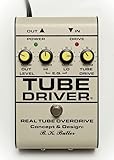 |
BK Butler Tube Driver | ★★★★☆ | Check Price |
| 5 |  |
Behringer Vintage Tube Monster VT999 | ★★★★☆ | Check Price |
Real Glass in the Dirt
Every pick runs an actual vacuum tube: a NOS 6205 in the Fender MTG, dual 12AY7s in the English Muff’n, and the BK Butler Tube Driver that defined the sound for famously vocal lead tones.
The Behringer VT999 makes the concept nearly free, a real 12AX7 with a noise gate, while the Maxon RTD800 splits overdrive and distortion modes across three tone circuits.
1. Fender MTG: LA Tube Distortion

Fender MTG: LA Tube Distortion
Tube distortion pedal with a NOS 6205 preamp tube, three-band EQ, footswitchable boost, and global Tight control.
Pros
- Real NOS 6205 tube for rounded distortion
- Full three-band EQ for precise shaping
- Boost has independent gain and level
- Global Tight control firms up low end
Cons
- Medium-to-high gain, not a fuzz monster
- Premium price for a single channel
The MTG: LA is a tube-powered dirt box developed in collaboration with amp guru Bruce Egnater, and it shows. A real NOS 6205 preamp tube sits in the signal path, so the distortion lands rounder and more amp-like than you’d expect from a standard pedal, with gain that runs from medium crunch into genuinely high territory.
Beyond the three-band EQ, a global Tight control firms up the bottom end at higher gain so the low strings stay focused rather than flubbing out. The footswitchable boost has its own gain and level knobs, letting you set a lead jump that’s louder, more saturated, or both.
It’s the most flexible and consistently musical pedal in this roundup.
2. Maxon RTD800 Real Tube Overdrive/Distortion
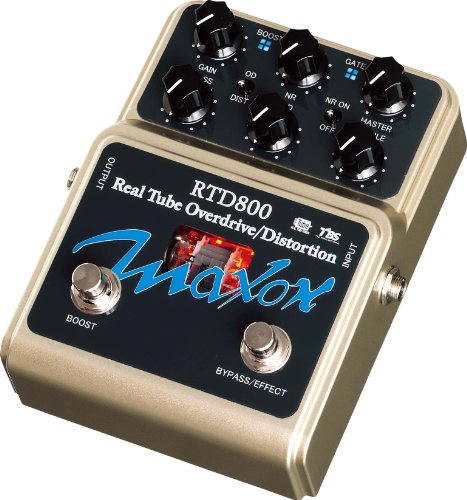
Maxon RTD800 Real Tube Overdrive/Distortion
Selectable overdrive and distortion circuits with a post-distortion tube stage and three independent tone controls.
Pros
- Switchable overdrive and distortion circuits
- Post-distortion tube stage for realistic tone
- Three independent tone controls reduce overlap
- Footswitchable boost variable from 3 to 9 dB
Cons
- Large footprint on a crowded board
- Many controls mean a learning curve
The RTD800 packs a glowing tube behind a window and pairs it with selectable overdrive and distortion circuits, so a single pedal covers everything from a traditional gritty boost to thick high-gain saturation. Maxon places the tube after the distortion stage, a post-distortion configuration that gives the output a more realistic valve character.
Three independent tone circuits cut down on the cross-talk and frequency overlap you get from interactive EQ, which means dialing treble, mid, and bass actually lands where you expect. A footswitchable boost adds a variable 3 to 9 dB on tap for solos.
There’s a lot to configure here, but the payoff is one of the more versatile tube boxes around.
3. Electro-Harmonix English Muff’n Tube Overdrive

Electro-Harmonix English Muff'n Tube Overdrive
Dual vacuum tube preamp running two 12AY7 tubes for a true tube overdrive voiced after classic British amps.
Pros
- Dual vacuum tube preamp, not a simulation
- Ships with two Electro-Harmonix 12AY7 tubes
- Swap tubes to dial more or less distortion
- True bypass using a mechanical relay
Cons
- Needs an external power supply, no battery
- Large enclosure eats pedalboard space
The English Muff’n runs a genuine dual vacuum tube preamp built around two Electro-Harmonix 12AY7 tubes, the same family of valve that helped give classic British amps their bite. This is a true tube overdrive rather than a circuit imitating one, and it shows in the warmth and feel.
The best part is the tube swapping. Drop in different valves to push the gain hotter or pull it back, which turns the pedal into a small playground for tone chasers.
True bypass through a mechanical relay keeps your signal clean when it’s off, though you’ll need an external supply since there’s no battery option and the enclosure is on the larger side.
4. BK Butler Tube Driver

BK Butler Tube Driver
Hand-built tube overdrive pedal famous for a uniquely vocal, amp-like voice from light grit to classic rock.
Pros
- Genuine vacuum tube delivers dynamic grit
- Goes from smooth boost to JCM800-style drive
- Cleans up beautifully with guitar volume
- A truly distinctive, hard-to-replicate tone
Cons
- Can be finicky and amp-dependent to dial in
- Premium price and limited availability
The Tube Driver is a piece of pedal history, hand-built and famous for a uniquely vocal voice that has ended up on countless records. With a real vacuum tube at its heart, it travels from a light, smooth grit all the way to a classic rock roar, and it cleans up beautifully when you roll back your guitar volume.
The trade-off is that it can be finicky. Dialing in the sweet spot is amp-dependent, and finding that magic setting takes patience, but with the right rig there’s little else that sounds quite like it.
Add a premium price and limited availability and this becomes a connoisseur’s pick rather than a grab-and-go overdrive pedal.
5. Behringer Vintage Tube Monster VT999

Behringer Vintage Tube Monster VT999
Affordable tube overdrive built on a 12AX7 valve with a switchable noise gate and three-band EQ.
Pros
- Real 12AX7 tube at a very low price
- Warm blues to heavy distortion range
- Switchable noise gate with adjustable threshold
- Dedicated gain, three-band EQ, and master
Cons
- Plastic enclosure feels less rugged
- Growlier voice can sound less refined
The VT999 proves you can get a real tube into a pedal without spending a fortune. It’s built around a hand-selected 12AX7 valve and ranges from warm blues overdrive all the way up to heavy distortion, which is a wide spread for a budget box.
A switchable noise gate with adjustable threshold helps keep things quiet at those higher gain settings.
You also get dedicated gain, a three-band EQ, and a master control for real sound shaping, plus a status LED that doubles as a battery check. The plastic enclosure feels less rugged than the boutique options and the voice runs a touch growlier and less refined, but for the money this is a genuinely impressive way to get tube grit on your board.
Final Thoughts
For most players, the Fender MTG: LA is the tube distortion pedal to beat. Its NOS 6205 tube delivers the rounded, dynamic dirt that makes valve circuits worth chasing, and the combination of a three-band EQ, a global Tight control, and a fully independent boost means it adapts to almost any rig and any style from crunch to high gain.
If you want maximum flexibility from a single box, the Maxon RTD800 is right behind it, with switchable overdrive and distortion modes and three independent tone circuits that make sculpting your sound genuinely easy. Tone tinkerers who love to experiment should look hard at the Electro-Harmonix English Muff’n, where swapping the dual 12AY7 tubes opens up a whole range of voices.
On a tight budget, the Behringer Vintage Tube Monster VT999 puts a real 12AX7 and a useful noise gate within reach of nearly anyone, while the hand-built BK Butler Tube Driver remains the choice for players hunting that one unmistakable, amp-like voice. Any of these will turn a clean tube amp into something with real teeth.