You want more low end than a standard guitar gives you, and an extended-range model is the obvious answer. The hard part is choosing between seven strings and eight.
For some players, that seventh string scratches the whole itch. Others chase even heavier territory and won’t settle for less than eight.
Both get you a deeper, bigger sound. The catch is what each one asks of your hands and your style.
This guide weighs range, feel, and how the music you play should steer the call. We’ll begin with the core difference between them.
7 vs 8 String Guitar: The Core Difference
The main difference between a 7-string and an 8-string guitar is the low end. A 7-string adds one extra low string for a bit more depth, and an 8-string adds another on top of that for even more.
The result is a bigger overall sound, especially when playing chords and heavy riffs.
The 8-string is built to go lower than a 7-string, and that cuts both ways. The upside is serious depth and room for thick, growling soloing and riffing.
The downside is that all that range can be overwhelming, and the thicker low strings are physically harder to hold down. That extra effort adds discomfort to an instrument that already takes time to get used to.
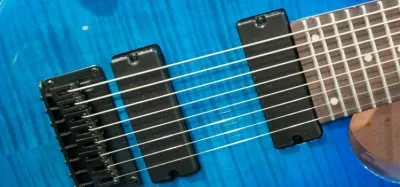
The other real difference is fretboard width. An 8-string neck is wider than a 7-string, which is wider than a standard 6-string.
More strings mean more space to cover, and that affects how the guitar feels in your hands as much as how it sounds.
Should a Beginner Get a 7 or 8 String Guitar?
If you’re just starting out, I wouldn’t recommend either a 7 or an 8 string. Get yourself a 6-string first and learn the basics on that.
An 8-string in particular can be a lot to deal with as a beginner. There are no shortage of questions and difficulties when you first learn to play, and knowing that every single string has its own set of things to learn can kill your desire for the instrument entirely, even if you’re serious about getting good.
Learning to play a chord on a 6-string is the same fundamental skill you’ll use on a 7 or 8 string later. Start with simple chords, give it a few months, and build from there.
A 6-string is an incredibly valuable learning tool precisely because it doesn’t pile on extra strings before you’re ready for them.
Which Is Better for You, a 7 or 8 String?
In truth, the only real differences between the two are the bottom end and the fretboard width. A 7-string has a bit more low end than a 6-string, and an 8-string has much more.
That extra range helps round out your sound and fills in songs that feel thin or lacking in low end for your taste.
One of the best ways to gauge whether you’re ready is to ask whether you’ve ever felt frustrated or limited by your 6-string. If you’re at least an intermediate player looking for extra growl and depth, an extended-range guitar makes sense.
The question then becomes how low you actually need to go.
If you mostly want a touch more range without straying far from a familiar feel, a 7-string is the easier, more comfortable jump. If you specifically want the deepest possible tones and you’re willing to manage a wider neck and heavier strings, the 8-string is built for that.
When you’re setting one up, the right components matter. We’ve related guides on the best 8 string guitar pickups and the best strings for 8 string guitar to help you dial in the low end.
How to Choose Between a 7 and 8 String
Use this quick comparison to match the instrument to your situation:
| Factor | 7-String | 8-String |
|---|---|---|
| Low-end range | Extra depth beyond a 6-string | Deepest range of the two |
| Fretboard width | Wider than a 6-string | Widest, most to cover |
| Playability | Closer to a standard feel | Thicker strings, harder to fret |
| Best for | Intermediate players adding range | Players chasing the lowest tones |
| Learning curve | Moderate | Steepest |
The decision comes down to a few honest questions. How experienced are you?
How low do you actually want your sound to go? And how comfortable are you with a wider neck and heavier strings under your fingers?
If you can play a 6-string cleanly and you crave more low end without a big jump in difficulty, the 7-string is the safer pick. If your goal is the heaviest, lowest tone possible and you’re ready to put in the extra practice, the 8-string rewards that commitment.
Frequently Asked Questions
Is an 8-string guitar harder to play than a 7-string?
Yes. An 8-string has a wider fretboard and an extra, thicker low string, both of which make it more physically demanding to play.
Holding down the heavy low strings takes more hand strength, and covering the wider neck takes more practice than a 7-string requires.
Can you play normal songs on a 7 or 8 string guitar?
Absolutely. The standard strings on a 7 or 8 string are tuned the same as a 6-string, so any song you already know still works.
The extra low string or two simply gives you more range to use when you want it, without taking anything away.
Do you need different strings for a 7 vs 8 string guitar?
Yes, each requires a string set made for its specific number of strings, since the extra low strings need heavier gauges to stay in tune and sound clear. For the deeper 8-string in particular, the right strings make a big difference, which is why it helps to check out our guide to the best strings for 8 string guitar.
Is a 7-string enough for metal?
For most players, yes. A 7-string covers the vast majority of heavy and metal tones with room to spare, and many well-known players never go beyond it.
You only really need an 8-string if you specifically want tones lower than a 7-string can reach.
Final Thoughts
Whether you end up a 7-string or an 8-string player, the decision really hinges on what feels best for you. The two instruments are more alike than different, separated mainly by how low they go and how wide the neck is.
If you’re just starting out, learn on a 6-string first so the fundamentals stick. Once you’re comfortable and hungry for more low end, reach for a 7-string for an easier transition, or an 8-string if you want the deepest possible range and don’t mind the extra effort.
Either way, pick the guitar that matches your skill level and the sound in your head. The right choice is the one that keeps you excited to keep playing.