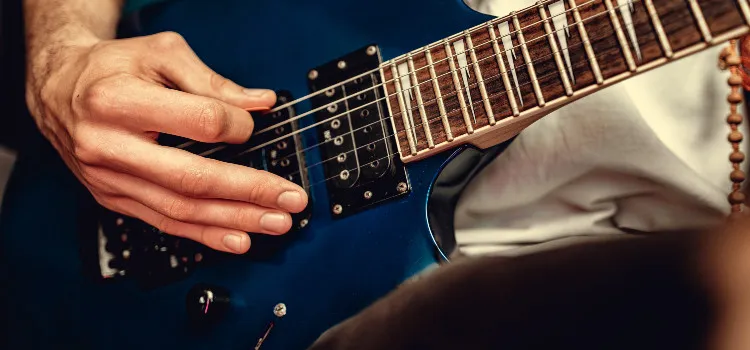
You can play the riff clean at home, then your picking falls apart the second the tempo and gain go up onstage. A flimsy pick is often the hidden culprit, since it flexes right when metal needs it to stay firm.
A stiffer pick gives you a sharper attack and tighter control through fast runs. That’s why so many metal players reach for the heavy end of the rack.
We’ll explain why thickness matters this much and how to land on a gauge that fits your hand. You’ll also see what players like James Hetfield and Kerry King actually swing.
There’s a smart way to test a few before you settle. Let’s start with the thickness that works best for metal.
What Is The Best Guitar Pick Thickness For Metal?
Typically, when playing metal, players go for a heavier gauge of string that’ll produce stronger tones that’ll help cut through the mix at live performances. To compensate for this thicker sound from the strings, heavier picks, like 1.5mm or above, are used which produces a sharper attack on the strings and provides better tonal quality.
Thicker picks also help you play more aggressively and speed through a song without losing any of that low end.
Other Things To Consider With Guitar Picks For Metal Music
Although heavier picks are best for metal, you’ll also want to make sure that the pick is comfortable in your hand. If it’s too thick, it’ll be uncomfortable to hold and you won’t be able to improvise if playing on stage.
To get the right feel, you should always try a variety of different picks until you find one that’ll suit your musical needs.
How To Choose The Right Guitar Pick Thickness For Metal
When deciding on the right pick thickness for metal, you’ll be best off going to a professional player or guitar store that can help you pick out a custom-fit pick. Of course, there are also online shops where you can get the desired gauge from around the world with just a few clicks.
If you’re buying a guitar pick for the first time, however, it’s best that you try a variety of different picks until you find the one that’ll be able to suit all of your tonal needs.
What Thickness Picks Do Different Metal Players Use?
It’s also helpful to do a bit of research to see what thicknesses different metal guitarists use. This will give you an idea of what sizes you should go for in the different brands.
James Hetfield
The picks that James Hetfield uses is a Dunlop Tortex 1.50mm and 2.00mm and Fender Heavy picks at the thickness of 1.50mm and 2.00mm which can be found on his personal website. He uses these picks to produce the growling sound in Metallica that fans have come to love over the years.
Zakk Wylde
Zakk Wylde of Black Label Society is known for his heavy, distorted playing style and thick metal riffs. Zakk, as a result, uses picks that are typically 2.00mm and above, which brings the notes out even more clearly than with a lighter pick.
Avenged Sevenfold
This is another metal band with members known for their aggressive playing styles and speed. Their guitarists use 1.88mm Dunlop Tortex picks or 2.10mm Fender Jim Dunlop picks for their live shows to ensure that their sound is crisp, clean, and sharp all the way through.
Kerry King
Kerry King, who’s the lead guitarist for Slayer, uses 0.88mm Tortex Triangle picks that he has found to be extremely durable for live shows and being thrown about on stage. He loves the feel of these picks in his hand and how they’re able to withstand a lot of stress without breaking or wearing down.
Kirk Hammett
Kirk Hammett, the lead guitarist for the legendary band Metallica, uses 1.38mm picks, depending on the song and the need at hand. He finds that 1.38mm works best for most songs and he therefore sticks with these thicknesses for live performances, which is a pretty surprising thing when you consider how fast he’s able to play.
Other Things To Consider
There are a lot of different things to consider when choosing the right thickness of guitar pick. Of course, if you’re looking for a pick that’ll only be used for practice, it’s fine to go with a thinner gauge.
However, the thicker picks are best for when you want to play on stage and want to ensure that your sound will cut through the mix and be heard just as clearly as other instruments. From experience, I’ve found that there’s no way around using a thicker pick when playing metal.
The thicker picks seem to give you the best sound quality and help you play more aggressively, which is what metal is all about. If you’re unsure which gauge to choose, it’s best to start off with a 1.5mm or 2.0mm pick and go from there.
Don’t think that your playing will suffer because of the pick thickness. You’ll have no problem using a thicker pick, they just need some getting used to if this is your first time using them consistently.
The thickness also depends on your playing style. It’s important to realize that some people use lighter picks because they’re playing styles that require more precise strokes and faster movement.
Lighter picks will allow you to control the tone of the strings and produce a more even sounding string.
Frequently Asked Questions
What pick thickness is best for metal rhythm playing?
For chugging rhythm parts and palm-muted riffs, a pick of 1.5mm or thicker gives you the firmness needed to attack the strings hard without the pick flexing and softening your notes. The stiffness keeps your picking tight and percussive, which is exactly what heavy rhythm tone relies on.
If you play a lot of fast tremolo passages, some players drop slightly to around 1.0mm to 1.38mm for a touch more glide across the strings, much like Kirk Hammett does.
Are thin picks ever good for metal?
Thin picks under 0.6mm are generally not ideal for metal because they flex too much and rob your tone of attack and punch. They struggle to drive heavy strings cleanly, which makes them feel mushy under distortion.
There are exceptions for certain fast lead styles, and Kerry King famously uses 0.88mm Triangle picks, but those are still firmer than typical thin picks and chosen for durability and grip rather than flex.
Does pick material matter as much as thickness for metal?
Thickness has the bigger impact on attack and stiffness, but material affects grip, durability, and the brightness of your tone. Tortex, Ultex, and similar materials are popular in metal because they stay rigid and hold up to aggressive playing.
Once you’ve settled on a thickness that feels right, experimenting with materials is a good way to fine-tune your grip and the exact sharpness of your pick attack.
Final Thoughts
The thicker picks are best for metal when you need to control the sound of the strings and produce a better tone. They’ll also help you play more aggressively and speed through a song without missing any of that low end.
There’s also a time and place for aggressive practice. But if you need to choose the right guitar pick thickness for metal, it’s best to stick with a thicker pick.
Start around 1.5mm to 2.0mm, pay attention to comfort and grip, and adjust from there until your picking feels fast, tight, and powerful.