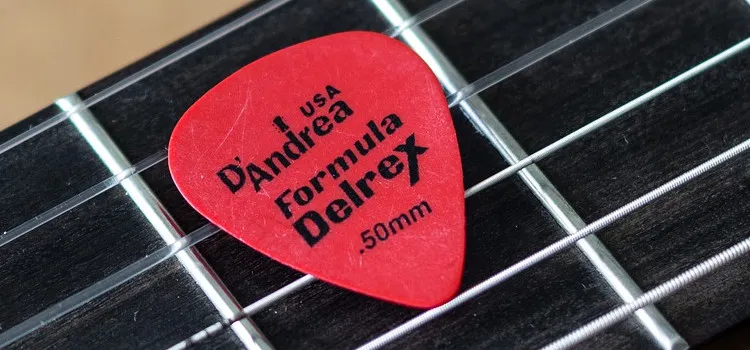
A guitar pick costs almost nothing. Yet its thickness pushes your tone and feel around more than most gear you’ll buy, and most players never give it a second look.
Switch from a bendy thin pick to a stiff one and the difference is instant. Strumming softens, lead lines tighten up, and the whole sound shifts under your hand.
This guide lays out the standard gauges in millimeters and ties each one to real playing. Strumming chords, chugging riffs, picking jazz lines, they all want something different.
First, let’s settle the big question: how thick should your pick actually be?
How Thick Should a Guitar Pick Be?
To answer this, you first need to know what you want the pick to do. There are three main factors to weigh: playing style, sound, and genre.
The thickness of a pick has a direct effect on how the guitar feels to play and an indirect effect on the tone you produce.
Playing Style
There are more pick designs on the market than ever, and it can be hard to keep up with all the thicknesses and materials available. As a general rule, thicker picks produce a cleaner, more controlled attack, while thinner picks give a lighter, more flexible feel.
That holds true across blues, rock, punk, jazz, folk, and pop.
Thickness also shapes the way you play. A jazz or blues player using a lighter pick tends to rely on a nuanced picking technique, whereas a metal player reaches for a stiff, thick pick to dig into the strings with more force.
Sound
Beyond feel, thickness directly affects tone, which makes it just as important as your picking technique. Ask yourself whether you want a bright, delicate sound or a heavier, fuller tone.
A clean tone for blues or jazz usually comes from a thinner pick, while metal players favor a thicker pick. Heavier styles such as power metal lean on thick picks because they add more heft and punch to the tone.
Genre
Genre is the third consideration. If you play metal or heavy rock, a stiffer pick adds sustain and punch to your tone.
Hardcore punk bands may have different needs, but they still rely on picks, as do players in essentially every genre.
In the end, balancing your desired playing style, sound, and genre gives you the best chance of getting exactly what you want out of your instrument.
Does Guitar Pick Thickness Make a Difference?
Yes. The thickness, or gauge, of a guitar pick changes both the sound and the playability of your instrument.
A thicker pick has more mass behind it as it strikes the strings, which can be a desirable effect for genres such as blues and rock. A thicker pick also naturally produces more volume.
That said, some playing styles call for the opposite. If you play jazz or blues, a lighter pick can be the better choice because it more closely simulates fingerpicking than a thick pick built for rock or metal.
Guitar Pick Thickness Chart
Pick gauges are usually grouped into a handful of standard ranges measured in millimeters. Here’s a quick reference for what each range is typically used for.
| Pick Type | Thickness | Used For |
|---|---|---|
| Extra Thin | less than 0.4mm | strumming chords |
| Thin | 0.4 to 0.6mm | strumming chords |
| Medium | 0.6 to 0.8mm | rhythm playing |
| Heavy | 0.8 to 1.2mm | lead guitar |
| Super Heavy | greater than 1.2mm | lead guitar |
Most Common Guitar Pick Thickness
The most popular guitar pick thickness is a medium pick at around 0.73mm (0.028 inches). A medium pick is the most versatile gauge you can own and a solid all-around choice.
It works with most pick materials and suits most playing styles. If you’re just starting out, this is the pick to buy first.
Best Pick Thickness for Your Situation
The ideal gauge shifts depending on your instrument, genre, and goals. Here’s how thickness breaks down across the most common scenarios.
Electric Guitar
Electric guitarists generally prefer a medium pick. Thicker picks push more overdrive into the tone and naturally boost your volume out of the amp, which is helpful in recording situations where the amp isn’t cranked to its loudest setting.
Acoustic Guitar
For acoustic guitar, the best thickness depends on your style of play. A lighter pick gives you a country twang, while a heavier pick produces a more distinct, edgier sound.
Beginners
If you’re a beginner, start with a medium pick and see how you like the feel and sound. From there, try a few thinner picks to compare.
If you want to play hard rock or metal, pick up some thicker gauges as well and experiment.
Heavy Metal
A thicker pick gives you the heavier attack that metal styles call for. A medium pick can handle more mainstream metal, while thrash and death metal often suit something stiffer.
A thicker pick also makes the strings easier to hit consistently and can produce a warmer tone.
Jazz and Blues
For jazz and blues, a medium pick is a good starting point. This thickness delivers a cleaner, jazzier tone that fits the genre well, and many jazz players go even thicker for a rounder, more controlled sound.
Strumming
If you mainly strum, a medium pick works fine for most styles. For heavier playing, try a thicker pick.
For lighter, softer genres such as folk or pop, a thin pick gives you the flexible, jangly feel that suits gentle strumming.
Thicker Strings
If your guitar has heavy strings, consider a thicker pick. The heavier the strings, the harder they’re to play with a thin, flexible pick.
A thicker pick also helps if you’ve larger hands and find thin picks too small to grip comfortably, and it can reduce hand fatigue over long sessions.
Lead Guitar
The lead guitarist often sets the mood and atmosphere of a song. A thicker pick helps you achieve a more raw, heavy, and powerful sound for lead lines and solos, and it gives you better control during fast runs.
Rhythm Guitar
For rhythm guitar, a medium pick is a reliable choice. It strikes a good balance between flexibility for strumming and enough stiffness for tighter, more defined chord work.
What’s the Difference Between Thin, Medium, and Thick Picks?
Thin, medium, and thick picks each give you a different sound and feel. Thin picks flex easily, which makes lighter strumming and reaching the higher frets feel effortless, and they’re popular with acoustic players for their clear, crisp sound.
Thick picks are built for riffs and rock solos because they generate more volume and a fuller attack. Medium picks sit in between and are used by a huge range of players, including most beginners, because they handle nearly everything reasonably well.
Picks With Multiple Thicknesses
Some picks are designed with more than one thickness in a single piece. These triangle-shaped picks have three points, and each point is a different gauge.
They’re handy for players who want to switch feel between different parts of a song without reaching for a separate pick.
More Related Guitar Pick Articles
Frequently Asked Questions
What guitar pick thickness should a beginner use?
Beginners are best served by a medium pick in the 0.6 to 0.8mm range, with a common starting point around 0.73mm. It’s flexible enough for easy strumming but stiff enough to teach good picking control.
Once you’ve played for a while, experiment with thinner and thicker gauges to find what feels and sounds best for the music you enjoy.
Is a thicker guitar pick better?
Not inherently. A thicker pick gives you more volume, a fuller attack, and better control for lead and heavy styles, which is why many rock and metal players prefer them.
For strumming, acoustic playing, or a brighter, lighter tone, a thin or medium pick can be the better fit. The right thickness depends on your style, not on the number alone.
What thickness pick do most professionals use?
There’s no single standard, since pros choose picks to match their playing. Many lead and metal players favor heavy picks above 1.0mm for precision, while plenty of strummers and acoustic players stick with thin or medium gauges.
A medium pick around 0.73mm remains one of the most widely used because it covers so many situations.
Does pick thickness affect tone more than material?
Both matter, but thickness usually has the most noticeable impact on attack and volume. A thicker pick produces a fuller, louder tone, while a thinner one sounds brighter and more delicate.
Material affects warmth, brightness, and grip, so the two work together. Once you settle on a thickness you like, experimenting with different materials can fine-tune your sound further.
Final Thoughts
Pick thickness is one of the cheapest and most effective ways to shape your tone and playing feel. Thin picks favor strumming and bright, crisp acoustic sounds, medium picks cover almost everything and make a great default, and heavy picks deliver the volume and control that lead and metal players want.
If you’re unsure where to begin, grab a medium pick around 0.73mm and play with it for a while. Then buy a small variety pack and compare a few thinner and thicker gauges side by side.
Your hands and ears will quickly tell you which thickness belongs in your case.