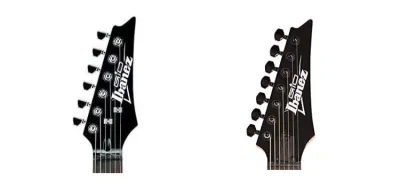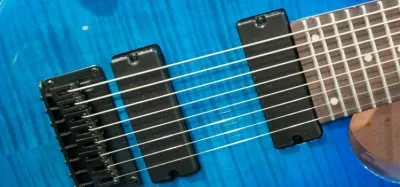

Eight tuning pegs can look like eight chances to get something wrong. In practice, tuning an 8 string is no harder than tuning a six.
The layout from a six-string carries straight over. You’re just setting two extra low strings on top of the usual routine.
Get that low end dialed in and the guitar growls. Leave it loose and the same notes turn to mud.
This guide covers the standard layout, a clean tuning process, and alternates worth a try when you want a new sound. Let’s start with standard tuning.
8 String Guitar Standard Tuning
So how’s an 8 string guitar tuned? For standard tuning, the notes from the lowest string to the highest are F# - B - E - A - D - G - B - E.
That’s the familiar 6 string E standard tuning (E - A - D - G - B - E) with two extra low strings added on top: a low B and an even lower F#. If you already know standard 6 string tuning, you only have two new notes to memorize.
Those bottom strings are what give 8 string guitars their signature heavy, extended low range. Because they’re so thick and low, they also need the right string gauges to stay tight and clear, which is worth keeping in mind before you start tuning.
How Do You Tune an 8 String Guitar?
The process of tuning an eight string guitar is no different than tuning a regular 6 string. You simply have two more strings to bring up to pitch.
Work one string at a time, matching each to its target note: F# - B - E - A - D - G - B - E from low to high. Use a tuner that can read low notes accurately, play each string open, and adjust the tuning peg until the pitch lands on the correct note.
A few practical tips make this easier:
- Tune up to the note rather than down to it, so the string settles under tension and holds pitch better.
- Re-check the strings after stretching them in, since new or low strings drift the most.
- Pay extra attention to the low F# and B, as their thickness makes the pitch harder to hear by ear.
Once all eight strings are in tune, you’re ready to play. For more on how the extra range affects notes and chord shapes, see this breakdown of 8 string guitar theory.
Alternate Tunings for 8 String Guitars
Since you have a relatively large number of strings to work with, there are plenty of cool alternate tunings to explore. Trying them is a great way to learn new sounds and start building your own riffs and songs.
Here are six alternate tunings to try on your 8 string guitar, listed from the lowest string to the highest:
- Drop D tuning - D - A - D - G - C - F - A - D
- E tuning - E - A - D - G - C - F - A - D
- F tuning - F - Bb - Eb - Ab - Db - Gb - Bb - Eb
- A tuning - A - D - G - C - F - A - D - G
- High A tuning - B - E - A - D - G - B - E - A
- Drop Eb tuning - Eb - Bb - Eb - Ab - Db - Gb - Bb - Eb
I’d recommend checking all of these out and experimenting with them. You can get some seriously heavy riffs out of the dropped and lowered options in particular.
Why Tune Down or Try Alternate Tunings?
Alternate tunings do more than change the pitch. Drop tunings like Drop D and Drop Eb let you play power chords with a single finger across the lowest strings, which makes fast, heavy riffing much easier.
Lowering the overall pitch, as with F or Drop Eb tuning, gives you a darker, chunkier tone that suits metal and progressive styles. Tunings that add a high string, like High A, open up extra range on top for leads and melodies instead of more low end.
The trade-off is string tension. Tuning lower slackens the strings, so heavier gauges help keep them tight and articulate.
If you plan to live in lower tunings, take a look at the best strings for an 8 string guitar to match the right set to your tuning.
Frequently Asked Questions
What’s the standard tuning for an 8 string guitar?
Standard 8 string tuning, from the lowest string to the highest, is F# - B - E - A - D - G - B - E. It’s regular 6 string E standard tuning with a low B and a low F# added beneath it.
This is the most common tuning and the one most 8 string songs and lessons assume, so it’s the best starting point for new players.
Is an 8 string guitar harder to tune than a 6 string?
Not really. The process is identical to tuning a 6 string, and if you’re weighing the two formats our 8 string vs 6 string guitar comparison covers the wider differences.
The main challenge is that the very low F# and B can be hard to judge by ear, so using a reliable tuner that tracks low notes makes the job straightforward.
What gauge strings do I need for low 8 string tunings?
Lower tunings need heavier string gauges to keep tension and clarity, especially on the bottom strings. Players using Drop Eb or F tuning generally reach for thicker low strings than someone staying in standard.
Matching your string set to your tuning prevents floppy, buzzy low notes. Our guide to the best strings for an 8 string guitar covers options for different tunings.
Can I use a regular tuner on an 8 string guitar?
Yes, as long as the tuner can accurately detect very low notes. The low F# sits well below a standard 6 string guitar’s lowest string, and some basic tuners struggle to read it cleanly.
A chromatic tuner or a tuner designed for extended-range and bass instruments will track those low strings reliably.
Final Thoughts
Tuning an 8 string guitar is much less daunting than it first appears. Standard tuning is F# - B - E - A - D - G - B - E, the process is the same as any 6 string, and a good tuner takes care of the tricky low notes.
Once you’re comfortable with standard tuning, the alternate options are where the fun begins. Just like with a 6 string, learning a few new tunings can completely reinvent your sound and inspire fresh riffs.
If you want to keep going, check out the best 8 string guitars for the instruments themselves, dig deeper into 8 string guitar theory, or grab some songs tuned a half step down to E flat to practice.