
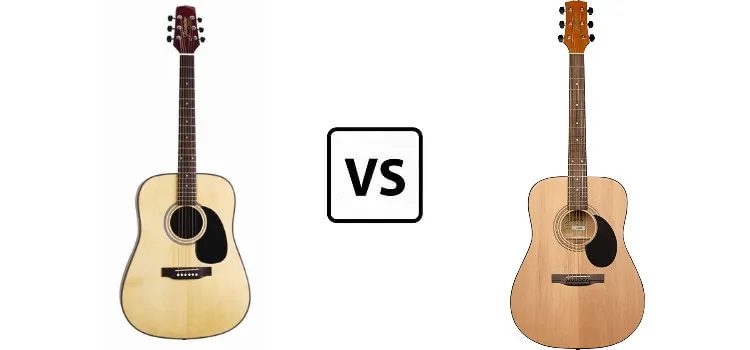
You’ve narrowed your first acoustic guitar down to two cheap Jasmines, and in photos they look like the same instrument. The S33 and the S35 are both budget dreadnoughts, so picking one can feel like a coin toss.
It isn’t, once you know where they part ways. The S33 leans toward the raw beginner, while the S35 chases a fuller, more balanced sound.
Small spec differences make a real difference here. They decide which guitar still feels right a year into playing.
Below I compare their woods, tone, and feel so you can choose with confidence. First up is the Jasmine S33.
Quick Comparison
| Category | Jasmine S33 | Jasmine S35 | Winner |
|---|---|---|---|
| Aimed at | Pure beginners | Beginners and hobbyists | Tie |
| Learning aids | Fretboard guide inlays | None | Jasmine S33 |
| Tone | Strong entry-level voice | Deeper, richer, balanced | Jasmine S35 |
| Extras | Hardshell case included | No case | Jasmine S33 |
| Playability | Easy and forgiving | High and comfortable | Tie |
| Stage use | Not built for gigs | Better, though still budget | Jasmine S35 |
| Overall | The first-guitar pick | The better-sounding pick | Depends |
The Jasmine S33 Acoustic Guitar
The Jasmine S33 has a dreadnought design, which is more substantial and somewhat heavier than other guitar styles, but that body is exactly what gives it a full acoustic voice. You get a strong tone in a guitar that shows off the natural colors of the wood with stainless steel strings.
The S33 features dovetail neck construction, a belly-shaped rosewood bridge, and the standard Takamine contour.
Features of the Jasmine S33
The S33 is affordable for almost any budget and ships with a hardshell case for added protection while traveling. The non-cutaway construction supports a richer sound, especially in the lower registers, because adding or reducing mass in the bracing and body materials has a real effect on tone thanks to basic physics.
The back and sides of the guitar are made of lacewood, and the top is made of spruce, a common choice for affordable guitars. The fingerboard is rosewood, which warms up the sound and is seldom used on entry-level guitars.
The fingerboard also has dot inlays that act as a playing guide across the 20 frets. Other important features include:
- Hollow body construction for better sound generation
- Six strings
- Glossy finish
- Hardshell case included
- Chrome hardware
Pros and Cons of the Jasmine S33
The pros of the Jasmine S33 acoustic guitar include:
- Affordability
- Easy to play
- Great sound for an entry-level guitar
- Guide inlays that help newcomers learn to play
The cons of the guitar include:
- Not designed for professional gigs
- A bit heavy for younger players
- No onboard electronics for plugging in
The Jasmine S35 Acoustic Guitar
The Jasmine S35 delivers a big sound for a minimal cost and includes a few features usually offered only on higher-priced instruments. The guitar is a great choice for beginners, serious hobbyists, or anyone who needs a backup or practice guitar.
Like the S33, it uses a dreadnought-sized body that provides bold sound and strong projection.
Features of the Jasmine S35
The natural, full sound makes the S35 a favorite among bluegrass, folk, and acoustic country players. The top is crafted from select spruce, and while it isn’t a single piece of wood, the guitar still comes across as balanced and warm with good resonance and sustain.
A two-piece top actually brings advantages, including a lower cost, and the tonal difference is something only top musicians are likely to notice.
The sides and back of the S35 are made from agathis, a wood similar to basswood and pine. Often called Kauri pine, this Southeast Asian wood delivers good tone, durability, and stability, and it grows plentifully in Asia, which helps keep the price down.
The bright tone adds something extra that helps you develop a signature sound, and the body is protected by a satin finish.
The bracing uses a signature Advanced-X pattern that provides strength and stability. The neck is nato, which has sound properties similar to mahogany and offers a great tone at a lower cost, while the slim neck profile improves playability for more experienced hands.
The fretboard is rosewood, the same material used on many pricier guitars. It resists wear and damage and plays smoothly without the stickiness some fretboards develop.
The tuners are chrome, which helps less experienced players keep the guitar in tune, and the synthetic bone used for the saddle and nut adds an extra layer of stability. Synthetic bone is often indistinguishable from real bone but costs less and lasts longer.
Pros and Cons of the Jasmine S35
The pros of the Jasmine S35 acoustic guitar include:
- Deep, rich sound
- Affordability
- Balanced highs and lows
- High playability
- Comfortable to play
- Great tone for the modest price
- Works well as a practice guitar for experienced players
The cons of the S35 guitar include:
- Factory strings that bother some players, easily fixed with a fresh set
- Requires regular setup adjustments
- Plain, run-of-the-mill appearance
- Occasional fret buzz around the 12th fret
How the Jasmine S33 and S35 Compare
The Jasmine S33 isn’t really aimed at professional musicians. It’s an entry-level guitar built for learning.
The fretboard inlays guide new players, and the guitar stays easy to play.
It’s the better pick in situations like these:
- New or inexperienced players
- Use as a practice guitar
- Use as an emergency backup
- Informal playing in social settings
The Jasmine S35 has a richer tone thanks to the rosewood fretboard and other touches, with a balanced response from bass to treble that can surprise you at this price. It tends to suit these situations:
- Slightly more experienced players
- Anyone who wants a step up from a bare entry-level guitar
- Blues, country, and folk performances
- Backup or practice guitar
- Players on a strict budget
- Band performances
- Musical accompaniment in live theater
Here’s a quick side-by-side of the two guitars:
| Feature | Jasmine S33 | Jasmine S35 |
|---|---|---|
| Body shape | Dreadnought (non-cutaway) | Dreadnought |
| Top | Spruce | Select spruce (two-piece) |
| Back and sides | Lacewood | Agathis (Kauri pine) |
| Neck | Dovetail construction | Nato, slim profile |
| Fretboard | Rosewood | Rosewood |
| Bracing | Standard Takamine contour | Advanced-X |
| Finish | Gloss | Satin |
| Nut and saddle | Standard | Synthetic bone |
| Best for | Absolute beginners | Beginners stepping up |
Which Jasmine Should You Buy?
If you’re buying your very first guitar and want the most forgiving, budget-friendly option, the S33 makes sense. The fretboard guide inlays, included hardshell case, and easy playability make it a comfortable place to start, and the glossy finish gives it a slightly dressier look on a shelf or stage.
If you have a little playing experience or simply want a warmer, more balanced tone, the S35 is the stronger choice. The select spruce top, Advanced-X bracing, slim nato neck, and synthetic bone hardware all push it a notch above pure entry-level territory, and most players will appreciate the extra resonance once they swap the factory strings.
Frequently Asked Questions
Is the Jasmine S33 or S35 better for beginners?
The S33 is the more beginner-friendly of the two because of its dot guide inlays, easy playability, and included hardshell case. The S35 is still very approachable, but its warmer, more detailed tone tends to reward players who already have a bit of experience under their fingers.
Are Jasmine guitars still made by Takamine?
Not in the original sense. Jasmine was founded as a budget line by the Japanese maker Takamine, but the brand changed hands more than a decade ago and is now owned by the KMC Music Company in Bloomfield, Connecticut.
You’ll still see “by Takamine” on older listings, which reflects that heritage rather than current manufacturing.
What body size are the Jasmine S33 and S35?
Both guitars use a full-size dreadnought body. That shape is larger and a little heavier than concert or parlor guitars, which is part of why both deliver such a bold, projecting acoustic sound.
The trade-off is that the dreadnought can feel slightly bulky for very young or small-framed players.
Do the Jasmine S33 and S35 have built-in electronics?
No. Both the S33 and S35 are purely acoustic guitars with no onboard pickup or preamp, so you can’t plug them straight into an amp.
If you want to amplify either one, you’d need to add an aftermarket pickup or mic the guitar.
Final Thoughts
When you’re buying a first or second guitar, the goal is a playable instrument that delivers strong natural sound without draining your wallet. The size, shape, and design of both the S33 and the S35 make them an easy recommendation at their price, and the value reinforces the choice.
Neither uses the most expensive tonewoods, but the materials are serviceable, durable, and fully capable of producing a great sound.
Choose the S33 if you want the simplest, most forgiving on-ramp to playing, complete with guide inlays and a hardshell case. Step up to the S35 if you want a warmer, more balanced tone and don’t mind a quick string swap and setup.
Either way, both Jasmine dreadnoughts are great companions for learning to play, taking on the road, or jamming informally with friends.