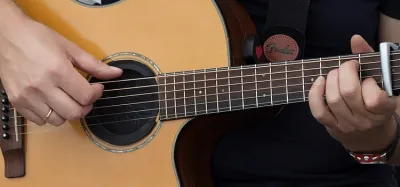

Your strings sit too high and your hand tires fast. You drop them down, and now half your notes rattle with fret buzz.
Every acoustic has a sweet spot between those two extremes. Finding it means working three points, the saddle, the nut, and the truss rod, in the right order.
This guide tackles them the way a tech would, so you lower the action a little at a time and stop before the buzz creeps in. The routine holds up on a Martin, a Taylor, a Yamaha, or an Epiphone, new or vintage, 6 or 12 string.
I run this same process whenever I get a new acoustic guitar. First, let’s look at what causes high action and buzz to begin with.
What Causes High Action and Fret Buzz
Action is the distance between the strings and the frets. When it’s too high, the strings sit far from the fretboard and the guitar feels stiff and tiring to play.
When it’s too low, the vibrating string clips the tops of the frets and produces the rattle known as fret buzz.
Most action problems trace back to one of four causes: a saddle that’s too tall, a neck with too much or too little relief, nut slots that were never cut deep enough, or intonation and setup that have drifted over time. Because these factors stack on top of each other, lowering action successfully means addressing them in the right sequence rather than attacking a single spot.
Worn or uneven frets can also cause buzzing that no amount of saddle sanding will fix. If your frets are visibly flat-topped or dented, a fret level is the real solution and you should diagnose that before removing any saddle material.
What You Need Before You Start
You don’t need a full luthier’s bench to lower action at home, but a few basic tools make the job accurate and reversible:
- A set of automotive feeler gauges or a string action ruler
- A capo
- Fine and medium grit sandpaper (around 220 and 400 grit) on a flat surface
- A set of nut files or fine needle files sized to your string gauges
- The correct truss rod wrench for your guitar (often included with the instrument)
- A tuner, since every measurement is taken with the guitar at pitch
Work slowly and keep the material you remove. You can always sand a little more off a saddle, but you can’t put it back, so small repeated passes beat one aggressive cut.
Measuring Your Current Action
Before changing anything, measure where you’re so you know how far you need to go. Tune the guitar to pitch, then measure the gap from the bottom of the string to the top of the 12th fret.
A comfortable starting target for most acoustics is roughly 2.0 mm to 2.5 mm on the high E string and 2.5 mm to 3.0 mm on the low E string at the 12th fret. Players with a light touch can go lower, while heavy strummers usually need a touch more height to stay buzz-free.
| Measurement point | Comfortable acoustic range |
|---|---|
| 12th fret, high E | 2.0 mm - 2.5 mm |
| 12th fret, low E | 2.5 mm - 3.0 mm |
| 1st fret, high E | 0.3 mm - 0.5 mm |
| 1st fret, low E | 0.5 mm - 0.7 mm |
Write your current numbers down. They tell you whether the problem lives at the saddle (high readings at the 12th fret) or at the nut (high readings at the 1st fret).
How to Set Truss Rod Relief First
The truss rod controls how much the neck bows under string tension, and getting relief right before touching the saddle prevents chasing buzz later. Capo the strings at the 1st fret, hold down the low E at the last fret, and look at the gap between the string and the frets near the middle of the neck.
You want a tiny amount of forward bow - around 0.25 mm of gap at the 7th or 8th fret. If the neck is dead flat or back-bowed, the strings will buzz in the lower positions no matter how you set the saddle.
To add relief, turn the truss rod nut counterclockwise a small amount. To reduce relief, turn it clockwise.
Move in quarter-turn increments, retune, and recheck.
If the rod feels stuck or the neck doesn’t respond, stop and take the guitar to a tech rather than forcing it.
How to Lower Action at the Saddle
The saddle is the white strip in the bridge that the strings rest on, and it’s where the majority of your action height adjustment happens. Lowering it brings every string closer to the frets at once.
Loosen and remove the strings, then lift the saddle out of its slot. Mark how much height you want to remove with a pencil line along the bottom - remember that sanding the bottom lowers the string at the 12th fret by roughly twice that amount, so removing 0.5 mm of saddle drops the action about 1.0 mm.
Lay your sandpaper flat on a hard surface and sand the bottom of the saddle in smooth, even strokes, keeping it perpendicular so the base stays square. Check your progress often by reseating the saddle and stringing up enough to measure.
It’s far better to sand twice than to remove too much in one pass.
If you remove too much and the strings buzz everywhere, you’ll need a new saddle or a thin shim underneath as a temporary fix. This is one of the acoustic guitar parts worth keeping a spare of if you tinker with your setup often.
How to Lower Action at the Nut
The nut sets string height at the headstock end, and it only affects playability in the first few frets. If your measurements at the 1st fret were high but the 12th fret felt fine, the nut slots are your target rather than the saddle.
Check each slot by holding the string down at the 3rd fret and watching the gap over the 1st fret - the string should nearly kiss the fret with just a sliver of clearance. If the gap is large, the slot is too shallow and needs to come down.
Using a nut file matched to the string gauge, file the slot a little at a time, angling slightly down toward the headstock so the string breaks cleanly over the front edge. Go very gently here: a slot cut too deep causes open-string buzz, and the only repair is filling or replacing the nut.
Most players overshoot the saddle and barely need to touch the nut, so treat this step as fine-tuning.
How to Avoid Fret Buzz While Lowering Action
Fret buzz is simply the string contacting a fret it should clear, so every step in this guide is really about leaving just enough clearance. The single most effective habit is to make small changes and play-test after each one.
After any adjustment, play every note on every string up the neck and listen for rattle. Buzz only in the first few frets points back to the nut or insufficient relief.
Buzz in the middle of the neck usually means the neck is too flat. Buzz high up the neck near the body often means the saddle is now too low or the frets need leveling.
If you hit buzz, you can usually back off the last change rather than starting over. Add a hair of relief, raise the saddle with a thin shim, or accept slightly higher action on the offending string.
Buzz-free low action is always a balance, and the sweet spot varies with your string gauge, playing style, and how hard you dig in.
How Much It Costs to Have a Pro Lower the Action
If you’d rather not file your own nut or you own an instrument you don’t want to risk, a professional setup is money well spent. A shop will adjust the truss rod, saddle, and nut together and dial in intonation as part of the same visit.
A standard acoustic setup that lowers the action typically costs around $50 to $100 in the United States, with custom nut work or a fret level adding to that. I’d definitely go this route for an expensive guitar or a vintage instrument, where a slip of the file can cost far more than the labor.
Frequently Asked Questions
Can you lower action without removing the strings?
For truss rod adjustments, yes - you can tweak relief with the strings on and at pitch. Saddle and nut work, however, require slackening or removing the strings so you can lift the saddle out or file the slots cleanly, so plan to restring as part of the job.
Does lowering action affect tone?
Slightly. Dropping the saddle reduces the string’s break angle over the bridge, which can soften volume and sustain a touch, especially if you go very low.
For most players the improvement in playability far outweighs the small tonal change, but heavy strummers who want maximum projection may prefer to keep the action a hair higher.
Why does my guitar buzz only on certain frets?
Localized buzz usually means an uneven or high fret rather than your overall action. A single fret that sits proud will buzz the notes just behind it while the rest of the neck plays clean.
This is a fret leveling issue and won’t be solved by sanding the saddle, so have the frets checked if buzz is isolated to one spot.
Can high humidity raise my action?
Yes. Acoustic guitars are sensitive to moisture, and high humidity can swell the top and increase relief, pushing the action up.
Dry conditions do the opposite and can flatten the neck enough to cause buzz. Keeping your guitar in a stable environment with a case humidifier helps your setup stay consistent year-round.
Final Thoughts
Lowering the action on an acoustic guitar without introducing fret buzz is less about one big fix and more about balancing three adjustment points. Set a little truss rod relief first, take the bulk of the height off the saddle, then fine-tune the nut only if the first frets are still high.
Measuring before and after each change keeps you from overshooting into buzz territory.
Work in small, reversible steps and play-test constantly, and you’ll land on a setup that feels effortless without rattling. Keep your old saddle and a few shims on hand so you can recover quickly if you go too far.
If your guitar is valuable, vintage, or showing signs of worn frets, hand the job to a qualified tech - the modest setup fee buys you a buzz-free, comfortable instrument and peace of mind. Either way, dialing in your action is one of the most rewarding upgrades you can make to how your acoustic plays.