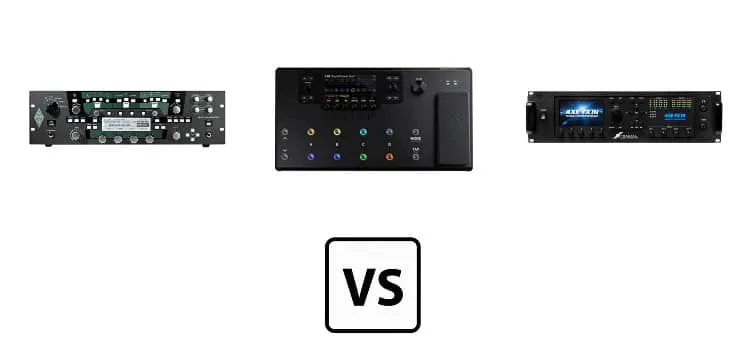
Picking a high-end modeler is a big decision and an even bigger check. The Line 6 Helix, Kemper Profiler, and Fractal Axe FX all promise tube-amp tone from one box, so the choice rarely feels obvious.
The catch is that they get there in different ways. One models amps from the ground up, one profiles a real rig you feed it, and one buries you in deep menus and endless tweaking.
This article puts all three head to head on tone, features, and how they hold up on stage. We keep the focus on what actually matters when you’re gigging.
We start with the box that built the modern modeling scene. Here’s the Helix.
Quick Comparison
| Category | Helix | Kemper | Axe FX | Winner |
|---|---|---|---|---|
| Approach | Modeling, Line 6 pedigree | Profiles your real amps | Pro-grade modeling | Tie |
| Live use | Floor unit built for stages | Floor versions available | Touring-grade consistency | Helix |
| Tone library | Big factory model set | Capture any amp you meet | Record-ready tones | Depends |
| Ease of use | Scribble strips, friendly | Profiling takes setup | Deepest editing to learn | Helix |
| Studio work | Strong | Beloved for amp recalls | The pro benchmark | Axe FX |
| Overall | The gigging favorite | The amp collector's tool | The top-spec pick | Axe FX |
Helix
Let’s begin with the former one of our take of these. Starting from the release of their cutting-edge POD in the 1990s to the high-end helix, the line6 happens to be the founding fathers of the digital amps.
The helix amp, packed with as much as a punch of the rack-mount versions, happens to come with an ergonomically-designed pedalboard which sort of meets up the dreams of gigging guitarists and bands!
Anyways, the features are what we need to take a close look at before having to judge our take of these modern amps.
Features:
- The vs Helix amp comes with a Dual DSP-powered engine.
- Consists of over 200 amp, mic, cabs, and effects models.
- Offers a 6.2” LCD and customizable LCD scribble strips.
- For editing purposes, the profiling amp comes with 12 touch-sensitive switches.
- Comes with 10 inputs & 12 outputs which also includes 4 effects loops.
- It comes with a USB audio interface of 8-in/8-out.
- Comes with a Mic-level XLR input.
- Has got LED color rings (RGB).
- Happens to come with touch-sensitive and capacitive switches for parameter recalling.
- Has L6 link, AES/EBU, and S/PDIF digital outputs.
- Comes with a solid-grade aluminum construction and tour-grade footswitches.
- Has got preset and stomp-box modes & an integrated looper.
That’s it for the former one - the Helix! Onto the Kemper amp.
Kemper
The Kemper profiler, as it’s popularly called, comes handy as it allows you to create a profile of your amplifiers and further to store it into the memory. Thanks to its real gain and tone knobs ever ready to be plugged into a power amp, sound system, or even a recording system.
With the Kemper Profiler, one can be limited to genuine amps (that indeed exist) unlike the other modern amps with modeling patches and therefore giving him/her the most realistic imitation of the artists’ tonal characteristics and feel.
Not shying away from other features that are listed further, one of the impressive features of the Kemper profiler is that it has got a plethora of built-in effects to support. However, these aren’t the easiest of setups to control using the unit’s front panel.
Nevertheless, the Kemper profiler comes with a dedicated Kemper Foot controller that’ll help you control the parameters at a moment’s notice!
Anyways, onto the features now.
Features
- This lunchbox-sized guitar preamplifier comes with an exclusive feature that intends to help you create profiles of any other physical guitar amplifier.
- Includes around 200 profiles to start with.
- Can offer a way to easily profile one’s own amplifier(s).
- Comes with a built-in DI that can split its receiving signal to a direct output thereby ensuring a simultaneous recording of the dry guitar signal and the guitar amp profile.
- Has got automatic spillover.
- Has this feature of locking individual locking settings when changing presets.
- Has got effects loops that help in integrating hardware effects.
Next, onto the final contender of our take.
Axe FX
The Axe FX comes from the Fractals which happen to be the makers of the ‘pro-grade’ modeler. Specially designed for those touring musicians, the amp offers optimal tonal consistency and an excellent feature of record-ready tones.
Thanks to its amazing delays, reverbs, and modulation palettes the amp happens to be famously used in conjunction with other classical amps to offer that premium-sound effects.
Features:
- Has an easy-to-use front panel that helps in an easy controlling of the knobs & buttons.
- Has got quite a large backlit LCD.
- Comes with an all-powerful two-state-art of Analog devices &Tiger SHARC DSPs.
- Comes with over 180+ different amp models onboard.
- Has a high-resolution speaker simulator (with over 150+ “Factory models”!).
- Comes with a ‘Tone Matching’ feature that enables to clone it with other devices.
- Hosts an impressive USB connectivity that renders it to become a 2x4 audio interface with a 1x1 high-speed MIDI.
- Consists of the all-new Humbuster technology that helps in reducing the problems of ground loop noise.
Frequently Asked Questions
What’s the difference between modeling and profiling?
Modeling, used by the Helix and Axe FX, recreates the sound of an amp from a digital model the manufacturer has built. Profiling, used by the Kemper, captures a snapshot of a real amp’s tone so you can store and recall it.
In short, modelers give you a library of preset amp emulations, while the Kemper lets you clone the exact amps you’ve access to for a more direct copy of their character.
Which is best for gigging guitarists?
The Helix is often the favorite for gigging because its floor unit, scribble strips, and footswitch layout are built with live performance in mind. The Kemper and Axe FX are excellent live too, especially in their floor versions.
The right pick really depends on how you like to control your rig on stage and whether you prefer modeled tones or profiles of your own amps.
Do I need a separate power amp or cabinet?
All three can run straight into a PA, audio interface, or studio monitors with cabinet simulation, so no traditional cab is required for recording or front-of-house use.
If you want to use a real guitar cabinet on stage, you can add a power amp, but many players now skip that and go direct for a simpler, lighter rig.
Can these modelers replace a real tube amp?
For most players, yes. Modern modelers like the Helix, Kemper, and Axe FX get close enough to real tube amps that the difference is hard to hear in a live mix or recording.
Some purists still prefer the feel of a cranked valve amp, but the convenience, consistency, and huge range of tones make these units a genuine replacement for many guitarists.
Final Thoughts
That sums up the take of our popular modern top guitar amps. It’s clear that each has got its specialization and tend to offer a lot.
It so happens that the Axe FX amp just pips the other two down to look itself at the top spot. However, the other two aren’t far behind: the Helix is meant for offering the best user experience and the Kemper happens to be the most loved amp!