You want the tones Fractal is famous for, but you don’t want to babysit a rack at every show. The AX8 answers that exact wish by putting the company’s modeling on a pedalboard-style unit you can drive with your feet.
What really matters here’s how much of the bigger picture survives the shrink. Fractal kept the core engine but gave you fewer effects blocks and dropped dual-amp routing, so the question is whether those cuts ever get in your way.
We tested it the way a gigging player actually would. That meant running it straight into a PA, then into a powered cab, and pushing it through a full set.
This review walks through the modeling, the footswitch layout, the build, and who’s a good fit for it. First, let’s talk about how it sounds and feels under the hands.
Sound and Playability
If you’ve ever played through an Axe-Fx processor, the sound quality of the AX8 will come as no surprise. Fractal builds more than 200 amp and cab models, covering everything from roaring 6505-style metal sounds to Fender tweed cleans, so the tonal range here’s enormous.
The amp models cover boutique designs, modern workhorses, and a deep bench of vintage classics from the 1950s onward, while the cabs span a wide spread of brands, models, and speaker configurations. More importantly, the tones aren’t just authentic, they’re clear and responsive in the way a real amp is, which is what people mean when they talk about Fractal nailing the “amp in the room” feel.
Where the AX8 really earns its keep is live. A lot of players worry that modelers fall apart on stage, but because the AX8 makes full use of a modern PA’s full-range speaker system, your tone stays consistent through the front-of-house mix instead of depending on a poorly placed cab mic.
Hooked up to a big rig in a large venue, it sounds clear and genuinely huge.
Build and Features
The AX8 weighs about 15 pounds and is built like a tank, with aircraft-grade aluminum end caps and a solid steel chassis designed to survive years of touring and rough handling. A metal bar runs above the footswitches to act as a handle and to protect the knobs from accidental kicks.
There’s no mechanical contact between the footswitches and the internal components, which helps prevent wear, and the unit is built to shrug off the occasional fluid spill.
On the I/O and control side, the layout will feel familiar to anyone who has used a multi-FX or MIDI floor controller. Eight footswitches sit across the top, each with three LEDs for the three functions you can assign per switch, and six knobs along the edge handle master volume plus resonance, presence, bass, mids, treble, and drive.
An LED screen and a set of soft-push buttons handle the deeper edits.
Under the hood, a powerful processor lets you build sophisticated rigs and store up to 512 presets in internal memory, with overflow backed up to a computer over USB. Two free applications round out the package: AX8-Edit, an editor and librarian for programming custom presets from your computer, and Fractal-Bot for handling preset transfers and firmware updates.
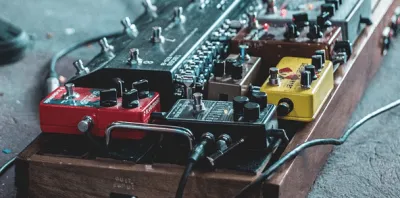
It’ll run into a standard guitar amp with speaker emulation disabled, but it sounds best going direct to a console, monitors, or a PA. If you’re folding it into a larger board, our guide to the best order for pedals on a pedalboard is worth a read.
The effects engine is one of the AX8’s strongest features, giving you instant access to rack and pedal effects that would otherwise take years to collect. Everything from lush delays and extreme modulation to natural spring reverbs and high-end dirt is covered, and each effect can be tweaked independently, including sequencing, ADSR curves, and frequency parameters.
Who It Is For
The AX8 handles any genre well, but it’s especially strong for progressive metal and rock, and it shines just as much in neo-soul, R&B, blues, and worship settings. It’s built for bands that play live and spend a lot of time on the road, and it’s a natural fit for pit orchestras and theater productions where you almost always plug in via DI.
If you want a single floor unit that replaces a rack, a pedalboard, and an amp, and you’re comparing it against other modeling amps, the AX8 is squarely aimed at you.
Pros and Cons
Pros
- Axe-Fx II core modeling engine for authentic, responsive tone
- More than 200 amp and cab models covering every era and style
- Rugged aluminum-and-steel build made for the road
- Deep, fully tweakable effects with up to 512 onboard presets
- Free AX8-Edit and Fractal-Bot software for editing and updates
Cons
- Fewer effects blocks than the flagship Axe-Fx II
- No dual-amp signal chains
- Dialing in presets from the unit takes time, though a computer speeds it up
Frequently Asked Questions
Is the AX8 as good as the Axe-Fx II?
For tone, it’s very close. The AX8 uses the same core modeling engine as the Axe-Fx II, so the amp and cab sounds are essentially identical.
The differences are in capacity, the AX8 has fewer effects blocks and can’t run dual-amp signal chains, but for most gigging players that gap is minor.
Do I need an amp to use the Fractal AX8?
No. The AX8 is designed to run direct to an FRFR cabinet, a PA system, or studio monitors, which is where it sounds its best.
It’ll also work into a standard guitar amp if you disable the speaker emulation, so you can use it either way.
How many presets does the AX8 hold?
The unit stores up to 512 presets in internal memory. If you need more, you can back them up to a computer over USB and load them as needed, so you’re never really limited by onboard storage.
Is the AX8 hard to program?
Because it carries hundreds of amps, cabs, and effects, building presets from the front panel takes some patience. The free AX8-Edit software makes it far quicker, letting you build and organize custom presets from your computer with a full visual layout.
Final Thoughts
The Fractal AX8 takes the amp and cab modeling that made Fractal famous and puts it in a floor unit you can run straight into an FRFR cabinet or PA. Because it shares the Axe-Fx II core modeling engine, it delivers flagship-grade tone, and with 512 onboard presets, a full set of amp, cab, and effects blocks, and a rock-solid chassis laid out for easy stage access, it’s a complete rig in a single box.
The trade-offs, fewer effects blocks and no dual-amp routing, are easy to live with for most players. If you want one durable, pro-level unit to cover your live and studio sound, we highly recommend it.