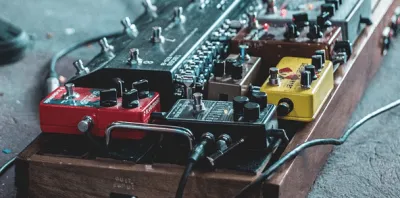
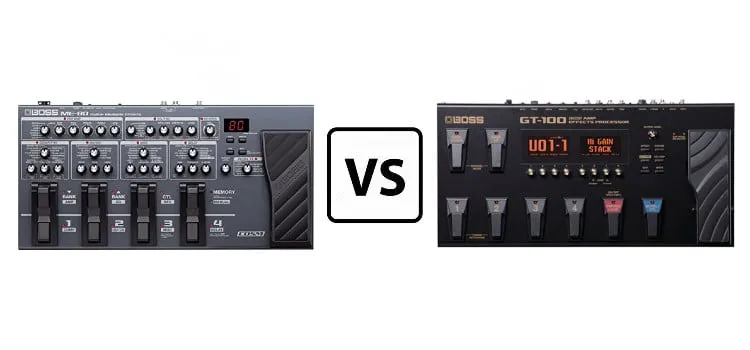
A multi-effects unit can stand in for a whole board of pedals, plus a stack of amps you’ll never own. Two Boss units come up again and again when players shop for one.
The ME-80 and the GT-100 look like rivals, but they were never built for the same player. One is a knob-driven box you tweak by hand, while the other is a deeper menu you program.
That gap is the whole question here. Are you the type who wants to grab a sound and go, or the type who likes to build a tone from scratch?
Answer that and most of the decision settles itself. We’ll lay out where each one pulls ahead so you can choose with eyes open.
Quick Comparison
| Category | Boss ME-80 | Boss GT-100 | Winner |
|---|---|---|---|
| Interface | Knob-driven, hands-on | Icon and menu system | Boss ME-80 |
| Simultaneous effects | 8 at a time | Up to 15 | Boss GT-100 |
| Amp models | 9 | 25 | Boss GT-100 |
| Programs | 72, with 36 user slots | 400 | Boss GT-100 |
| Signal paths | One | Two, with flexible routing | Boss GT-100 |
| Live performance | Built for the stage | Deeper but fiddlier | Boss ME-80 |
| Price | More affordable | More expensive | Boss ME-80 |
| Overall | Fast hands-on stage unit | Deep sound-design machine | Depends |
Boss ME-80 vs GT-100: The Main Difference
The main difference between the Boss ME-80 and the Boss GT-100 is the number of effects, amp simulations, and presets. The Boss GT-100 gives you far more options for the number of guitar effects, amp sims, and tones you can create and store at a time.
The Boss ME-80 also has four fewer footswitch-driven pedals than the GT-100.
Boss built the ME-80 as a lower-tier unit derived from the more advanced GT-100, which leads a lot of players to ask which one is actually the best fit. Is the ME-80 enough, or should you skip the compromise and go straight for the GT-100?
The answer depends on how and where you play, so let’s look at each unit in detail.
Boss ME-80: Key Features and Overview
The ME-80 is a compact yet powerful multi-effects guitar pedal built around a simple, knob-driven interface. It offers 8 simultaneous effect categories, each with many effect types, plus dial-up tones that make it easy to recreate the sound of your favorite stompboxes.
It includes a strong selection of high-quality effects, ranging from modern MDP effects to the classic Boss stomps players already know. The amp section uses updated flagship-level COSM amps carried over from the GT-100.
On the control side, you get 8 multifunction footswitches and an expression pedal, along with a manual mode that lets you switch stompbox types on and off. The memory recall for changing a complete patch is fast and reliable.
ME-80 Specs at a Glance
- Knob-based system for dialing in audio effects
- Generates 8 effects at a time
- Limited routing flexibility
- Can plug straight into an amplifier
- 72 programs total: 36 presets and 36 user slots
- 9 amp models
- One signal path
- Three parameters useful for editing sound effects
- Fixed effect order
Boss GT-100: Key Features and Overview
The GT-100 is built around advanced COSM amps that model classic amp tones while also delivering sounds you haven’t heard before. It features an improved EZ Tone system with a graphical Tone Grid for building new patches quickly.
The customizable AMP and OD/DS sections let you create original amp voicings, overdrive, and distortion by personalizing how they behave. A dedicated ACCEL pedal provides constant or simultaneous control over many parameters at once.
The unit also includes two LCD displays, MIDI connectors, 44 effects, 400 program memories, and a USB connector for recording and editing.
GT-100 Specs at a Glance
- Icon and menu system for introducing sound effects
- Generates up to 15 effects at a time
- Provides far more sound flexibility
- Effect order isn’t fixed
- Many diverse parameters across the sound effects
- Two signal paths
- 25 amp models
- 400 programs total: 200 presets and 200 user slots
Differences in Performance
The GT-100 and the ME-80 are both excellent units despite their differences. The ME-80 is a clear, clean multi-effects pedal, and that’s exactly what it sets out to be.
The GT-100, by comparison, packs in newer technology and a much deeper set of features.
The ME-80 falls short on the number of effects, programs, and amp models you can use at one time. For many traditional players, though, that’s more than enough.
Players chasing innovation, or simply wanting more to work with, will find the GT-100 a better match. It costs a bit more than its smaller cousin, but it goes well beyond what you’d expect from a multi-effects pedal.
Don’t let its straightforward looks fool you - this device stands out when it comes to sound design.
The GT-100 brings together 25 amp models, 400 onboard programs, and the ability to generate many effects at once. When it comes to raw performance, both units do a remarkable job, which makes sense given they come from the same company.
There’s no real concern about quality or reliability on either side.
For user-friendliness, the GT-100 pulls ahead because Boss built in support for a 4-cable method. With the ME-80, you connect directly to the amp.
You can still use an amp with switchable channels to get more variance in your tone and play with clean effects, but setting up and switching channels that way is demanding. The GT-100 eliminates that hassle - with the four cables, you get far more control and variance over the sound you play.
Design and Intended Use
The Boss ME-80 is aimed at stage performers.
On stage, you often don’t need a huge stack of multi-effects. You lean on a handful of crisp, clean sounds.
The ME-80 gives you enough room to be creative during a live set while staying simple and reasonably priced.
The GT-100, on the other hand, is built for music producers and recording in a professional studio. If you’ve time to experiment and tweak your tone exactly to your needs, it rewards that effort.
It’s pricier on this side of the comparison, but if you want the widest variety of sound effects, the GT-100 is the stronger choice.
How the ME-80 and GT-100 Compare
We’ve covered the features, performance, and design of both units, so let’s see how they stack up overall. If you want to explore other options in this space, the Fractal AX8 review covers a similar style of multi-effects unit.
On effects and amp models, the GT-100 clearly leads with 25 amp models and the ability to run up to 15 effects at a time, versus 9 amp models and 8 effects on the ME-80. On storage, the GT-100 again wins with 400 programs against the ME-80’s 72.
For ease of use, the ME-80’s knob-driven layout is faster to grab and tweak on the fly, while the GT-100’s menu and Tone Grid system trade some immediacy for far deeper editing. On routing, the ME-80 keeps a single fixed signal path, while the GT-100 offers two flexible paths and 4-cable method support.
Both units come from Boss and deliver excellent build quality and tone, so the real decision comes down to how much depth and flexibility you actually need versus how quickly you want to dial in a sound.
Frequently Asked Questions
Is the Boss ME-80 good for beginners?
Yes, the ME-80 is well suited to beginners and intermediate players. Its knob-based layout lets you dial in tones the same way you’d with individual stompboxes, so there’s very little menu diving to learn.
That hands-on approach makes it easy to understand what each control does, which helps when you’re still developing your ear for effects and amp settings.
Does the GT-100 sound better than the ME-80?
Both units share the same high-quality Boss COSM amp modeling, so neither is inherently low quality. The GT-100 simply offers more amp models, more effects, and deeper editing, which gives you more room to fine-tune a tone.
If you want maximum control over your sound, the GT-100 has the edge. For straightforward, great-sounding tones with less tweaking, the ME-80 holds its own.
Can you use the ME-80 or GT-100 with an amp?
Yes, both can be used with an amplifier. The ME-80 is designed to plug straight into an amp and works well that way.
The GT-100 adds support for a 4-cable method, which gives you more control over how the effects interact with your amp’s preamp and effects loop. That makes it more flexible in a complex rig.
Which one is better for live performance?
The ME-80 is generally the easier choice for live performance. Its footswitches and knob layout make on-the-fly changes quick, and its simpler design suits the handful of core tones most players rely on during a set.
The GT-100 can absolutely perform live too, but its deeper menu system is better suited to players who have taken the time to program their patches in advance.
Final Thoughts
Both the ME-80 and the GT-100 do a superb job of bringing remarkable effects to your guitar. The GT-100 is a little more expensive and carries a much wider array of features and effects that many music producers are looking for.
For pure stage and practice use, though, that extra depth isn’t always worth the higher price.
In most head-to-head opinions, the GT-100 holds more perks, and the ME-80 isn’t quite comparable to it when it comes to flexibility and versatility. The GT-100 is extremely powerful, which makes it an ideal choice for studio work and players who want to dig deep into their tone.
That said, if your budget is tighter or you mainly want a reliable unit to practice and gig with, the ME-80 is the smart pick. Match the pedal to how you actually play, and either Boss unit will serve you well.