A loop pedal lets one guitarist sound like a whole band. You record a part, it plays back on a loop, and you stack more layers on top.
Boss builds its loopers under the Loop Station name, and the lineup is wide. Some are single-button units you learn in minutes, while others are studio-grade pedals with several tracks and built-in rhythms.
Picking one really comes down to your budget and how you’ll use it. A practice tool and a pedal that anchors a live set are very different buys.
This guide walks through each main model so you can find your match. For wider background, our ultimate guide to loop pedals covers the format itself.
What Boss Loop Pedals Offer
Every Boss Loop Station does the same core job: it records a phrase, plays it back on a loop, and lets you stack more layers on top. The differences come down to how many tracks you get, how much recording time is on board, and how much hands-on control you’ve over your loops.
At the simple end, you press one footswitch to record, play, and overdub. At the high end, you get dedicated footswitches for undo and redo, multiple stereo tracks, reverse and half-time playback, and dozens of preset rhythms to play along with.
The right model depends on whether you want something to practice with or a pedal that can drive a whole live set.
Boss RC-500 Loop Station
The Boss RC-500 Loop Station is the biggest and most feature-laden looper in the lineup. It’s loaded with useful controls, including dedicated footswitches for storing loops, undo and redo, a loop indicator, and a half-time function.
It can store up to roughly 13 hours of stereo audio at a time, lets you play along with your loops in real time, and includes 57 preset rhythms with excellent sound quality. The pedal also offers reverse playback, so you’ve plenty of creative options on tap.
The RC-500 is a strong choice for guitarists who want to create complex loops that require a lot of tweaking. The controls are easy to reach, and the undo/redo footswitch comes in handy whenever you make a mistake.
It’s on the expensive side, and it isn’t as beginner-friendly as the simpler models, but the depth of features makes it worth a look. You can also connect external footswitches for even more control.
Boss RC-300 Loop Station
The Boss RC-300 Loop Station is slightly less complex than the RC-500, but it shares many of the same core features in a floor-based, multi-track format.
It has three stereo input tracks that can be looped, along with a reverse button. The loop footswitches control playback from the left or right stereo channels plus reverse playback, while the stop and start buttons handle pause and play.
There’s no separate dedicated footswitch labeled for undo and redo, but you can achieve similar results using the stop and start controls.
The RC-300 delivers full stereo sound and behaves like having a small studio on the floor in front of you. If you want to build layered, multi-part loops live, its three-track layout gives you room to work.
Boss RC-5 Loop Station
The Boss RC-5 Loop Station is the compact sibling of the larger Loop Stations. It packs the essential looping functions into a small, pedalboard-friendly enclosure at a much lower price.
It offers stereo looping plus a half-time feature and reverse playback. Because it’s a single-footswitch pedal, you don’t get the same dedicated undo/redo footswitch found on the bigger models.
It has an LCD screen for a handful of basic settings, but otherwise the controls are minimal, which keeps it very easy to use.
All of this makes the RC-5 a solid choice for players who want a capable looper that’s simple to operate and easy to fit on a crowded board.
Boss RC-3
The Boss RC-3 is a relatively simple loop pedal designed for playing along with your loops. The footswitch toggles recording, playback, and overdub, and lets you switch between loops.
It provides stereo looping along with a half-time feature and reverse playback. The RC-3 also has an effects send and return, which lets you shape how your loops sound on playback.
On board you get up to 3 hours of stereo recording time and 99 memory slots for storing phrases.
If you’re looking for a straightforward pedal to use with a basic guitar setup, the RC-3 is worth considering. It’s simple, easy to use, and still flexible enough to grow with you.
Boss RC-1 Loop Station
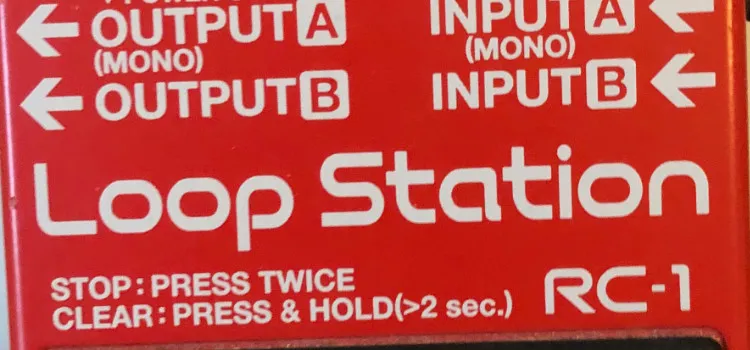
The Boss RC-1 Loop Station is the simplest looper Boss makes, built to give you clean, no-fuss control over a single loop. The footswitch handles recording, overdubbing, and playback, and the unit can store up to roughly 12 minutes of stereo audio.
A level control lets you adjust how loud your loop sits without constantly stopping playback, and a ring of LED indicators shows you where you’re in the loop. It’s inexpensive and aimed squarely at beginners, so it doesn’t have many extra controls or options.
If you’re just starting out with looping and want good sound quality without a learning curve, the RC-1 is hard to beat as a first pedal.
How to Choose the Right Boss Loop Pedal
Start with how you plan to use the pedal. If you mainly want to practice, jam, and build simple backing loops, a single-track unit like the RC-1 or RC-3 covers everything you need without overwhelming you.
The RC-5 is the natural step up when you want a compact pedal with a screen and a few more features.
If you perform live and want to layer bass, rhythm, and lead parts into a full arrangement, the multi-track RC-300 or the feature-packed RC-500 are the ones to look at. Think about recording time, number of tracks, and whether you want built-in rhythms before you spend more.
For a wider view of the category and other brands, our roundup of the best loop pedals is a good next stop.
Frequently Asked Questions
What’s the easiest Boss loop pedal for beginners?
The RC-1 is the easiest place to start. It uses a single footswitch to record, play, and overdub, with almost no menus to learn, so you can focus on your timing instead of the controls.
The RC-3 is a close second and adds memory slots, an effects loop, and reverse playback if you want a little more room to grow.
What’s the difference between the RC-3 and the RC-5?
Both are compact single-footswitch loopers with stereo looping, half-time, and reverse playback. The RC-3 leans on physical knobs and 99 onboard memory slots, while the RC-5 uses an LCD screen for its settings and has a more modern, streamlined interface.
For most players the choice comes down to whether you prefer a simple knob-based layout or a small display for navigating settings.
Do I need a multi-track looper?
Only if you want to build arrangements from separate parts, such as a bass line, a rhythm part, and a lead, each on its own track that you can start and stop independently. That’s where the three-track RC-300 and the RC-500 shine.
For practicing, jamming, or laying down a single backing loop, a one-track pedal like the RC-1, RC-3, or RC-5 is plenty.
Can you connect external footswitches to a Boss looper?
Yes. The higher-end models, including the RC-500, support external footswitches so you can add hands-free control over functions like stop, undo, and track selection.
This is especially useful in a live setting where you want to trigger loops without reaching down to the pedal between phrases.
Final Thoughts
Boss makes a loop pedal for nearly every player, from the bare-bones RC-1 up to the deep, multi-track RC-500. The simpler models are ideal for practice and your first steps into looping, while the larger Loop Stations are built for layering full arrangements on stage.
If you want professional-grade looping with plenty of advanced features, the RC-300 or RC-500 will give you room to experiment with complex arrangements. If you just want to get looping quickly and cheaply, start with the RC-1 or RC-3 and upgrade later as your needs grow.
Whatever your goal, matching the pedal to how you actually play is what makes looping fun instead of frustrating. Pick the model that fits your budget and workflow, and you’ll have a tool that can turn a single guitar into a whole band.