
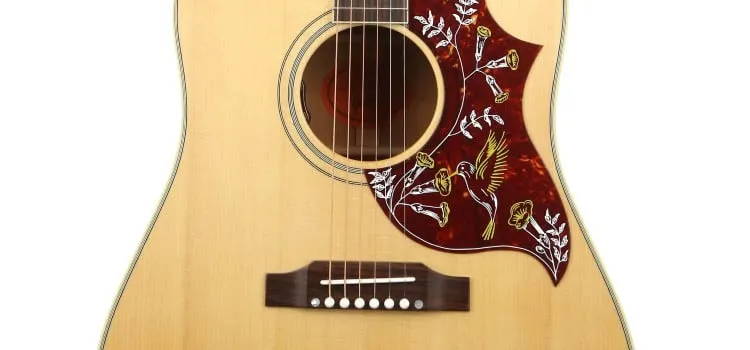
You’ve played plenty of dreadnoughts, and now you’re eyeing the one with the carved hummingbird on its pickguard. The question at this level is never whether it’s good, but whether it justifies what Gibson asks for it.
This square-shoulder model has held the same shape and voice since 1960. The engraved pickguard gets the attention, but the Sitka spruce top over mahogany is what shapes the warm, full sound underneath.
So this is an heirloom-grade instrument, hand-built in Bozeman with a glued dovetail joint, and aimed at intermediate and advanced players. A first guitar it’s not.
We dig into the tone, the feel, the build, and whether the splurge pays off, with a few other acoustic guitars to weigh against it. Let’s start with how it sounds and plays.

Gibson Montana Hummingbird
A premium, handcrafted square-shoulder dreadnought for intermediate and advanced players who want heirloom-grade vintage tone.
Pros
- Hand-scalloped, dovetail-jointed build
- Warm, full tone with great note separation
- Versatile for strumming and fingerpicking
- Reliable Gotoh tuners and smooth bone nut
Cons
- Premium, expensive price point
- Full dreadnought body feels heavy for beginners
Sound and Playability
The Hummingbird is built to be played for hours, and it shows. The 50s rounded neck profile fills the hand comfortably, and the bone nut keeps fretting smooth and clean whether you’re strumming open chords or working your way up the fingerboard.
It’s equally at home with a pick or fingers, which is a big part of why this guitar has stayed in heavy rotation with so many players over the years.
Tonally, this is where the Hummingbird really earns its reputation. The Sitka spruce top delivers crisp, articulate highs and strong projection, while the mahogany back and sides round things out with a warm, woody low end.
Chords come through thick and full, and the bass and treble stay balanced with excellent clarity, so it’s easy to pick out individual notes within a chord. The guitar is boomy and lively without tipping into overly loud territory, and like any good vintage-styled dreadnought, it plays cleanly without buzzing.
It handles rock, blues, country, and everything in between with the same rich, deep character.
Build and Features
Gibson keeps the Hummingbird’s recipe faithful to its 1960 roots. You get a Sitka spruce top over a mahogany body, with a rosewood fretboard, a traditional bridge, and the engraved pickguard that gives this guitar its instantly recognizable look.
The spruce adds crispness and projection while the mahogany brings warmth, a classic tonewood pairing that has defined this instrument for generations.
The real story is the craftsmanship. The body features traditional hand-scalloped bracing and a glued-in dovetail neck joint, the kind of construction that holds up for decades and is a big reason a well-maintained Hummingbird can become an heirloom.
The 24.75-inch scale length keeps string tension a touch more relaxed and contributes to the guitar’s full, singing tone. Gotoh Keystone tuners hold tuning reliably, and the guitar ships with medium-gauge strings to fill out the dreadnought voice.
Some Hummingbird models also include onboard electronics with a preamp, so you can plug straight into an amp or PA for live use while keeping the guitar’s natural acoustic character.
Who It Is For
The Gibson Montana Hummingbird is aimed at intermediate and advanced players who want a premium, vintage-styled dreadnought and are prepared to invest in it. If you perform regularly, value handcrafted construction, and want an instrument that looks as iconic as it sounds, this guitar delivers on all three.
The balanced tone and easy note separation reward players who already have some technique under their fingers, and the build quality means it can stay with you for life.
It’s a less obvious choice if you’re a complete beginner or shopping on a tight budget. The price is steep, and the full-size dreadnought body can feel a little large and heavy for newer players.
But for the musician it’s built for, the Hummingbird offers studio-grade tone and heirloom craftsmanship with very little to fault.
Frequently Asked Questions
Is the Gibson Montana Hummingbird good for beginners?
It’s a fantastic guitar, but it isn’t the most practical first instrument. The price is high and the full-size dreadnought body can feel large for newcomers.
It’s better suited to intermediate and advanced players who can appreciate its tone and craftsmanship.
Where is the Gibson Hummingbird made?
The Hummingbird is handcrafted at Gibson’s acoustic facility in Bozeman, Montana, which is why this model is often referred to as the Gibson Montana Hummingbird.
What scale length is the Gibson Hummingbird?
The Hummingbird uses a 24.75-inch scale length. The slightly shorter scale lowers string tension a touch and contributes to the guitar’s warm, full tone and comfortable feel.
Can you plug in the Gibson Hummingbird?
Many Hummingbird models include onboard electronics with a preamp, so you can plug into an amp or PA for added volume and versatility. Unplugged, it still delivers the rich acoustic sound the model is known for.
Final Thoughts
The craftsmanship behind the Gibson Montana Hummingbird is exceptional. The body is sleek and unmistakable, the kind of guitar you’re proud to show off, and the sound more than backs up the looks with warm, balanced, room-filling tone.
It’s a serious investment, but if the budget is there and you want a vintage-styled dreadnought that can last a lifetime, the Hummingbird is well worth it.