
A single flat string makes a whole guitar sound wrong, no matter how clean your playing is. The fix is the cheapest thing in your gear bag.
The catch is that “tuner” covers a lot of different tools. A polyphonic pedal like the PolyTune 3 reads all six strings at once, which is a different job than a clip-on for your headstock or a strobe built for fine precision.
The right one depends on whether you gig, record, or just practice at home. This guide ranks nine tuners on accuracy, how readable the display stays on a dark stage, build, and value.
If your guitar keeps drifting out of tune, a tuner is only half the answer, but it’s the half you can buy today. The chart below lines up all nine side by side.
Quick Comparison Chart
| # | Product | Our Rating | ||
|---|---|---|---|---|
| 1 |  |
TC Electronic PolyTune 3 | ★★★★★ | Check Price |
| 2 |  |
BOSS TU-3 Chromatic Tuner | ★★★★★ | Check Price |
| 3 |  |
Peterson StroboClip HD Clip-On Tuner | ★★★★☆ | Check Price |
| 4 |  |
KLIQ UberTuner | ★★★★☆ | Check Price |
| 5 |  |
Korg AW-LT100B Clip-On Bass Tuner | ★★★★☆ | Check Price |
| 6 |  |
Snark SN5X Clip-On Tuner | ★★★★☆ | Check Price |
| 7 |  |
Korg PC1 PITCHCLIP | ★★★★☆ | Check Price |
| 8 |  |
D'Addario NS Micro Soundhole Tuner | ★★★★☆ | Check Price |
| 9 |  |
JOWOOM T2 Smart Automatic Guitar Tuner | ★★★★☆ | Check Price |
Pedal, Clip, or Robot
The PolyTune 3 reads all six strings in one strum, the Peterson StroboClip splits hairs at strobe accuracy, and the BOSS TU-3 remains the pedalboard tank with its 21-segment meter.
The oddballs earn their keep: D’Addario’s NS Micro hides inside the soundhole permanently, and the JOWOOM T2 tunes the string for you while winding at 180 RPM.
1. TC Electronic PolyTune 3

TC Electronic PolyTune 3
Ultra-compact polyphonic tuner with chromatic and strobe modes plus a built-in all-analog BonaFide buffer.
Pros
- Tune all your strings at once polyphonically
- Strobe mode hits 0.5 cent accuracy
- Built-in buffer preserves tone on long runs
- Three tuning modes in one compact pedal
Cons
- Pricier than a simple clip-on
- Needs a pedalboard and power supply
The PolyTune 3 is the most complete tuner here, and it earns its top spot by doing three jobs in one ultra-compact pedal. Strum all your strings at once and the polyphonic mode instantly shows which ones are off, then drop into strobe mode for 0.5-cent accuracy when you want it perfect.
The built-in all-analog BonaFide buffer is the bonus, preserving your tone across long cable runs and crowded pedalboards.
If you want one tuner that covers everything from a quick check between songs to precise intonation work, this is it. It’s pricier than a simple clip-on and needs a spot on your board, but for a gigging or recording player the convenience is hard to beat.
We dig deeper into pedal options in our guide to the best tuner pedals for guitar.
2. BOSS TU-3 Chromatic Tuner

BOSS TU-3 Chromatic Tuner
Industry-standard stage tuner in a tank-tough stompbox with a 21-segment LED meter and high-brightness mode.
Pros
- Accurate to plus or minus one cent
- High-brightness mode cuts through outdoor glare
- Tank-tough BOSS stompbox build
- Supports 7-string guitars and 6-string basses
Cons
- No polyphonic full-strum tuning
- Meter can be hard to read in low light
The TU-3 is the tuner you see on more pro pedalboards than any other, and for good reason. As the successor to the legendary TU-2, it pairs plus-or-minus one cent accuracy with a 21-segment LED meter and a high-brightness mode that cuts straight through harsh outdoor glare.
The Accu-Pitch function flashes a clear visual confirmation the moment a string lands in tune.
Housed in the famously tank-tough BOSS stompbox body, it’s built to survive years of touring abuse, and it handles 7-string guitars and 6-string basses without complaint. It doesn’t do polyphonic full-strum tuning, and a few players find the meter tricky in very low light, but as a workhorse stage tuner it’s close to untouchable.
3. Peterson StroboClip HD Clip-On Tuner

Peterson StroboClip HD Clip-On Tuner
Clip-on strobe tuner with an HD backlit LCD display and tenth-of-a-cent accuracy for serious intonation work.
Pros
- Strobe accuracy down to a tenth of a cent
- High-definition backlit LCD display
- Clips on, so no pedalboard needed
- Great for intonation and 12-string setups
Cons
- Premium price for a clip-on
- Strobe display takes getting used to
When pinpoint accuracy is the priority, the Peterson StroboClip HD is in a class of its own. Its strobe engine reads pitch down to a tenth of a cent, which is the kind of resolution you want for dialing in intonation or wrangling a fussy 12-string.
The HD backlit LCD makes that strobe display easy to read in bright sun or a dark venue.
Because it clips to the headstock, you get studio-grade precision without surrendering a pedalboard slot. It costs more than most clip-ons, and the strobe readout takes a little practice to interpret, but for guitar techs and detail-obsessed players it’s worth every penny.
It’s also a favorite among acoustic players chasing perfect intonation.
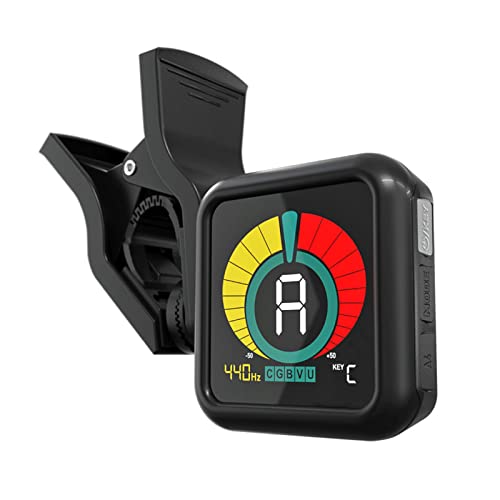
4. KLIQ UberTuner
KLIQ UberTuner
Fast, accurate chromatic clip-on with a 360-degree full-color display and dedicated modes for many instruments.
Pros
- Accurate to within one cent every time
- Full-color display rotates to any angle
- Vibration sensor ignores background noise
- Padded clip protects your headstock finish
Cons
- Less precise than a dedicated strobe tuner
- Sensor needs a moment to settle on acoustics
The KLIQ UberTuner is our pick for the best all-around clip-on, the one that suits almost everyone who clamps it on. A professional-grade piezo sensor and fast processor lock onto pitch within one cent, and the full-color display rotates a full 360 degrees so it stays readable whether you mount it front or back, right or left handed.
Because it reads vibration rather than sound, it ignores background noise completely in loud rehearsals.
Dedicated modes cover guitar, bass, violin, ukulele, mandolin, and banjo, and the padded clip grips firmly without scratching your finish. It isn’t as precise as a dedicated strobe, and the sensor needs a beat to settle on acoustics, but for everyday tuning it’s fast, accurate, and a great value.
See more options in our best clip-on guitar tuner roundup.
5. Korg AW-LT100B Clip-On Bass Tuner

Korg AW-LT100B Clip-On Bass Tuner
Bass-specific clip-on with a dedicated low-frequency circuit, strobe mode, and a 100-hour battery life.
Pros
- Detects ultra-low frequencies below 100 Hz
- Strobe mode reaches 0.1 cent accuracy
- Color LCD with white backlight stays readable
- One-hand shuttle switch operation
Cons
- Tuned for bass, overkill for guitar
- Display is small for some players
Bass players have a real problem with most clip-ons: the low strings sit below the range many tuners track reliably. The Korg AW-LT100B fixes that with a dedicated bass circuit that accurately detects ultra-low frequencies below 100 Hz, making it ideal for 5- and 6-string instruments.
A strobe mode pushes accuracy to 0.1 cent when you need exact pitch for recording.
The bright color LCD with a white backlight stays visible from wide angles on any stage, and the triangular shuttle switch makes one-hand operation easy. It’s purpose-built for bass, so it’s more than you need on a standard six-string, and the display runs a touch small, but for low-end players it’s the clear choice.
A single AAA battery delivers an outstanding 100 hours of run time.
6. Snark SN5X Clip-On Tuner

Snark SN5X Clip-On Tuner
Affordable clip-on for guitar, bass, and violin with a stay-put clip and a display that rotates 360 degrees.
Pros
- Very affordable for new players
- Display rotates a full 360 degrees
- Works on guitar, bass, and violin
- Clips to the front or back of the headstock
Cons
- Build feels fragile and breaks if dropped
- No reference pitch for tuning by ear
The Snark SN5X is the tuner that lives in a thousand gig bags because it’s cheap, simple, and does the job. It clips onto guitar, bass, or violin with a stay-put grip, and the display rotates a full 360 degrees so you can read it from any angle, front or back of the headstock.
For a beginner who just needs to get in tune fast, the value is excellent.
The trade-offs are what you’d expect at this price. The build feels a little fragile and won’t survive being dropped on a hard floor, and there’s no reference pitch if you like tuning by ear.
Treat it gently and it’s a perfectly capable everyday tuner that costs about as little as these things get.
7. Korg PC1 PITCHCLIP

Korg PC1 PITCHCLIP
Low-profile, lightweight clip-on chromatic tuner with a reversible display and battery-saving auto power-off.
Pros
- Compact, discreet, and lightweight
- Display reverses for either side of the headstock
- Bright, easy-to-read LED display
- Auto power-off extends battery life
Cons
- Basic feature set with no strobe mode
- Clip is less grippy than premium rivals
The Korg PC1 PITCHCLIP keeps things refreshingly simple. It’s a low-profile, lightweight chromatic clip-on that all but disappears on your headstock, and the display reverses so it reads easily whether you mount it on the front or the back.
The bright LED display is quick to respond and easy to see, and auto power-off keeps the battery from draining when you forget to switch it off.
There’s no strobe mode and the feature set is basic, so it won’t satisfy a precision-obsessed player, and the clip is a bit less grippy than pricier rivals. But as an affordable, no-fuss tuner that just gets you in tune and stays out of sight, it’s a solid little performer.
8. D’Addario NS Micro Soundhole Tuner

D'Addario NS Micro Soundhole Tuner
Discreet soundhole tuner for acoustics with an accurate piezo transducer and a color screen for dark stages.
Pros
- Mounts invisibly inside the soundhole
- Piezo picks up vibration, not noise
- Wide 410 to 480 Hz calibration range
- Color screen reads well in the dark
Cons
- Designed for acoustics, not electrics
- Tucked away, so harder to glance at
The D’Addario NS Micro Soundhole tuner takes a different approach: it mounts inside your acoustic’s soundhole and vanishes from view entirely. An accurate piezo transducer picks up the instrument’s vibration rather than ambient sound, and a wide 410 to 480 Hz calibration range keeps it precise.
A color screen makes it easy to read even in dark environments.
For acoustic players who hate the look of a clip-on perched on the headstock, this is the discreet answer. It’s built for acoustics rather than electrics, and because it’s tucked inside the body it’s a little harder to glance at mid-song, but the non-marring clip and quick, accurate readout make it a clean, low-profile option.
9. JOWOOM T2 Smart Automatic Guitar Tuner

JOWOOM T2 Smart Automatic Guitar Tuner
Automatic tuner with a 180 RPM electric string winder that tunes acoustic guitars and ukuleles hands-free.
Pros
- Tunes strings automatically, hands-free
- Built-in 180 RPM electric string winder
- USB rechargeable battery
- Great for teachers tuning many instruments
Cons
- Accuracy is decent, not pro-grade
- Best suited to acoustics and ukuleles
The JOWOOM T2 is the wild card of the group, an automatic tuner that does the turning for you. Hold it to a tuning peg and its built-in 180 RPM electric string winder spins the string to pitch hands-free, which is a genuine time-saver for teachers facing a room full of out-of-tune acoustics and ukuleles.
The USB-rechargeable battery means no fiddling with disposables.
It’s best understood as a convenience tool rather than a precision instrument. The tuning accuracy is decent rather than pro-grade, and it’s happiest on acoustic guitars and ukuleles, so most performing players will still want a strobe or clip-on for fine work.
But for fast, hands-free tuning of a lot of instruments, nothing else here does what it does.
Video Reviews
More demos worth a watch:
Final Thoughts
If you want one tuner that handles everything, the TC Electronic PolyTune 3 is our top pick. The combination of polyphonic full-strum tuning, a 0.5-cent strobe mode, and a built-in BonaFide buffer makes it the most versatile option here, and it’s equally at home checking tuning between songs or dialing in intonation in the studio.
For players who live on stage, the BOSS TU-3 is the safe, proven choice, with a near-bulletproof build and a high-brightness display that survives outdoor gigs. And when nothing but pinpoint accuracy will do, the Peterson StroboClip HD gives you tenth-of-a-cent strobe tuning in a clip-on you can take anywhere.
On a tighter budget, the KLIQ UberTuner and the Snark SN5X both deliver fast, reliable tuning for a fraction of the price, while bass players are best served by the low-end-savvy Korg AW-LT100B. Whichever you choose, the most important thing is the habit: tune before you play, every time, and your guitar will always sound its best.
If yours still drifts, read up on why guitars go out of tune and consider a set of locking tuners.