You’re about to order a new saddle for your acoustic, and you want to know if any old one will drop into the bridge. It’s a smart thing to check first.
The answer is no, and width is the reason. A saddle has to fit the slot already cut into your bridge, so the part you buy must match your specific guitar.
This article explains what the saddle does and how to measure yours before you order. You’ll also learn the warning signs of a worn one, what each material brings, and a simple home replacement.
First, let’s look at what that little strip actually does.
What Is an Acoustic Guitar Saddle?
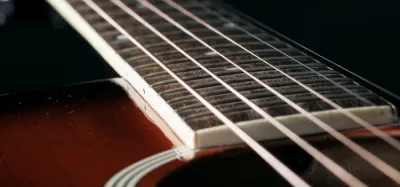
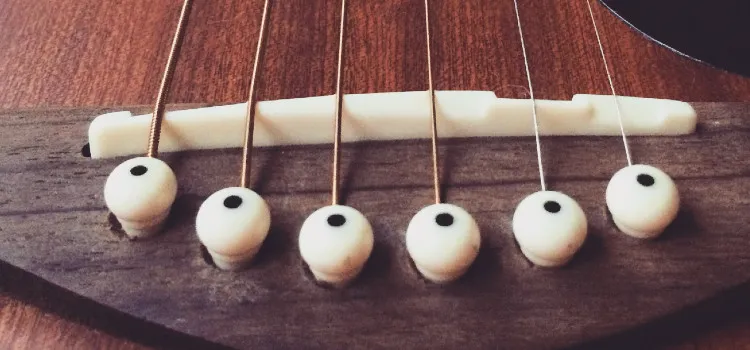
Acoustic guitar saddles sit at the top of your acoustic guitar bridge as part of the design and construction of an acoustic guitar. The saddle’s job is to transfer the sound vibration from your guitar’s strings to the bridge.
From there, the vibration passes into the guitar’s body, which is what produces the sound you hear.
Because the saddle is the contact point between the strings and the body, its material and fit have a real effect on tone and intonation.
Are Acoustic Guitar Saddles Universal?
No. Saddles aren’t a universal size.
The dimension that differentiates one saddle from another is its width, and you need to match that width to your specific guitar.
Most acoustic guitar saddles are either 3/32 inch or 1/8 inch wide. If you buy the wrong width, the saddle will either be too loose to seat properly in the bridge slot or too thick to fit at all.
Length and height can usually be adjusted, but width can’t, so always check your saddle’s width before ordering a replacement.
Do I Need to Replace My Saddle?
There are a few things to look at to decide whether your saddle actually needs replacing:
- Broken - it’s rare, but a saddle can crack or break in half.
- String grooves - the top of the saddle should be smooth with no grooves or slots. Grooves mean the strings have worn into the saddle material over time, and they’re most likely to cause intonation problems.
- Adjusting the action - if your action is too low and causing buzzing, a new (taller) saddle can resolve it.
- Upgrading the material - some guitars ship with inferior plastic saddles. A quick upgrade to bone or brass can improve your guitar’s tone.
If none of these apply, you probably don’t need a new saddle at all.
Acoustic Guitar Saddle Height
Before buying a new acoustic guitar saddle, you might want to know how to raise or lower the height of your current one instead.
Saddle height is measured from the top of the bridge to the top of the saddle. That height sets your action, so small changes make a noticeable difference in how the guitar plays.
The easiest way to lower the height is by sanding the bottom of the saddle down to the height you want. To increase height, you can add a thin shim or two underneath the saddle in the bridge slot.
Acoustic Guitar Saddle Replacement Cost
Replacing a saddle is fairly inexpensive. A new bone saddle is one of the cheapest guitar parts you can buy.
Take a look at these on Amazon if you want a recommendation.
A brass saddle, which is my favorite, costs only slightly more. Here’s my recommendation on Amazon for that one.
Either option is cheap enough that swapping the saddle is one of the most cost-effective tone upgrades you can make.
Which Way Does the Saddle Go?
Saddle direction is easy to get right. Most saddles have a small notch or step cut into the section where the B string sits.
Just orient the saddle so that notch lines up under your B string when you set it into the bridge.
If your saddle is symmetrical with no notch, it’ll fit either way, but it’s still worth keeping the original orientation if you’re reusing an old one.
Acoustic Guitar Saddle Material Types
Saddles are made from a variety of materials, and each one affects tone and longevity differently:
- Plastic - probably the least desirable. Plastic can reduce clarity in your tone, and it’s the material most worth replacing.
- Bone - found on many higher-end acoustics. Bone lasts far longer than plastic and transfers vibration more efficiently for better tone. It may still need replacing if grooves wear in over time, and its only real downside is that the material can be inconsistent.
- Tusq - a synthetic material known for adding clarity and brightness to your tone with very consistent results.
- Brass - my favorite and, in my opinion, the best. It transfers vibration extremely well and is hard enough to resist string grooves while still being softer than the strings themselves.
How to Replace an Acoustic Guitar Saddle
Replacing a saddle is a relatively simple process:
- Remove the acoustic guitar strings.
- Pull the saddle out of the bridge.
It should pop right out, though you may need a pair of needle-nose pliers to grip it. 3. Adjust the height by sanding the bottom of the new saddle.
How much you sand depends on your desired action. If the action with the old saddle was good, you can often just sand the new one down to match the old saddle’s height. 4. Push the new saddle firmly into the bridge slot. 5. Restring and tune the guitar.
If you prefer to see it done, look for a video that walks through a saddle replacement in detail before you start.
Frequently Asked Questions
Are all acoustic saddle widths the same?
No. The two most common acoustic saddle widths are 3/32 inch and 1/8 inch, and they aren’t interchangeable.
The width has to match the slot in your bridge, so always confirm your guitar’s width before buying.
How do I measure my saddle width?
Pull the saddle out of the bridge and measure its thickness with calipers or a precise ruler. Width is the thin dimension, not the length or height.
If you get close to 3/32 inch or 1/8 inch, that’s your size.
Can I use a longer saddle and cut it down?
Yes for length, but not for width. A blank saddle that’s too long can be trimmed to fit your bridge slot, and the bottom can be sanded for height.
Width, however, can’t be reduced cleanly, so it must match from the start.
Does a bone saddle really sound better than plastic?
In most cases, yes. Bone is denser and transfers string vibration more efficiently than plastic, which tends to add clarity and volume.
It’s one of the cheapest upgrades available, which is why so many players swap a stock plastic saddle for bone or brass.
Final Thoughts
You don’t need to rush out and buy a new acoustic guitar saddle. Take a look at your current one first and only replace it if it’s broken, grooved, or holding back your action or tone.
When you do replace it, skip the search for “universal” saddles. They don’t exist in a one-size-fits-all sense.
Instead, check the width of your specific guitar, pick 3/32 inch or 1/8 inch to match, and choose a material like bone or brass that suits the tone you’re after.
With the right width and a few minutes of sanding, a new saddle is one of the simplest and most affordable ways to improve how your acoustic plays and sounds.