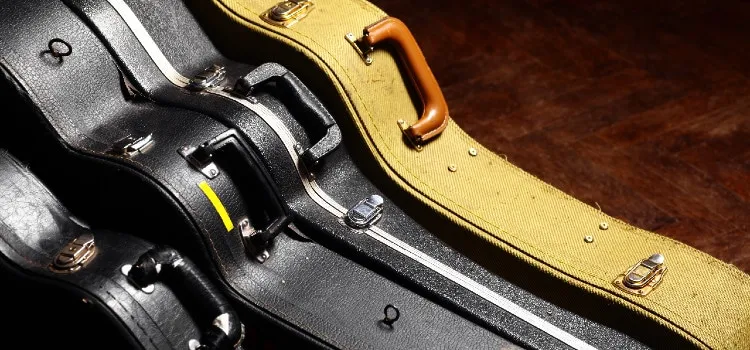
You lift your case, and the handle gives way with that sickening little crack. It’s easy to panic, but a snapped handle is one of the simplest case problems to put right.
That strip of leather or plastic takes the full weight every time you carry the guitar, so wear and tears come with the years. When it finally fails, you don’t need a new case.
You’ve really got two paths: bolt on a fresh handle, or sort it with a quick DIY guitar repair at home. Both cost far less than most players assume.
We’ll cover the temporary patches, the lasting fixes, and when a shop is the smarter call. First, let’s look at the replacement handles you can buy.
What Types of Replacement Handles Are Available?
Depending on the type of guitar case you’ve, there are several replacement handle grips on the market. Most bolt on through a pair of mounting plates and work across hard cases, soft cases, and even luggage.
Here are five common styles to look for.
Artificial Leather Case Handle
This style has a mounting hole spacing of 23 mm on each plate and a 92 mm inner mounting hole. It’s a sturdy, heavy-duty handle that suits musical cases, luggage, and especially guitar cases.
The handle itself measures roughly 127 mm x 55 mm, not counting the mounting plate. To attach it you’ll need case rivets and screws, which usually aren’t included in the package.
Fender Guitar Case Handle
This handle is designed for Fender guitar cases but is also compatible with many other case types. It’s a sturdy, reliable option that a lot of players trust, and it often comes in a choice of colors.
As with the leather handle, rivets and screws aren’t included.
Ferree’s Tools Vinyl Case Handle
Compatible with all types of guitar cases, this vinyl handle is durable and well made. The quality vinyl holds up well even under punishing, everyday use, no matter where you’re hauling the case.
It’s a good choice if you want something secure that’ll last.
E55 Plastic Case Handle
This handle is plastic but still sturdy and reliable. Like the others, it mounts with rivets or screws (not included).
The heavy-duty black plastic works on all types of cases, so it’s a safe match for whatever guitar case you own. If your current handle is worn out, this is a solid, no-fuss replacement.
4423 Plastic Case Handle
This plastic grip is built to be durable and secure for carrying a guitar case, and it works just as well on other musical cases and suitcase luggage. The high-quality plastic is meant to handle heavier objects, so it stands up to a full instrument.
Rivets and screws aren’t included and are needed to mount it.
How to Replace a Guitar Case Handle Yourself
Guitar cases and their handles are built to keep your instrument safe, but broken handles are one of the most common complaints, especially handles that snap off completely. If you like to get hands-on, replacing one is a quick project.
Below are a temporary fix and a permanent fix, along with the materials you’ll need.
Needed materials:
- Replacement guitar case handle
- Duct tape
- Pliers
- Wire cutter
- Scissors
- 2 split rivets
- Screws (if necessary)
Temporary Duct Tape Fix
If you need to move the case before a replacement arrives, a duct-tape handle will get you through:
- Pull off 3 to 4 feet of duct tape.
- Using a motion with your wrists and hands, roll the tape into a tight cocoon.
The motion is similar to reeling in a fishing pole, and the rolled piece becomes the actual handle you grip. 3. Once the handle is formed, bend it into a crescent shape. 4. Cut several more pieces of duct tape about 4 inches long. 5. Wrap those pieces around the ends of the handle so it attaches firmly to the case. 6. Test it by picking up the case to make sure it holds. 7. Add more tape if you need extra strength.
Permanent Handle Replacement
If you’d rather swap in a new handle, follow these steps:
- Before you start, make sure the guitar is out of the case.
- Remove any broken pieces or tears from the old handle that are still attached to the case.
- Snap the original rivet in half with a wire cutter to remove it.
- Slide the new handle into place on the original hardware, between the holders.
- Slide the split rivets through the hardware, with the flat ends on the insides of each handle end.
- Bend the split ends of the rivets as close to a 90-degree angle as possible so they lock the handle in place.
When to Use a Repair Shop
If you’d rather not do the work yourself, or you don’t have the time, a repair shop can handle it for you. Local luggage and shoe repair shops are often equipped to replace a case handle quickly and affordably, since the hardware is similar to what they already work with.
Frequently Asked Questions
How is a guitar case handle attached?
Most replacement handles attach through a pair of mounting plates using split rivets or screws. You slide the handle into the existing hardware, push the rivets through, and bend the split ends to lock everything in place.
Are guitar case handles universal?
They’re close to universal but not guaranteed. Many bolt-on handles use a standard mounting hole spacing, such as 23 mm per plate with a 92 mm inner hole, but it’s worth measuring your case and checking the handle dimensions before buying so the holes line up.
Can I fix a broken handle without buying parts?
Yes. A duct-tape handle is a reliable temporary fix that uses materials most people already have at home.
Roll a few feet of tape into a firm grip, bend it into a crescent, and tape the ends to the case. It isn’t permanent, but it’ll carry the case safely until a real replacement is ready.
Where can I get a guitar case handle replaced?
Replacement handles are easy to find online and are usually inexpensive, so a DIY swap is the cheapest route. If you’d rather have it done for you, a local luggage or shoe repair shop can fit a new handle.
Final Thoughts
The handle on your guitar case has to be strong and secure enough to carry your instrument, so replace it as soon as you spot tears, rips, or a loose mount. Letting a worn handle linger only risks a drop down the line.
Replacement handles are everywhere online and many sell for very little, with leather, vinyl, and heavy-duty plastic options to match almost any case. If you’re the creative type, a duct-tape handle or a quick rivet swap will get the job done at home.
And if you’d rather hand it off, a local repair shop can take care of it for you.